Plainfield Epoxy Flooring brings more than 20 years of epoxy-flooring in Bellwood work to repair garages, service stations and home garages, and the station and shop floors are the ones we start planning earliest. Those floors are worked every shift: jacks and creepers roll across them, fluids drip onto them, and someone mops them at close. A resin system that lasts there has to be chosen around all three of those facts.
What sets this village apart is that its own ordinance has already settled several floor questions before a coating contractor arrives. The code decides what the floor is made of, where it sits relative to the ground outside, and what may never be used to clean a pit. We plan every station or garage job around those decisions rather than around a product catalog, because the coating has to live inside them.
This page walks through the rules in the order they affect the work: the concrete itself, the floor level, the pit-cleaning ban and the cleaning routine it leaves behind. Then it covers how we choose a system for that routine and how the same thinking carries into a house garage. The rules belong to Bellwood, and our coating only has to respect them; nothing here claims the village has reviewed our work.
Bellwood’s code decides the floor before any coating does
The floor shall be of concrete
Chapter 119 of the village code covers service stations, garages and parking lots, and Section 119.13 sets the standards for station buildings. Its floor clause is short: the floor level shall be above grade, and the floor shall be of concrete. That second sentence matters to us because it defines what we are working on. The concrete is the floor the village requires, and a coating is a finish that rides on top of it.
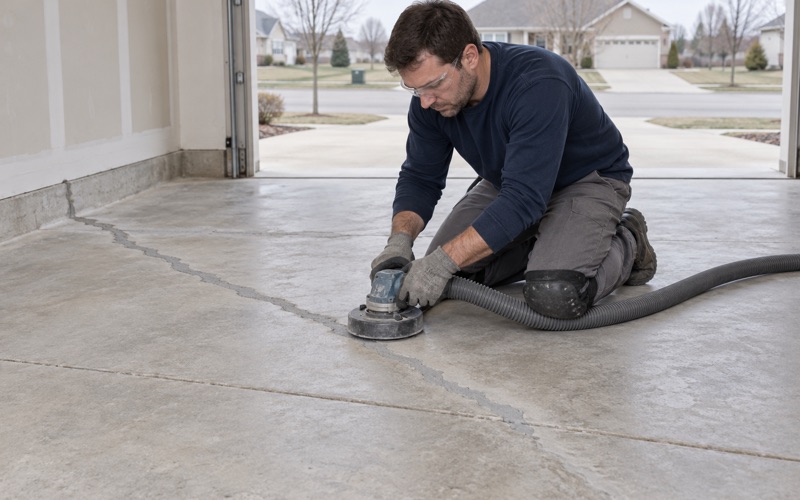
That puts the slab’s condition ahead of any color or flake choice. Before we price a Bellwood station or garage, we walk the floor and study its cracks, saw-cut joints, spalled patches and any old coating still hanging on. If the concrete itself is failing, a resin layer will not rescue it, and the owner hears that from us before a proposal is written rather than after the coating lifts.
No basement, only grease pits
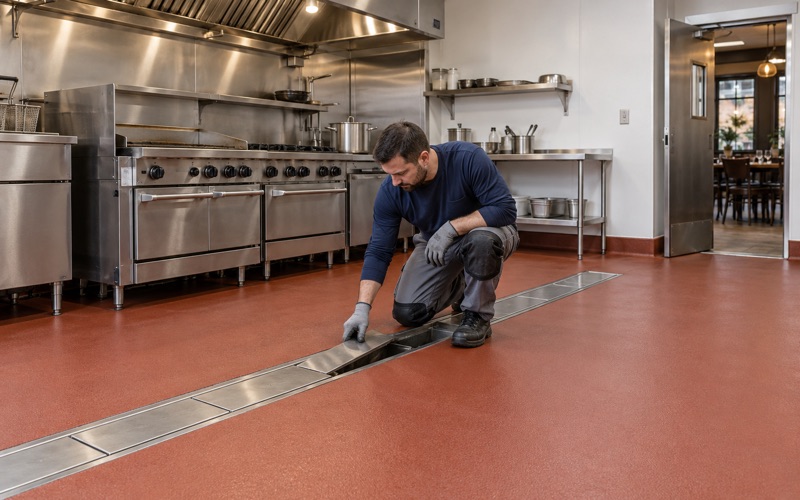
The same section bars any basement or excavation under a service station building, with one exception: grease pits. So in a Bellwood station the only space below the floor is the pit itself, and every other square foot of shop floor is concrete above grade. For a coating plan, that means two very different surfaces in one building: an open working floor and the walls and floor of a pit.
We scope them separately. The open floor takes our full system, while the pit is quoted on its own after we have looked at its walls, its access and how it is ventilated. Some owners choose to leave a pit as bare, sound concrete, and that is a reasonable call when the pit is in daily use and cannot be taken out of service for a cure.
The 3,500 psi garage floor amendment
Section 150.06, one of the village’s building code amendments, changes the model garage floor-surface provision. Garage floor surfaces shall be improved with Portland cement concrete of 3,500 psi, not less than four inches thick. That is a strength and a thickness for the slab, set by the village for the concrete a builder pours. It says nothing about coatings, and we never present it as a coating requirement.
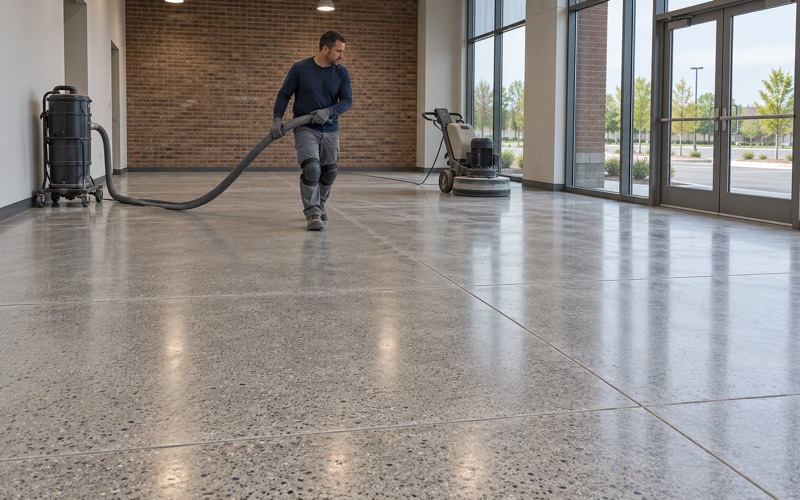
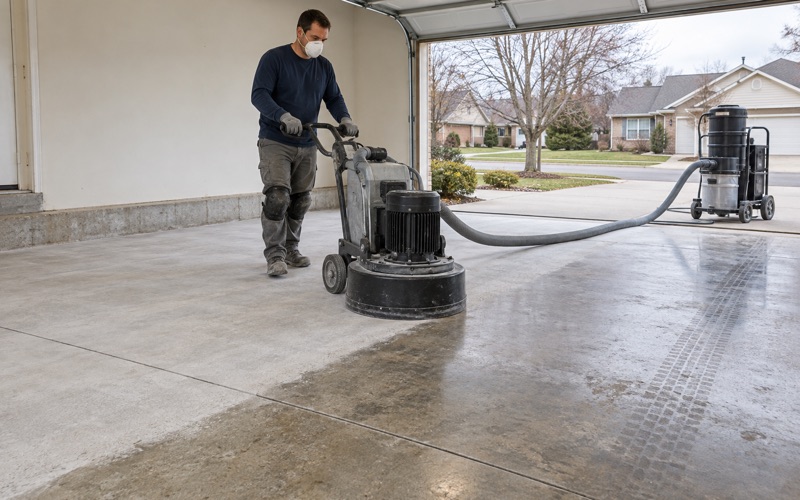
Strong, dense concrete still has to be opened up before resin will grip it. We prepare every slab mechanically and compare the result against ICRI CSP chips for the primer we have chosen, and a chemical wash that only cleans the surface has no place in our process. On a 3,500 psi pour, that profile step is what decides whether the system stays bonded for years or lets go at the first hot tire.
Looking for epoxy-flooring closer to Crestwood? See Crestwood Epoxy-Flooring.
Above grade, so liquids and vapors stay out
What the floor-level rule is for
The code writes its reason into the rule itself: the floor level shall be above grade so as to prevent the flow of liquids or vapors into the building. Rainwater, runoff from the apron and anything spilled in the lot are meant to stay outside. The rule concerns where the slab sits, and that was settled when the building went up, long before anyone thought about a finish.
A coating changes none of it. It adds a few mils, or at most a fraction of an inch, to a slab whose height was fixed by its pour, and it is neither a vapor barrier nor spill containment. We put that in writing, because an owner who believes a resin keeps fuel vapor out of a building has been promised something no floor coating can deliver.
No lip at the overhead door
Where a coating can work against the floor-level rule is at the door. A thick broadcast system that stops in a squared-off edge at the threshold builds a small ridge, and a ridge holds back whatever is running toward the door, including mop water and spilled fluid on its way out. On a floor that was raised so liquids move away from the building, that is exactly the wrong detail.
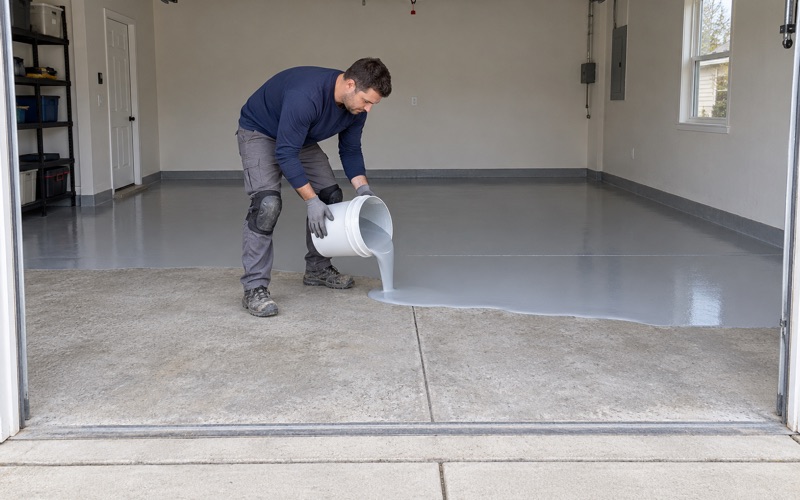
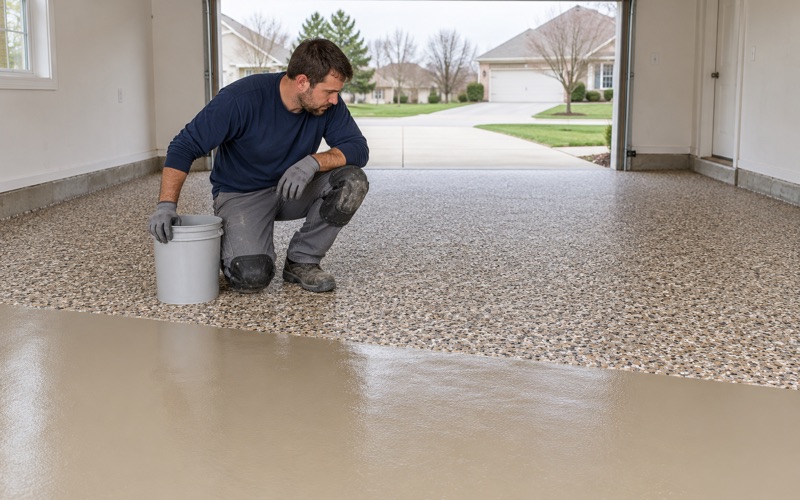
So we finish coating edges at overhead and walk-in doors flush. The edge is ground into a shallow recess or feathered down so the coated surface meets the bare apron concrete without a step. That keeps the slab’s fall toward the door working the way the builder intended, and it removes the chipped leading edge that tires catch on every day.
Measuring the slope before we coat
Before we commit to a system, we check the floor’s fall with a level and mark any low spots where water already ponds. A coating follows the slab beneath it, so a dip that collects mop water today will collect it on a glossy surface tomorrow. Low spots are better corrected in the concrete, with a patch or a self-leveling repair, than buried under a thicker coat that only hides them.
No gasoline or naphtha in the pit: cleaning without solvents
What the village bans
Bellwood’s service-station chapter states that gasoline or naphtha shall never be used to clean out any pit, whether the pit sits inside a building or enclosure or outside in the open. It is a direct rule about solvents, and it reflects how readily those liquids turn to vapor. For the floors around a pit, it also sets the tone for how the whole shop gets cleaned.
A shop that cannot reach for a solvent to cut grime in its deepest, dirtiest space tends to clean the rest of the floor the same way. That means a coating we install in a Bellwood station will meet water-based degreasers, detergent and absorbent far more often than anything stronger. We design for that routine instead of assuming a solvent wash-down that the village has ruled out where it matters most.
Grease pits and ventilation
The chapter also calls for ventilation in every greasing pit installed in a building or enclosed by three or more walls. We have not read the full ventilation clause and do not describe its details, but the rule tells us something useful. A pit is a confined space where air movement already matters, and any coating work inside one is planned around that.
When an owner asks us to coat a pit, we choose low-odor, low-solvent materials, keep the existing ventilation running and stage the work so nobody is down in the pit while a coat cures. If the pit is in daily service, the job is booked for a window when it can sit empty, which is the scheduling question every station owner asks first.
Working around the hours the shop keeps
A service station or repair garage loses money for every bay that is roped off, so we plan Bellwood jobs around the hours the business has to stay open. That can mean coating one half of the floor at a time, working overnight between closing and opening, or using a weekend with a fast-return polyaspartic topcoat. The building keeps earning while the floor changes underneath it.
The schedule is fixed before the proposal is signed, with each bay’s out-of-service period written down. That way the owner can tell customers when a lift will be back, and we can mix material in batch sizes one session can actually lay down. A bay that reopens on time matters more to a shop than any finish we could offer.
Choosing a coating for degreaser-and-mop cleaning, at the shop or at home
Chemical resistance that matches the cleaner
Water-based shop degreasers are usually alkaline, and they sit on the floor for a few minutes before they are scrubbed and rinsed. A coating chosen for that routine has to take repeated alkaline contact without softening or dulling. A 100% solids epoxy base under a polyaspartic or polyurea topcoat handles it well, and urethane cement is the heavier option where hot fluids and constant scrubbing meet.
We pick the topcoat by asking what the shop actually uses at close. If the owner mops with a particular degreaser, we look at it before specifying, because the cleaner is the chemical the floor will meet every single night. A topcoat that shrugs off a rare spill but hazes under the daily detergent is the wrong choice for a Bellwood shop.
A surface that lets grime go
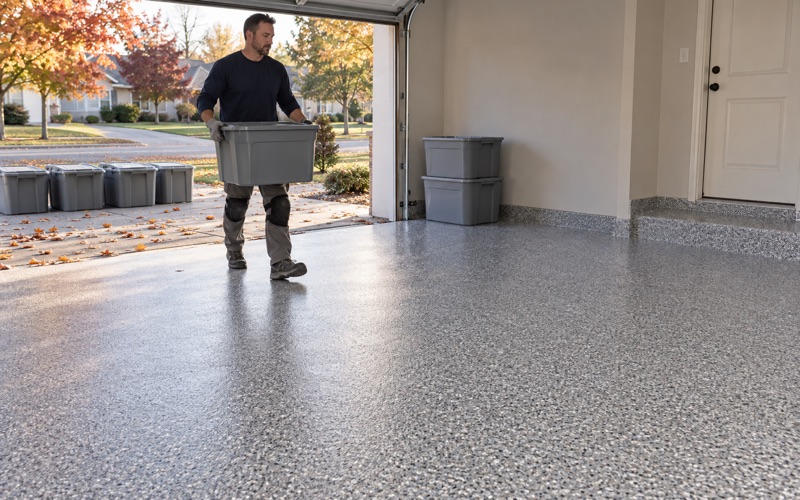
Without solvent to fall back on, the finish has to release dirt to a mop and an absorbent. Heavy textures give traction but hold grime in their valleys, while a fine quartz aggregate broadcast locked in by the topcoat gives grip that still cleans. Vinyl flake suits customer areas and offices, but on the working floor we usually lean toward quartz.
Absorbent works best on a surface it can be swept off cleanly. A seamless coated floor lets granular absorbent soak up a spill and leave with the broom instead of pushing material into open cracks. We fill saw-cut joints with a semi-rigid polyurea joint filler before the topcoat goes down, so the broom has nothing to catch on and nothing collects at the joint lines.
The home garage version of the same rules
The village’s 3,500 psi, four-inch amendment covers garage floor surfaces generally, so a house garage in Bellwood sits on the same kind of concrete the rules expect at a shop. Homeowners inherit the station logic too, often without realizing it: keep the slab draining toward the door, and clean the floor with detergent rather than gasoline.
For a home garage we apply the same thinking at a smaller scale: a flush edge at the overhead door, a topcoat that tolerates household degreaser and a texture that cleans with a mop. Between the Eisenhower Expressway to the south and the Proviso rail yards to the north, Bellwood is a Proviso Township village in Cook County, and permit questions go to the Village of Bellwood Building Department before work begins.
- 20+ Years of Floor Coating Work
- Moisture Testing in Every Scope
- Free Written Estimates