Plainfield Epoxy Flooring has spent more than 20 years putting down epoxy-flooring in Bridgeview and across the southwest suburbs, and some of our most useful conversations start before any product is chosen. An owner of an industrial building asks whether a resin floor will keep chemical vapors from coming up through the slab. The answer is no, and this page explains why, along with what a coating does do well.
That question deserves a straight reply because the stakes are higher than appearance. Vapors that travel from soil into a building are a health matter, handled by specialists who measure indoor air and design ventilation beneath the floor. A floor contractor who promises a coating will stop them is selling something no epoxy, urethane or polyaspartic system was built to deliver, however thick it is.
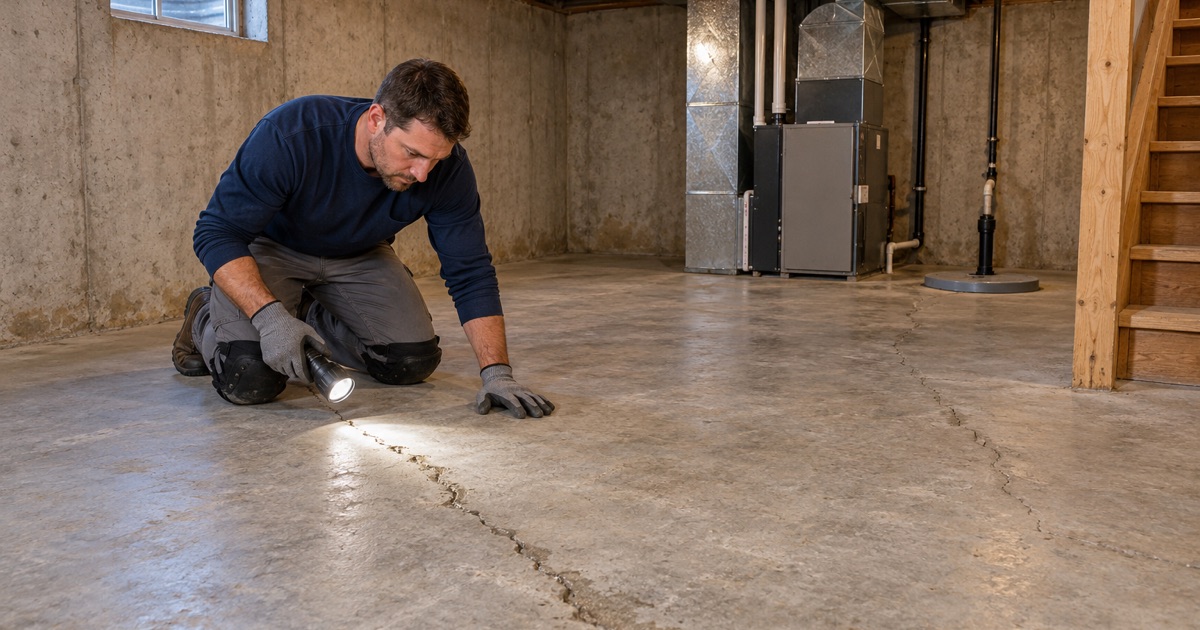
What we can offer is a floor that works inside a plan someone qualified has drawn up. We walk every crack, control joint and old patch on a slab before pricing it, because those openings matter to the people managing air quality as much as to us. Where a plan exists, the coating becomes the durable top layer over work the vapor design already called for.
Solvent Tanks and the Path From Soil to Floor
What the State Record Lists on South 77th Avenue
Bridgeview sits about 15 miles southwest of the Chicago Loop, and its industrial streets hold chemistry most suburbs never see. The Illinois State Fire Marshal’s underground storage tank record for facility 2001982, PLZ Corp. at 8407 S. 77th Ave., lists tanks 31, 32 and 34 as perchloroethylene and tank 43 as trichloroethylene, each holding 5,000 gallons and recorded as currently in use.
PLZ describes itself as a maker of specialty and private label aerosol and liquid products, and the address geocodes inside the village, in Lyons Township. Nothing is known about soil or groundwater at the site, we suggest no problem there, and PLZ is not a customer of ours. The record simply makes concrete a question any building near solvent handling may eventually face.
Why Chlorinated Solvents Get Asked About
Perchloroethylene and trichloroethylene are volatile, so wherever either one is present below ground it can evaporate into the soil gas around a foundation. EPA defines vapor intrusion as the migration of volatile contaminants from the subsurface into overlying buildings. A slab is the boundary that gas meets first, so owners naturally look down at the floor and wonder what a coating could add.
That does not mean every slab near an industrial street has a problem, and most never will. Whether vapors are present under a particular building is answered by sampling, not by guessing from a map. Our part is narrower and practical: knowing enough about the issue to recognize when a floor project should pause until someone qualified has looked.
How Gas Finds Its Way Through Concrete
Concrete looks solid, but soil gas rarely needs to pass through the slab itself. EPA’s mitigation guidance names the usual entryways: openings in a slab, major cracks in walls, utility penetrations, sump lids that do not fit tightly and floor drains. In an older plant those openings multiply over the decades as conduit is added, machines are moved and drains are rerouted.
That list is why a coating pitch falls apart on inspection. A resin floor covers the open field of the slab, which was rarely the main route in the first place, and it stops at the edges where pipes, drains, column bases and wall joints carry the real traffic. Gas moving under a pressure difference uses whichever gap is left.
Looking for epoxy-flooring closer to Brookfield? See Epoxy-Flooring in Brookfield.
What EPA Says About Sealing a Slab
Sealing Alone Is Not a Reliable Technology
The phrase is EPA’s, not ours. In its Engineering Issue on vapor intrusion mitigation, publication EPA/600/R-08-115, the agency notes that both its own 1993 guidance and New York’s state guidance take the position that sealing alone is not a reliable technology. Sealing still matters, the report adds, as a useful and necessary supplement to sub-slab depressurization rather than a control on its own.
Sub-slab depressurization means a fan and piping that draw soil gas from beneath the floor and vent it outdoors, keeping the pressure under the slab lower than the pressure in the room. Sealing the openings makes that system more efficient, because the fan is not fighting leaks. The fan does the real work, and the sealing helps it do that work.
Settling Reopens What Was Closed
EPA also explains why sealing cannot stand on its own: normal settling of a building opens new entry routes and reopens old ones, and the places where vapors enter can be hard to identify and permanently seal. Concrete keeps moving for decades through shrinkage, temperature swings and loads, so a crack filled tight this year may open again beside the repair.
That matches what we find when an old coating comes off. Cracks we can trace under a failed finish often run past the patch someone made years earlier, and control joints that were filled rigidly have usually split along one edge. A floor treated as a permanent seal is a floor nobody is checking, which is the opposite of what a vapor design needs.
Sealants Are Not Sealers
The guidance draws a distinction worth knowing before talking to any contractor. Sealants, in EPA’s usage, are materials that close cracks, joints and penetrations against air movement, while sealers are materials used to coat a surface. A clear concrete sealer, an epoxy primer and a full resin floor all fall on the sealer side of that line, whatever a label says.
The report adds that air tightness against pressure is more difficult to achieve than an aesthetic or structural repair. A crack filled so that it looks finished and carries a forklift wheel can still pass gas. That is the gap between our work and a vapor specialist’s work, and we name it in the proposal so nobody reads a floor as something more than it is.
Where a Coating Fits in a Vapor-Control Design
The Environmental Professional Leads
When vapor control is on the table, the design belongs to an environmental professional, who decides whether sampling is needed, where a depressurization system goes and which openings get sealed with what. Testing indoor air, designing mitigation and signing off on it are not things we do. Our first question to an owner in that position is simple: who is your consultant, and can we see the plan?
If no consultant is involved and an owner is worried about solvents nearby, we suggest stopping before a floor is scheduled. A coating laid first can bury cracks and penetrations the consultant would later want to inspect, map or seal a particular way, and pulling up a new floor to reach them is expensive. The investigation comes first and the finished surface comes last.
Coating Over Work the Design Called For
Once the plan is set, a coating has a sensible place in it. The cracks, joints and penetrations the design names are closed with the specified sealant, the depressurization piping is installed and checked by the people responsible for it, and then the resin system goes down as the wearing surface. We keep the coating off any monitoring port, sump lid or fitting the plan needs left reachable.
We also agree in writing who touches the slab openings. If our surface preparation would cut into a sealed joint or disturb a penetration seal, we stop and call the consultant rather than improvising. That respect for the design is the whole contribution a floor contractor can make, and it costs nothing more than a phone call before work reaches that part of the room.
What a Resin Floor Still Does Well
Inside a plant that handles liquids, a seamless resin floor has real merits that have nothing to do with vapors from below. Spills sit on the surface where they can be seen and collected instead of soaking into bare concrete, and a light color shows drips at a glance. Chemical resistance is product-specific, so we choose a system against the exact liquids that floor will meet.
Basements, Sumps and the Radon Parallel at Home
The Same Logic Under a House
Homeowners meet the same physics in a different form. Most of Bridgeview’s housing was built before 1980, with 1,196 units dating from the 1960s and 1,058 from the 1950s, and many of those homes sit on basement slabs that have settled and cracked over the years. Soil gas finds those cracks, the gap around a sump and the floor drain just as it would in a factory.
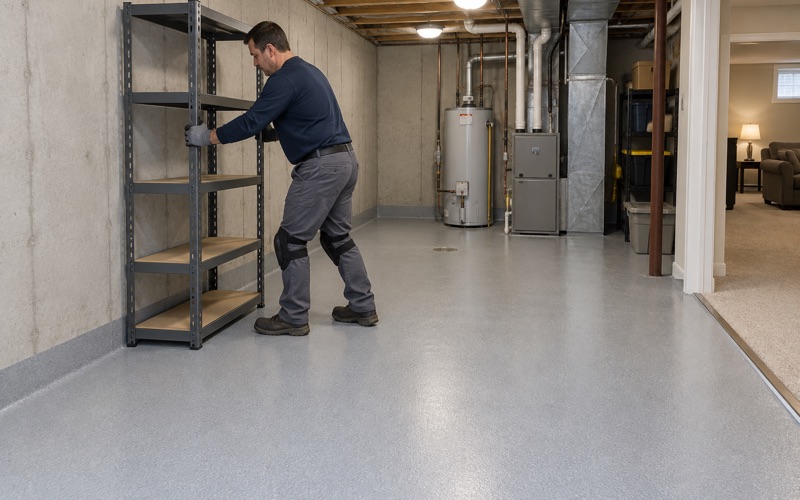
Radon is the household version people already know. In Illinois radon mitigation is licensed work, and we do not present a floor coating as a way to reduce it. A coated basement floor can be cleaner and brighter, but the depressurization fan and the sealing around it belong to a radon mitigator holding the state license, with our floor going down afterward.
Sump Pits and Floor Drains Stay Open to Inspection
A loose sump lid is one of the entryways EPA names, and it is also the spot a homeowner most wants a coating to reach. We stop the resin at a clean edge around the pit so a mitigator’s sealed lid or a plumber’s access is never buried. A coating that glues a sump lid shut is a problem for the pump and for any radon system that depends on that lid.
The same goes for the floor drain. We finish the coating to the drain’s rim without filling its trap or covering a cleanout, and we leave the joint where the floor meets the foundation wall free rather than locking that edge into one rigid piece. Those edges move with the house, and a radon mitigator may want to seal them with a flexible material of their own.
Water Comes Before the Coat
Bridgeview has reported repeated flood losses in its hazard planning, including homes along Roberts Road and 100th Place, and most of the village lies in a high urban flooding susceptibility zone. A basement that takes water, or a slab that pushes moisture up from below, will lift a resin floor whatever was said about vapors. Neither problem is solved by a coating.
That is why moisture testing appears as its own priced line in every basement scope we write, before any product is picked. If the readings or the history point to water entering, the drain tile, sump or grading comes first and the floor waits. Getting that order right protects the floor, and it keeps the vapor conversation with the professional who measures it.
- 20+ Years of Floor Coating Work
- Moisture Testing in Every Scope
- Free Written Estimates