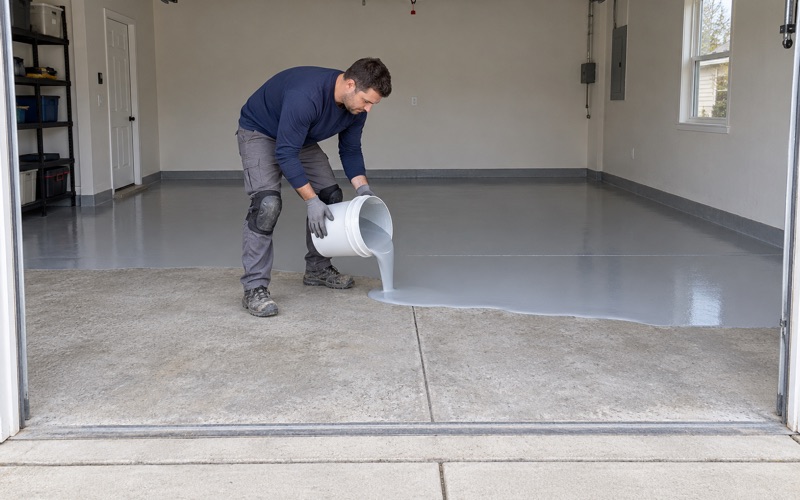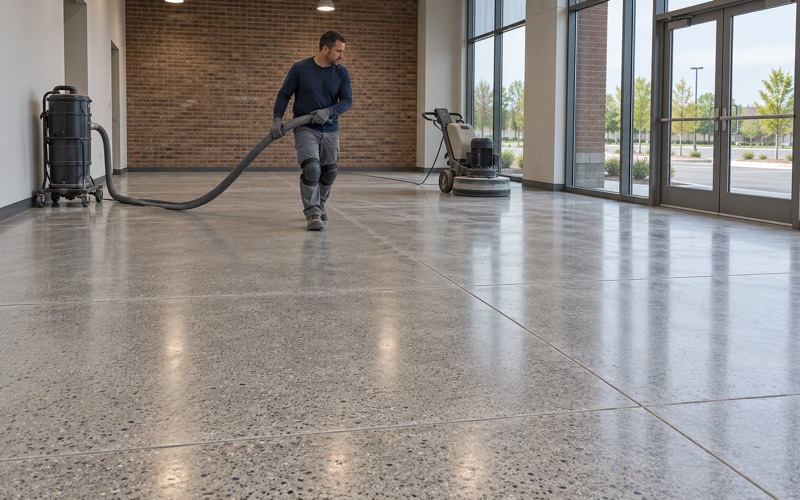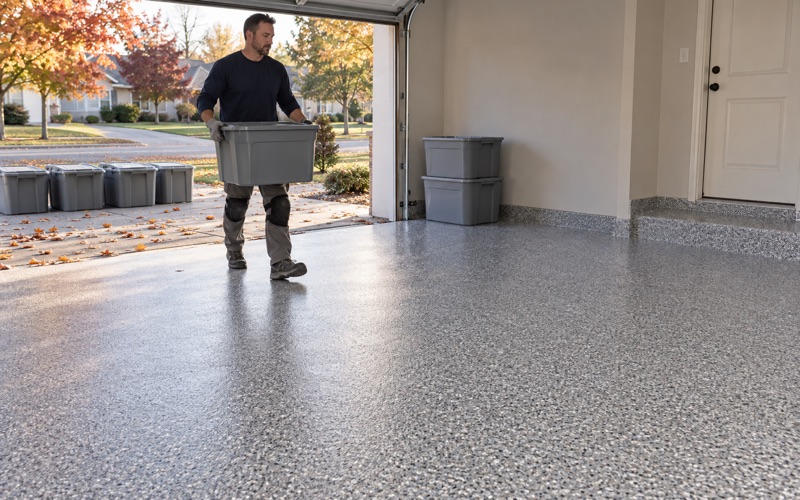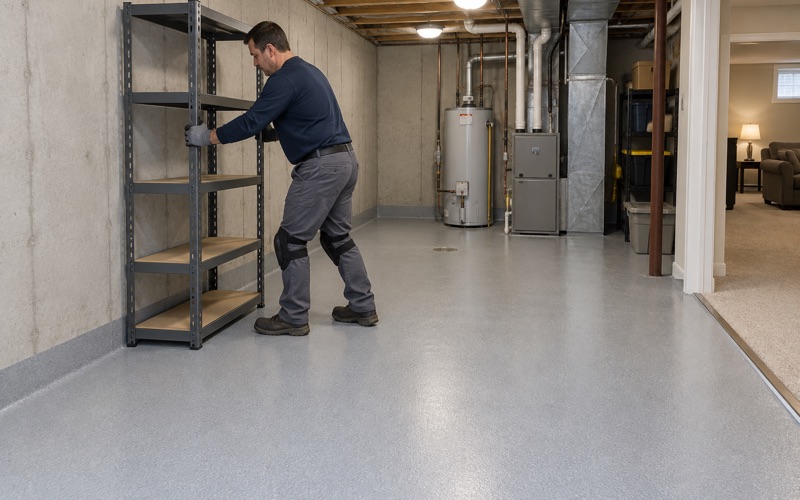
Plainfield Epoxy Flooring handles epoxy flooring in Brookfield with more than 20 years in the trade, and the work here starts with the cracks already in a slab before any coating goes on. A basement or garage floor holds a record in its concrete: where it has cracked, how far each crack runs and how wide it has opened. A coating hides all of that within an afternoon.
That matters most when a homeowner may one day need to show what a floor looked like on a given date. Once a resin film is down, the crack map under it is gone from view, and nobody can measure a width through 100% solids epoxy and a flake broadcast. So we photograph, date and measure the cracks first, and coat only when that record is complete and stored.
Brookfield adds a reason most towns do not have. Homes on the south side sit near an underground quarry outside the village that blasts on a regular schedule under a state vibration limit, and some residents have raised cracks with the quarry’s complaint line. We take no side in any of that. Our job is to make sure the floor we coat does not erase anything a homeowner may still need.
An Underground Quarry Just South of 47th Street
Where the blasting happens
The Village of Brookfield’s web page on quarry blasting names two operations near town. Vulcan Materials is the farther south and, in the village’s words, unlikely to affect Brookfield. Heidelberg Materials runs the quarry just south of 47th Street, where all blasting is conducted underground and generally at 2:00 p.m. The Riverside-Brookfield Landmark reported in January 2024 that the quarry moved from surface to underground mining in 2019.
The same paper put blasting at six days a week, Monday through Saturday, between 1:00 and 3:00 p.m. The quarry itself sits in McCook, outside the village, and the village states plainly that it has no ability to regulate how the quarry operates. The State of Illinois licenses quarries and sets their noise and vibration standards, which is where the next number comes from.
One inch per second at the nearest home
Illinois rules for aggregate mining, 62 Ill. Adm. Code 300.225, cap ground vibration by peak particle velocity: it shall not exceed one inch per second at the location of any protected structure, which includes a house. That number is how fast the ground itself moves as a blast wave passes, not how far it shifts. Airblast is capped separately, at 129 to 134 decibels depending on the measuring equipment.
The rule also says what happens when the limit is passed: the operator reports the exceedance to the state immediately by phone, with written or email notice within 24 hours. We cite the limit so a homeowner knows a standard exists and who answers to it. We have no readings from any Brookfield home, and nothing on this page suggests the quarry has gone over it.
Who measures it, and where a concern goes
Both quarries have installed meters that monitor sound and vibration, according to the village. The state rule requires a seismograph recording at or near the closest protected structure whenever the scaled distance there is under 65, and the Department may require recordings for any blast. The Landmark reported that Heidelberg Materials has placed seismographs at the quarry and at some homes.
Residents report noise, dust, blasting and gravel-truck concerns to the Lyons Township Quarry Council hotline, 1-866-934-3278, also listed as 1-866-WE-HEAR-U. The village managers of Brookfield and two neighboring towns review its logs each quarter with the companies, and the Landmark reported that Heidelberg invites residents who suspect blast damage to request an evaluation. Either step comes before a coating, not after.
Looking for epoxy-flooring closer to Chicago Ridge? See Epoxy-Flooring Services in Chicago Ridge.
Before You Coat: Date, Measure and Watch the Cracks
Why the coating goes on last
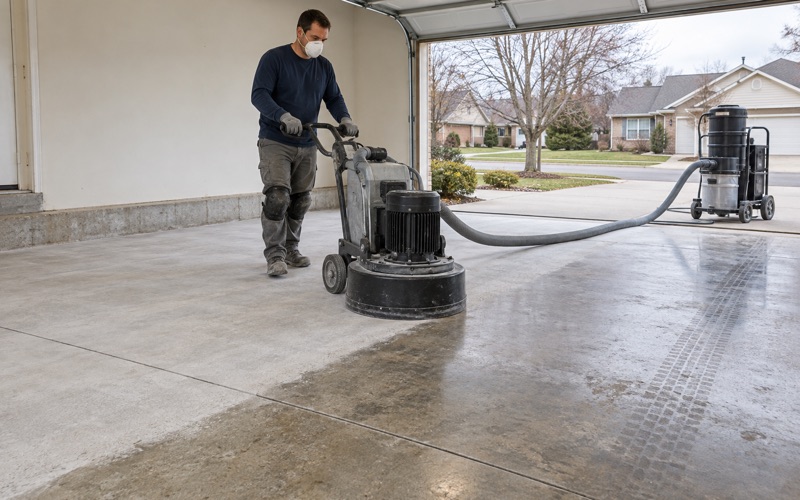
A floor coating covers exactly what a vibration concern turns on: where each crack sits, how long it runs and how wide it is. If a complaint is open or an evaluation has been requested, we wait for it to finish before grinding or coating that floor. Grinding alone can round off a crack edge and change the width someone is about to measure.
This is one place where reading the slab before we price it does real work. We walk the floor, mark every crack and any old coating that is lifting, and tell the owner when a crack has to be watched or repaired before a coat can follow. A quote that ignores the crack map is a quote for covering it up.
Dated photos and a crack gauge
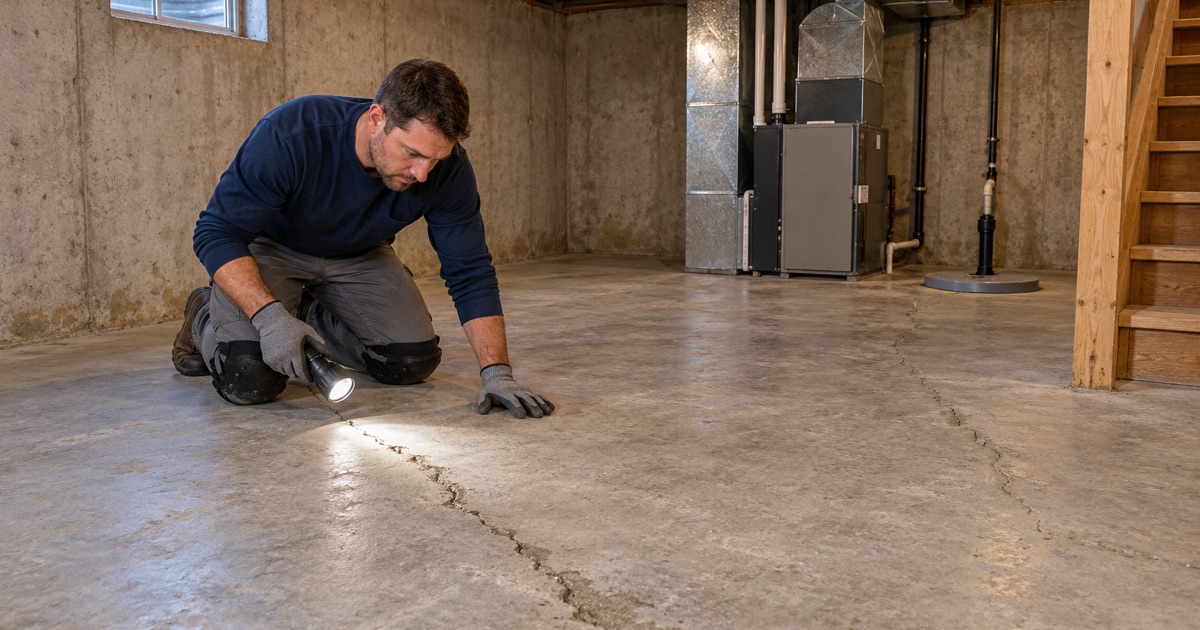
Each crack is photographed with a scale in the frame and the date recorded, so a picture can later be matched to a place and a width. We note widths with a crack gauge or comparator card at marked points along the crack, not one reading taken at its widest. The ends are marked too, because a crack that grows tends to grow at its tips.
The photos go into a simple file with the address, the room, a sketch of the slab and the readings. We hand the owner a copy and keep one, and the file belongs with the house rather than with us. If the owner already has an evaluation report or seismograph notes from the company, those go in the same folder.
Watching a crack over time
One set of readings says how a crack looks today; it cannot say whether the crack is still moving. Where the record raises that question, we come back and read the same marked points again over a period of weeks before anything is filled. If the widths hold, the crack is treated as settled; if they change, the floor waits.
Seasons matter in that reading. A basement slab can open and close slightly with temperature and moisture, so a single cold-month reading compared with one from summer is not proof of movement on its own. We compare readings taken in similar conditions, and where the pattern is still unclear, the owner is better served by a structural engineer than by a coating crew.
Moving Crack or Settled Crack: Repair by Type
A crack that has stopped
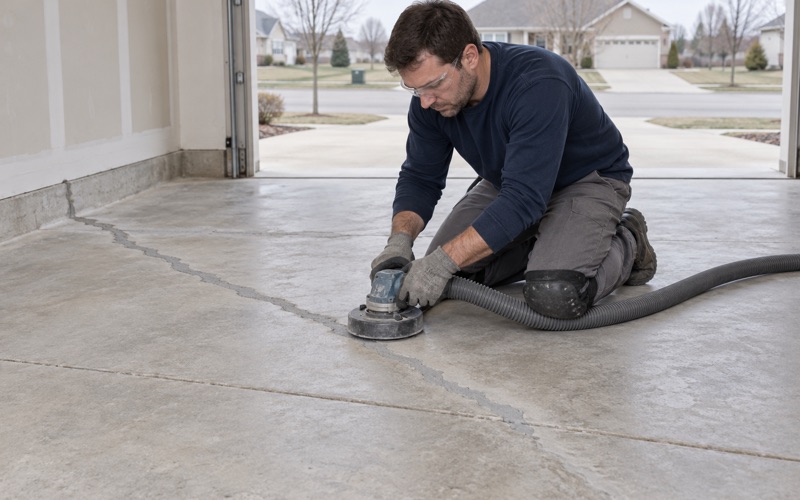
A settled crack, one whose readings held, is repaired as a rigid fill. We open it slightly with a crack-chasing blade so the repair has walls to grip, vacuum it clean, and fill it with an epoxy repair material meant to bond the two sides together. Once cured it is ground flush so the coating sees one continuous surface rather than a ridge.
The record still matters after the repair. Before filling, we photograph the crack once more at the same marked points, so the file shows the crack as it was on the last day anyone could see it. That final set of pictures is the one an owner would reach for if a question about the floor ever came up later.
A crack that is still opening
A crack that is still opening is not filled rigid, because a hard fill in a moving crack simply cracks again beside it and takes the coating with it. Where movement is small and the cause is understood, a semi-rigid polyurea filler can flex with it. Where widths keep growing, we stop and recommend that the owner have the structure looked at first.
We do not assess structural damage, and we will not coat over a crack that is actively widening to make a floor look finished. A fresh coating over moving concrete tends to show a new hairline within weeks or months, and by then the original crack is buried. Leaving that floor bare for now is the more useful answer for the owner.
Basement and garage slabs on the south side
Brookfield’s housing is old: of 7,927 units, 2,543 were built in 1939 or earlier and another 2,086 in the 1950s. Of occupied homes, 81.8 percent are owner-occupied, most of them detached houses with a garage slab or a basement floor that has had decades to crack and shrink. On the blocks near 47th Street that age and the quarry question arrive together.
Age is also why moisture testing sits in our written scope from the start on these floors, not as an extra after a coating blisters. The village says it is vulnerable to flooding partly because of a high water table due to bedrock, and old cracks are a ready path that water takes up through a basement slab. Each one we record is also a place we test.
What a Coating Can and Cannot Say About a Crack
Not a structural repair, not a vibration remedy
A coating is a film bonded to the top of the concrete. It is not a structural repair, it does nothing to stop vibration reaching a house, and it says nothing about what caused a crack under it. We will not describe a floor as protection against blasting, and we will not imply that a coated floor settles any question about the house it sits in.
What a coating can do is show change. On a floor that was mapped, repaired by type and then coated, a new line through the finish is easy to spot against the file, because the old cracks are on record by location and date. That gives an owner something specific to compare, which a bare, stained slab rarely offers.
Water through an old crack
In a basement, a crack that lets water through is a water problem before it is a flooring problem, and a coating does not waterproof a slab. We look for where the water comes from first, then run a plastic sheet test under ASTM D4263 and, where it matters, relative humidity probes set into the slab. If the readings are high, the scope changes before any coat is chosen.
Groundwater pushing up through a crack is a different job from storm water arriving at the garage door. Pressure from below may call for a moisture-mitigation primer, drainage work or a pause, while street-side water is managed at the door edge and slope. Adding drain tile or relocating a floor drain also moves the job onto the village’s permit side.
Keeping the record with the house
When the job is done, the owner gets the crack file back with the final photos, the repair type used on each crack and the date the coating went down. Kept with the house papers, it answers questions about the floor that might come up years later, without anyone needing to lift the coating to find out. We also note any crack left unfilled for watching.
If a homeowner later raises a concern with the Quarry Council hotline or the company, that file is theirs to share. We do not file complaints, contact the quarry or offer opinions on cause, and we have no relationship with either quarry. Our part ends at a floor that was documented honestly, repaired for the kind of crack it had, and then coated.
- 20+ Years of Floor Coating Work
- Moisture Testing in Every Scope
- Free Written Estimates