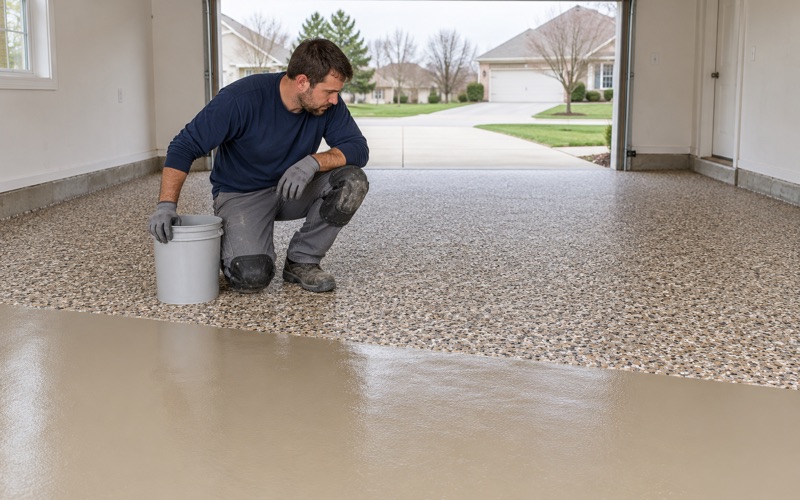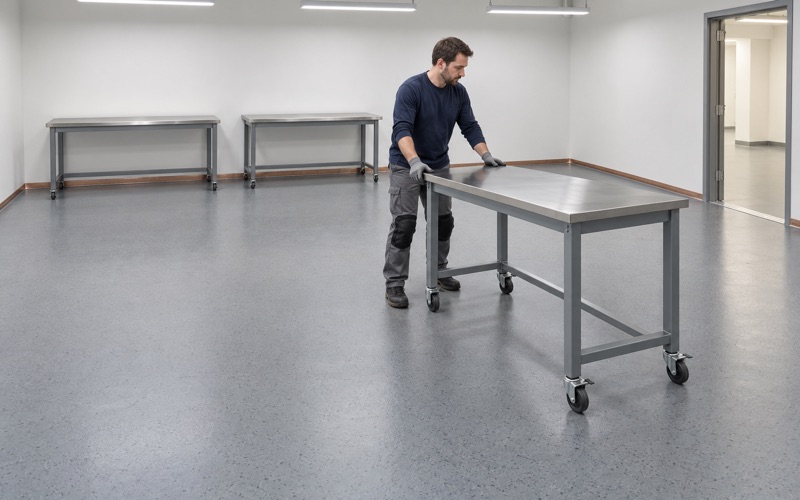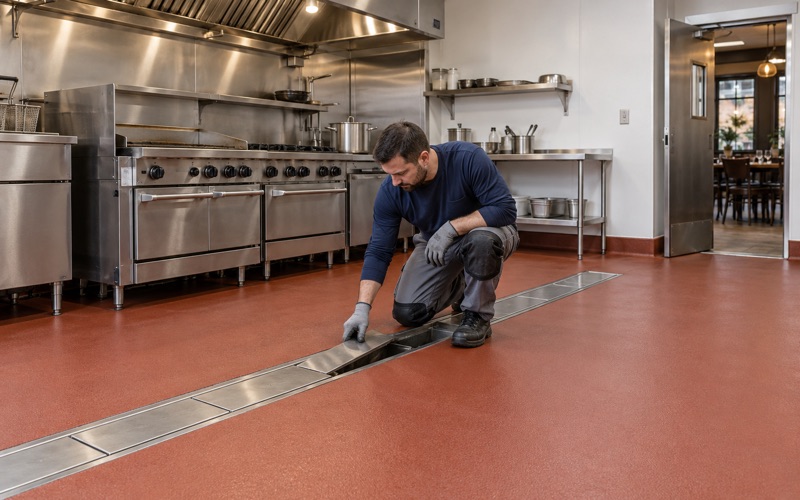
Plainfield Epoxy Flooring has more than 20 years behind its epoxy flooring in Burr Ridge, and the floors we think hardest about here are the ones that do more than carry shoes. In a therapy room, a clinic gym or a home exercise space, the floor is touched by wheels, mats, bags and, sooner or later, hands. That changes how the floor should be built and how it should be judged once it is down.
A floor in a room like that works less as a walkway than as a work surface. Patients sit on it, roll across it and set their belongings down on it, and staff wet clean it every day. We build those floors so the cleaning can be complete: no seams for soil to settle into, no open joint where floor meets wall, and a surface a mop actually reaches rather than skates over.
Below we explain why that matters, using one published hospital study and the kind of outpatient rehab building this village holds. We also say plainly what a floor cannot do. A resin floor makes the cleaning a facility already does more thorough, but it does not disinfect anything, it does not prevent infection, and it never replaces a clinic’s own infection control program.
An Outpatient and DayRehab Building on County Line Road
A Single-Story Building Where Therapy Happens Low
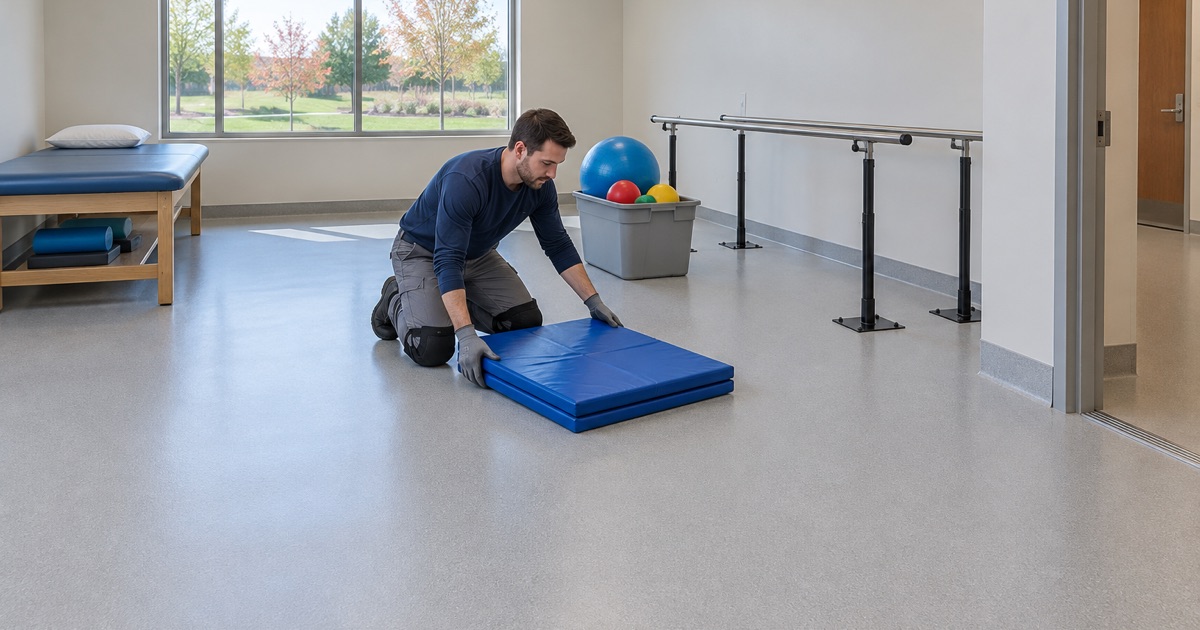
Shirley Ryan AbilityLab runs its Burr Ridge Outpatient & DayRehab Center at 7600 County Line Road, an address that sits inside the village on the DuPage County side. The engineer on the project describes a 25,000-square-foot single-story building holding both an outpatient clinic and a DayRehab center. The outpatient side keeps long days, Monday through Thursday from 7:30 a.m. to 7:00 p.m. and Friday until 5:30 p.m.
We name the building because it shows the type, not because we have worked in it. AbilityLab is not our customer, and we have not seen its gyms, its mats or its cleaning program. What the public listing does show is physical therapists, occupational therapists and speech-language pathologists working alongside prosthetics and orthotics services, which puts a great deal of the working day close to the floor.
Day Programs Mean Hours of Floor Contact
AbilityLab’s system-wide material describes DayRehab as intensive therapy for people who no longer need to be in a hospital, often around three hours a day, two to three days a week. We have not confirmed that the Burr Ridge program runs on that pattern. Even so, any day program of that shape keeps patients on the gym floor for much of a visit, not just walking across it.
Those hours become floor contact. A transfer from a wheelchair to a mat, gait practice along a marked path, balance work with a ball and a seated rest beside a gym bag all put people and their equipment on one surface. Every one of those things is picked up again later, and that second step is the part of a floor’s job that ordinary flooring advice leaves out.
Which Rooms in a Clinic This Applies To
Not every room in an outpatient building needs this treatment. Offices, consult rooms and a carpeted waiting area are judged on comfort and appearance. The rooms where we would apply everything on this page are the therapy gym, treatment rooms where patients transfer or lie down, any fitting area where devices are set down during adjustment, and the housekeeping closet where the mops and buckets are filled each morning.
Looking for epoxy-flooring closer to Morris? See Epoxy-Flooring in Morris.
What a Hospital Study Found on the Floor
Three Organisms Recovered From Patient-Room Floors
In 2017 the American Journal of Infection Control published a study by Deshpande and colleagues that sampled floors in patient rooms at five Cleveland-area hospitals. Floors were often contaminated with C. difficile, MRSA and VRE, and C. difficile was the pathogen recovered most often, in isolation rooms and ordinary rooms alike. The title asked whether hospital floors are an underappreciated reservoir for those organisms.
The authors’ explanation for why that reservoir gets overlooked is simple. Floors are not touched often, so limited attention has been paid to disinfecting them compared with bed rails, door handles and call buttons. The study’s argument is that a floor does not need to be touched directly to matter. It only needs to be touched by things that people then pick up.
41 Percent of Rooms Had Something Resting on the Floor
Of 100 occupied rooms the team surveyed, 41 percent had one or more high-touch objects in contact with the floor. The researchers then sampled hands, bare or gloved, that had handled those items. MRSA was recovered from 18 percent of them, VRE from 6 percent and C. difficile from 3 percent, which is a short chain running from floor to object to skin.
That chain is the reason we treat a therapy floor as an indirect touch surface. Nobody wipes a gym floor with the care given to a countertop, yet in a therapy gym, touching the floor is the whole point of much of the equipment. If the floor is going to be part of the route to hands, it has to be a surface the daily clean can fully reach.
What the Study Did Not Measure
The study sampled hospital patient rooms. It did not test rehab gyms, therapy mats or wheelchairs, and it only proposed wheelchairs and other wheeled equipment as a route worth assessing next. Anyone who tells you that paper found rehab gym floors testing positive, or found germs on wheelchairs, is stretching it past what it reports.
Our line from that paper to a rehab gym is a reasoned one, and we label it that way. A room where wheels, mats and bags sit on the floor for hours shares the mechanism the authors described, even though nobody measured it there. That is enough to shape how we build the floor. It is not enough to support claims about any particular clinic.
Wheels, Mats and Dropped Bags: A Floor the Daily Clean Can Reach
How the Floor Reaches Hands
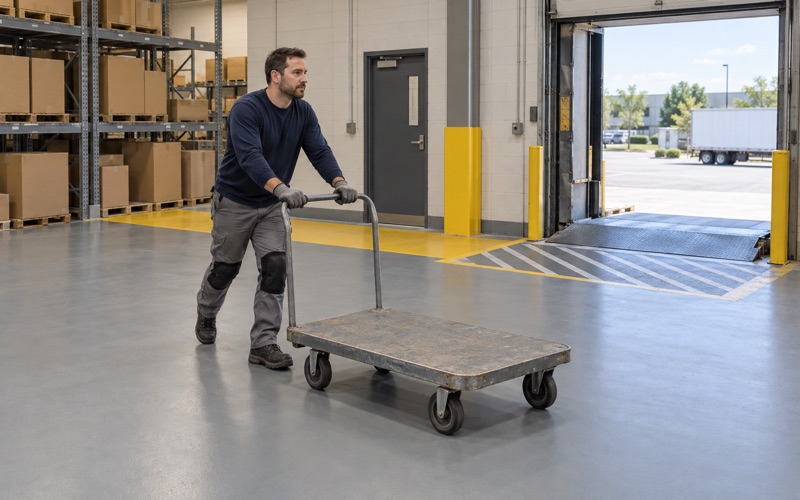
A patient pushing a manual wheelchair grips hand rims fixed to wheels that roll on the floor all day. A therapy mat set down for a transfer, a ball rolled back and forth, a bag dropped beside a chair and a gait belt left on the floor between sets each pick up whatever the surface holds. Each of them then goes back into someone’s hands.
The floor cannot stop that traffic, and it should not try to. What it can do is give the cleaning crew a surface with nowhere to hold soil, so the daily wet clean removes what it is meant to remove. Grout lines, open seams, chipped edges and deep texture are where a floor quietly starts working against that crew instead of with it.
Seamless and Coved at the Wall
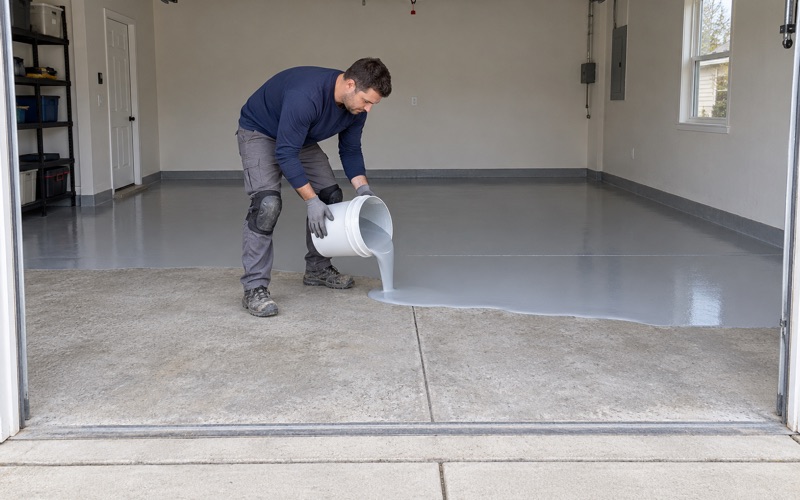
A seamless resin floor has no grout and no sheet seams, and a cove carries the floor up the base of the wall so there is no right-angle corner for a mop to miss. The edge of a room is where soil collects, along the line where the mop stops. A coved base turns that line into a curve the mop follows, the same reasoning behind the coved juncture rule in FDA Food Code 6-201.13.
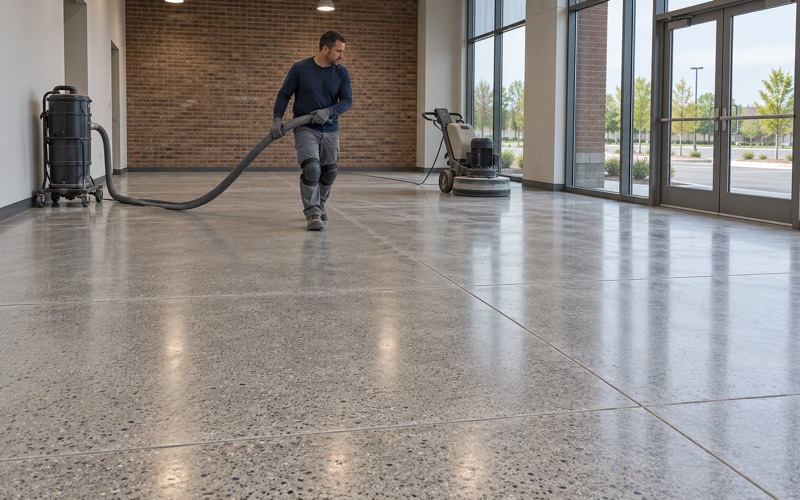
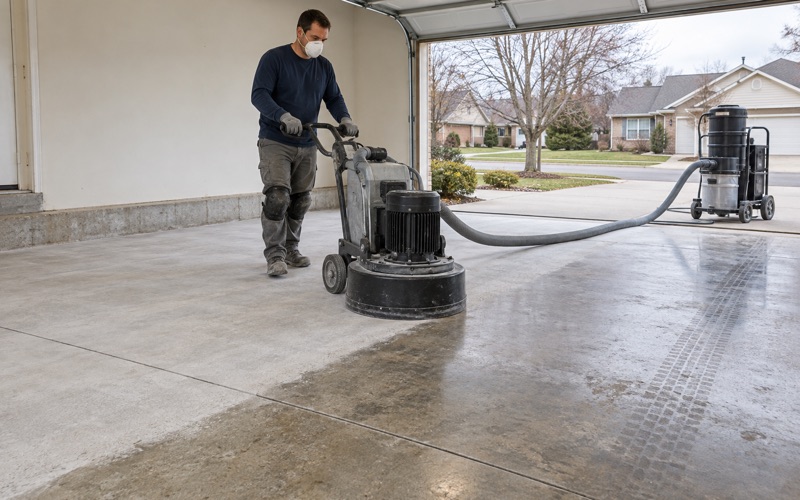
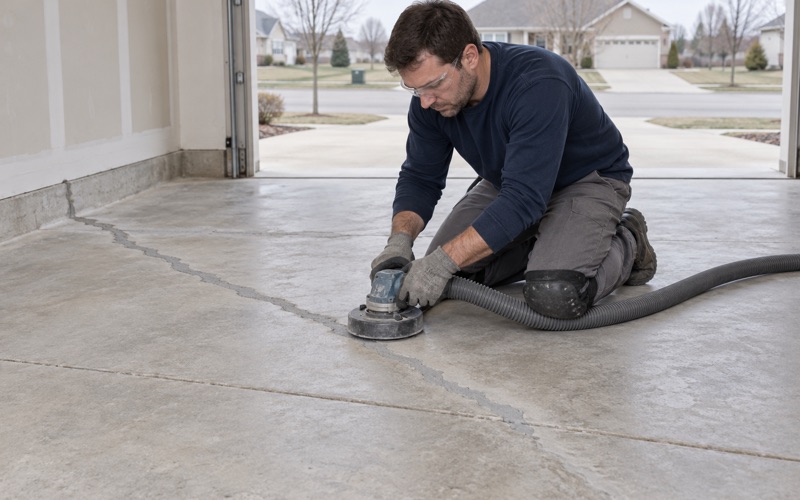
A seamless floor stays seamless only while it stays bonded, and bond starts with the slab. Before any primer touches the concrete, we open the surface mechanically to the profile the system calls for, so the resin locks into sound concrete rather than sitting on a skin of laitance and old sealer. A coating that lifts at its edges opens a new seam, which defeats the reason it was chosen.
Fine Texture and a Topcoat Matched to the Cleaner
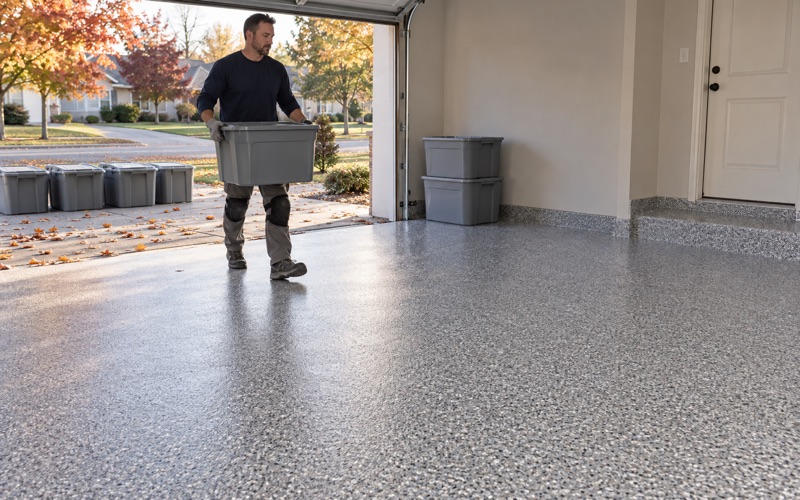
Texture is a tradeoff in a therapy room. A coarse quartz or vinyl flake broadcast gives plenty of grip, but its peaks and valleys hold soil against a mop head. For a rehab gym we lean toward a fine texture instead of a coarse broadcast, enough to give footing while the floor is still wet from cleaning, without building a surface the daily clean has to fight.
The topcoat is the layer the disinfectant meets every day, so we choose it after we know which cleaner and disinfectant the facility actually uses, not before. We check the topcoat maker’s guidance against that product and its dilution. The floor’s job is to stay intact and cleanable under that routine for years; controlling what lives on it is the job of the disinfectant and the cleaning program.
A Home Therapy Room or Basement Gym That Gets the Same Care
When Rehab Continues at Home
In a village where 94.0 percent of homes are owner-occupied, a room set aside for therapy exercises after an outpatient program ends is a project an owner can plan properly. The same logic carries over from the clinic. Wheels, mats and exercise bands spend time on that floor, and what they collect comes back into the hands of whoever uses them next.
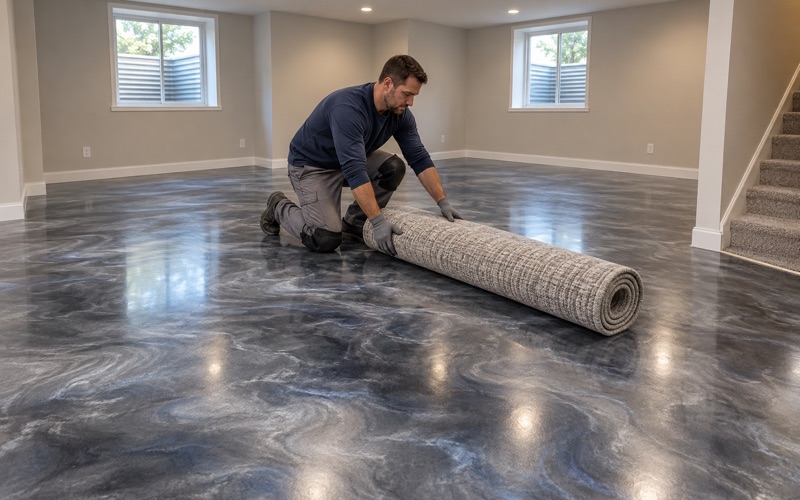
At home the cleaning is a family member with a mop rather than an environmental services team, which makes a cleanable floor more useful, not less. A seamless coat with a short cove at the wall, a fine texture and a topcoat chosen for the household cleaner already under the sink turns a quick daily wipe into a complete one. It still disinfects nothing by itself.
Basement Slabs Start With Moisture and Water
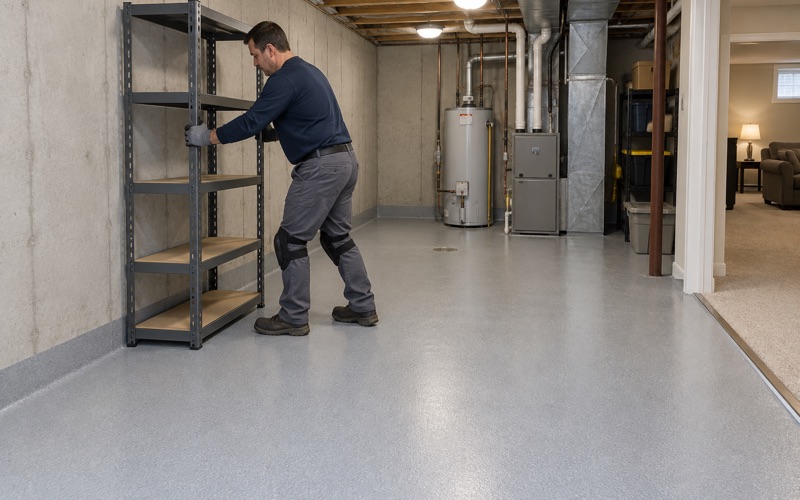
Many home therapy rooms end up in a basement, and a basement slab brings its own questions. About 61.6 percent of Burr Ridge’s housing dates from 1980 to 2009, and nothing recorded at the village level says whether a slab from that era was poured over a vapor retarder. We test for it rather than assume it, and the test is written into the scope before any price is agreed.
If the slab shows liquid water rather than vapor, the first job is finding where it comes from: a sump pit that cannot keep up, failed drain tile or grading outside. A floor coating is not waterproofing, and we tell owners so before anything is sold. Coating over active water traps it under the film, and the floor blisters or lifts in exactly the room where an intact surface was the goal.
Small Details in a Small Room
A home room magnifies details a clinic gym absorbs. A threshold into a carpeted hallway needs a clean transition a wheelchair can cross without a lip, the cove has to run tight around a sump lid or a support post, and the color should make dropped items easy to spot. We plan those edges at the quote, so the finished room is as cleanable at its corners as at its center.
- 20+ Years of Floor Coating Work
- Moisture Testing in Every Scope
- Free Written Estimates