Plainfield Epoxy Flooring has spent more than 20 years on epoxy flooring in Channahon and the rest of our service area, and the jobs that teach the most are the ones where wheels never stop moving. A coated floor under forklifts and pallet trucks is judged in its first month by one thing: how fast it starts looking dirty.
That is why we treat tire marks as a design question rather than a cleaning complaint. Before we quote a warehouse, shop or garage floor, we ask what rolls across it, what the tires are made of, and how light the finished color is meant to be. Those three answers decide more about how the floor looks in year two than the resin brand does.
None of that replaces the basics of a sound floor, which we cover further down. What changes in a busy building is the conversation that has to happen first, between us, the owner and whoever manages the fleet, and this page is mostly about that conversation.
Large Items on Amoco Road and What They Do to a Floor
A Million Square Feet of Bulky Goods
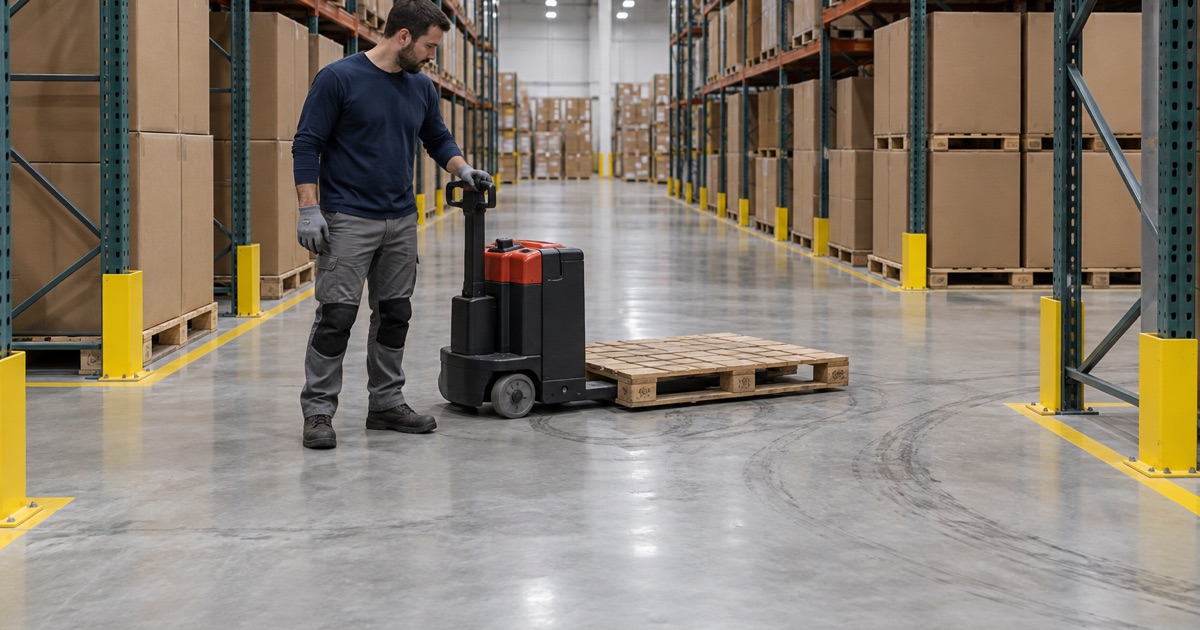
Amazon’s Channahon fulfillment center at 23714 W. Amoco Road began operating on August 23, 2020. It is a one-million-square-foot building between Route 6 and Bluff Road, opened with more than 1,000 full-time associates, and it packs and ships large items: patio furniture, bicycles, pet food, sports equipment and larger household goods. The first inbound item was a pallet of vacuums.
We have no connection to that building and have not seen its fleet or its floor. We mention it because it is the clearest local picture of the traffic we plan for: bulky goods on pallets, moved by powered trucks and pallet jacks from one shift to the next, across concrete that never gets a quiet day.
Crossroads 55 and the I-55 and I-80 Corridor
The Amoco Road address sits within Crossroads 55, a 3.3-million-square-foot park at I-55 and I-80. Another building there, at 24101 S. Frontage Road, is a 1,000,110-square-foot space leased to CJ Logistics America.
Channahon Corporate Center adds a 750,000-square-foot warehouse at Bluff Road and I-55 with 86 dock doors. Buildings of that size run forklifts and pallet trucks side by side, and every dock door is a place where wheels slow, turn and brake.
Smaller Shops Inside the Village
Not every Channahon floor is a million square feet. The village’s new development list includes a Penske truck collision repair building, a TVA Logistics trucking terminal, ATS fleet repair and an M&I Steel expansion on S. Northern Illinois Drive. Shops like these run smaller fleets on smaller floors, and the same marks gather across fewer square feet.
A floor in a building like that cannot simply close for a week, so we plan the work in sections and book the overnight and weekend hours when the fewest trucks are moving. One bay is coated while the next keeps shipping, and the cured half goes back into service before the next half starts.
Looking for epoxy-flooring closer to Plano? See Epoxy-Flooring in Plano.
Where Black Tire Marks Come From
Carbon Black Is the Reason Tires Last
Standard forklift and pallet-truck tires are black because of carbon black, the soot that goes into the rubber compound. Toyota Material Handling describes it plainly: the black soot is used in manufacturing to increase tire durability. It does its job well, and it is also exactly what transfers to a coated floor when the tire is pushed sideways.
A rolling tire in a straight line leaves little behind. The rubber that ends up on the floor comes off when the tire scrubs: a pivot in place, a hard stop, a loaded truck turning on a tight radius. Every one of those moments wipes a thin smear of black compound onto the surface. On bare gray concrete it blends into the slab; on a fresh coating it sits on top.
Turns, Aisle Ends and Dock Doors
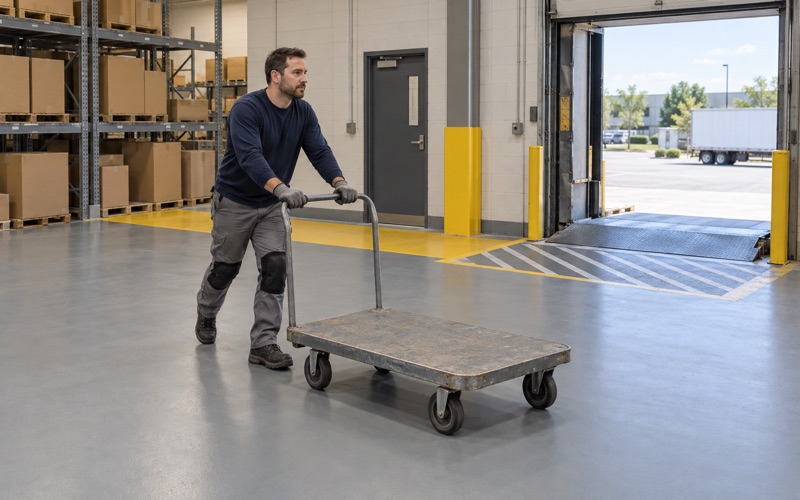
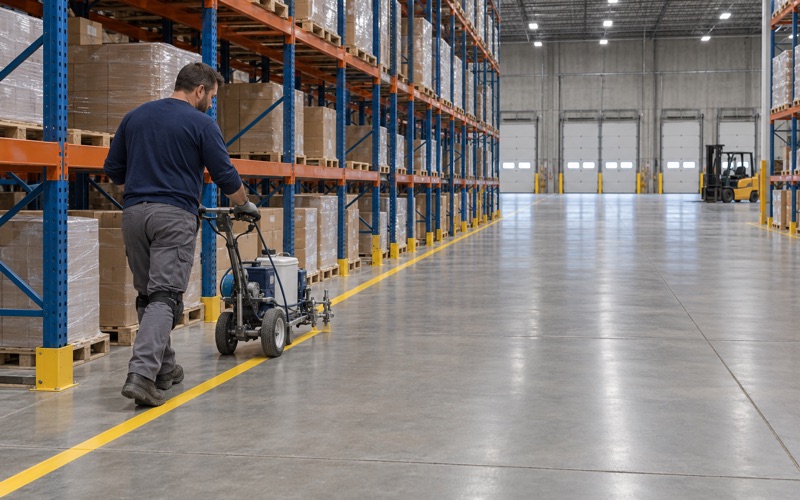
Scuffs are not spread evenly across a warehouse. They concentrate where trucks turn, brake and pivot, which in most buildings means the ends of racking aisles, the approach to every dock door and the staging lanes in front of them. The middle of a long aisle can stay clean long after the turn at its end has gone dark.
That pattern is useful when we plan a floor. Turn zones and dock aprons can take a tougher topcoat, a broadcast texture or a different color from the field of the floor, so the areas that mark worst are also the areas built to hide marks and clean easily. We mark those zones on the drawing before the proposal is written, not after the floor is in.
Why Light Floors Show It First
A light-colored or glossy coated floor is the first place black tire marks become obvious. The contrast is the whole problem: dark rubber on a pale, smooth surface reads as dirt from across the building, even when the floor underneath is sound. Owners often choose light gray or white for brightness and visibility, and that choice deserves an honest talk about scuffing before it is final.
A white floor can still work in a building that commits to non-marking tires across the whole fleet, including any rental trucks brought in at peak. Where outside equipment crosses the dock, we usually suggest a darker apron at the doors and the light color starting past the staging line.
Non-Marking Tires or a Floor That Hides Marks
What Silica Changes in the Tire
The alternative starts at the tire. Toyota describes non-marking tires as tires that replace the soot normally found in tires with silica, and notes they are generally used in retail storefronts to avoid unsightly black marks. Adaptalift, a forklift dealer, says they contain silica or chalk and are especially useful on warehouse floors with a light-colored coating and surface finish.
Food plants commonly require them for hygiene, which tells you they are a recognized option rather than a niche product. If your building already runs them, the floor color question gets much easier. If it does not, the switch is a fleet decision with its own costs, and it should be made with eyes open. We do not sell tires; we just make sure the question gets asked.
The Price and the Faster Wear
Non-marking tires cost more than standard tires, and they wear out sooner. Toyota says they need replacing more often; Adaptalift puts the difference at up to 25 percent faster wear on average. Across a fleet that runs every shift, that is a recurring cost the operations budget carries for the life of the trucks, not a one-time line on our proposal.
They are also not maintenance-free. Adaptalift notes that non-marking tires may not leave markings on the floor but create dust invisible to the eye, so the floor still needs regular cleaning. No coating we install stops every mark, and no tire choice removes the need for a cleaning plan; the goal is marks that are fewer, lighter and easy to lift.
Picking Color and Texture With the Fleet
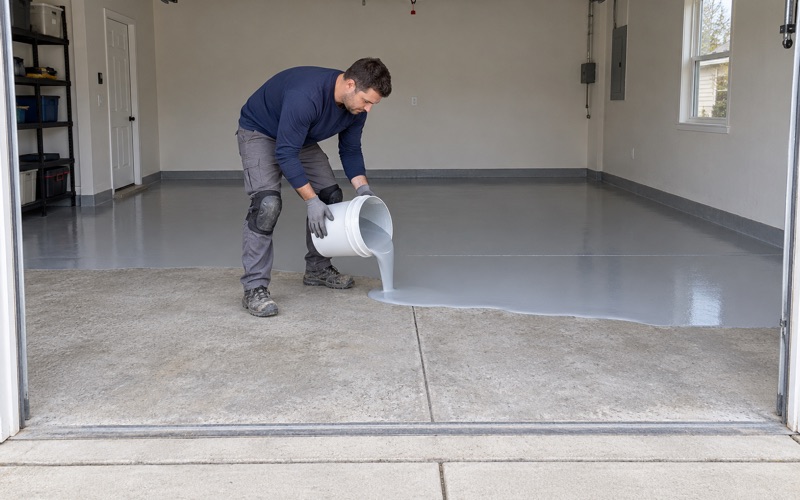
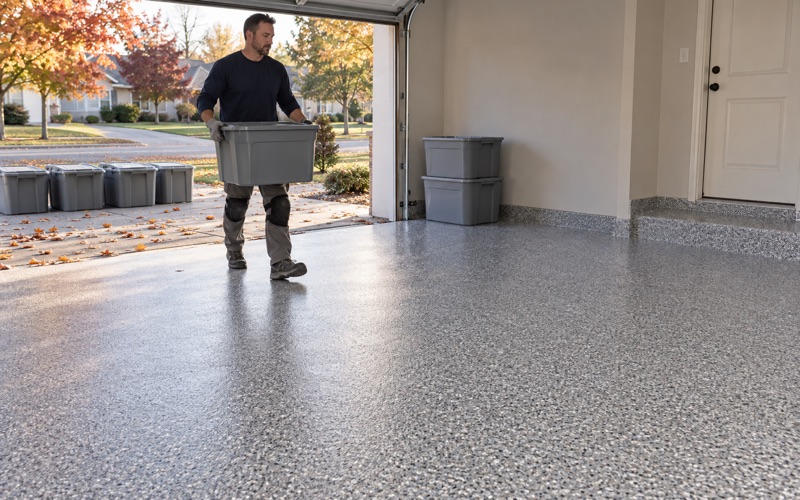
When standard tires are staying, the floor has to do the hiding. A mid-tone gray, tan or a blended vinyl flake broadcast disguises scuffs far better than solid white, and a quartz aggregate broadcast in turn zones adds texture that breaks up the smear. A polyaspartic or polyurea topcoat over 100% solids epoxy gives a hard, chemical-resistant surface that stands up to regular scrubbing.
This is why we want the fleet manager in the room before anyone picks a color chip. The right answer depends on tire type, traffic and how often the floor gets scrubbed. A building that cannot change its tires gets a darker field and textured turns; one that already runs silica tires can afford the brighter floor it wanted in the first place.
Scuffs at Home and How We Prepare the Slab
Car Tires, Carts and Hot Tire Pickup
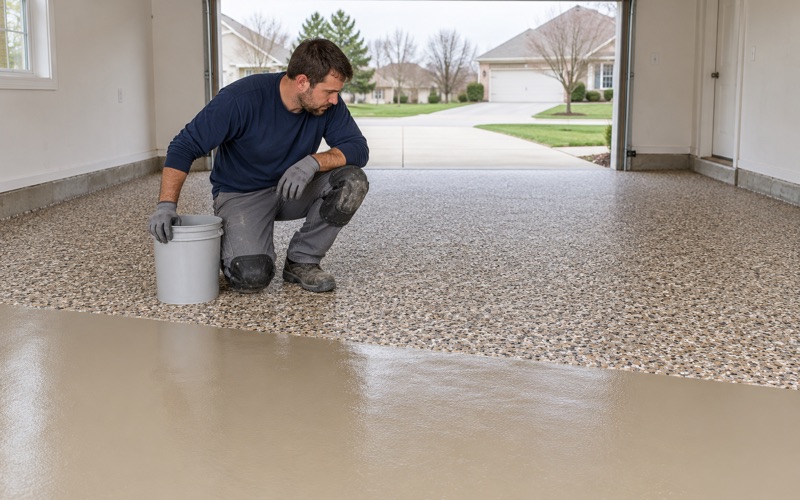
The same chemistry plays out on a smaller scale at home. In Channahon, 91.7 percent of owners live in detached houses and 62.8 percent of the housing was built between 1990 and 2009, so the typical residential job is a garage slab from those two decades. Car tires, a lawn tractor and a loaded cart all turn on it, and the swing into the parking spot is where marks gather.
Car tires add a second problem called hot tire pickup, where a warm tire softens a weak coating and lifts it off the slab. A properly bonded 100% solids epoxy base with a polyaspartic topcoat resists that, and a mid-tone flake blend keeps the turn-in marks from standing out. Turn-in marks on a garage floor are the same carbon black as in a warehouse aisle, just gathered in one patch where the car swings in.
Profile Before Color
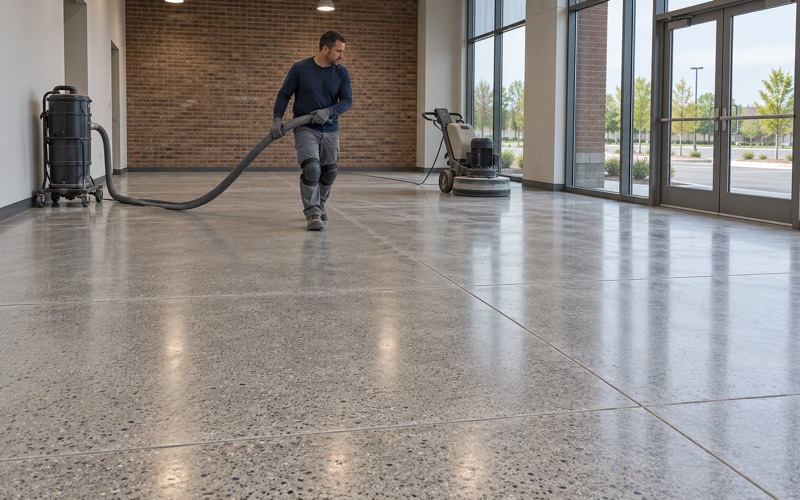
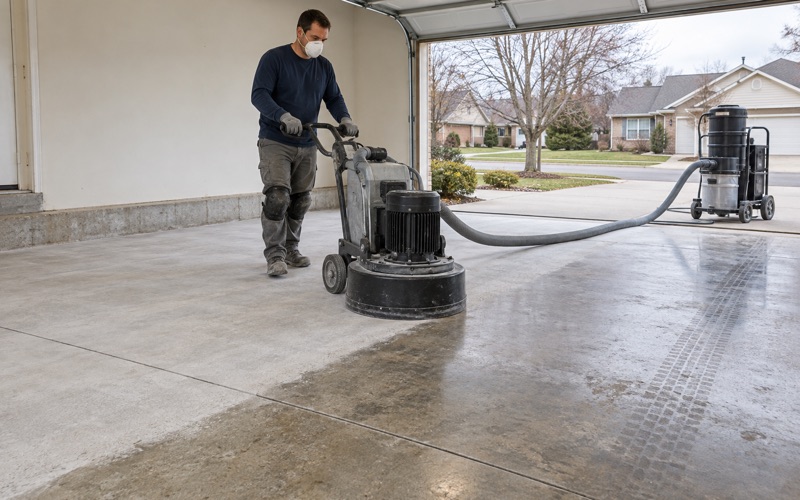
Whether the floor carries a forklift or a minivan, a coating holds in a scrubbing turn only as well as it grips the concrete. That grip comes from mechanical profiling, diamond grinding or shot blasting to an ICRI CSP range matched to the system, and acid etching has no place in our process. A turn zone is where a weak bond shows first, because that is where tires twist hardest.
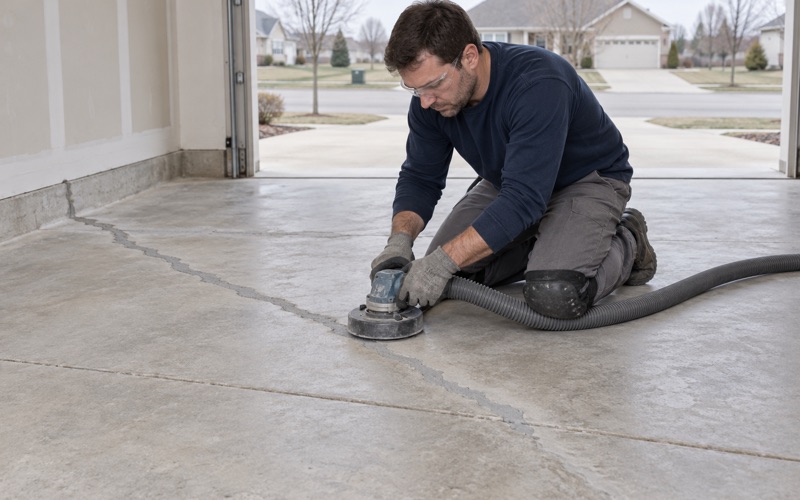
Joints in a warehouse aisle get a semi-rigid polyurea joint filler so hard forklift wheels cross them without chipping the edges. A chipped joint at an aisle end collects rubber and grit faster than the floor around it, and it turns a cleaning job into a repair. On a two-car garage the preparation is the same; only the machine size changes.
Moisture and Which Rules Apply
A slab that pushes vapor up will lift a coating no matter how good the tires are, so we test before we price, not after a blister appears. The test is its own line in the scope, using in-situ relative humidity probes under ASTM F2170, and when the reading is high a moisture-mitigation primer goes into the system from the start.
Who answers for a building depends on where it actually sits. Inside the village, the Village of Channahon’s building and zoning officer is the local authority, and the village spans Will and Grundy counties. Some businesses with a Channahon mailing address sit in unincorporated Channahon Township instead, where Will County rules apply, so we check which side of the line a building is on before work is scheduled.
- 20+ Years of Floor Coating Work
- Moisture Testing in Every Scope
- Free Written Estimates