
Plainfield Epoxy Flooring provides concrete grinding and shot blasting in Plainfield, IL, backed by 20+ years of slab preparation, and we prep floors in surrounding cities including Shorewood, Minooka, North Aurora, Warrenville and Lemont. Grinding is the step most people never see on a finished floor, yet it decides whether a coating stays bonded for years or starts peeling in the first winter.
We open every slab mechanically, with diamond grinders or a shot blaster, before any primer, coating or polish goes down, and we do not acid etch. The goal is clean, sound concrete with a consistent texture the next layer can grip, free of sealers, paint, adhesive and the weak surface layer left by finishing.
Grinding is also where we learn the most about a floor. With the surface opened, cracks, soft spots, old patches and moisture marks show clearly, and we tell you what we find before moving on, including when a section of slab needs repair or replacement rather than a coating.
Diamond Grinding and Shot Blasting
Diamond Grinding for Garages and Interiors
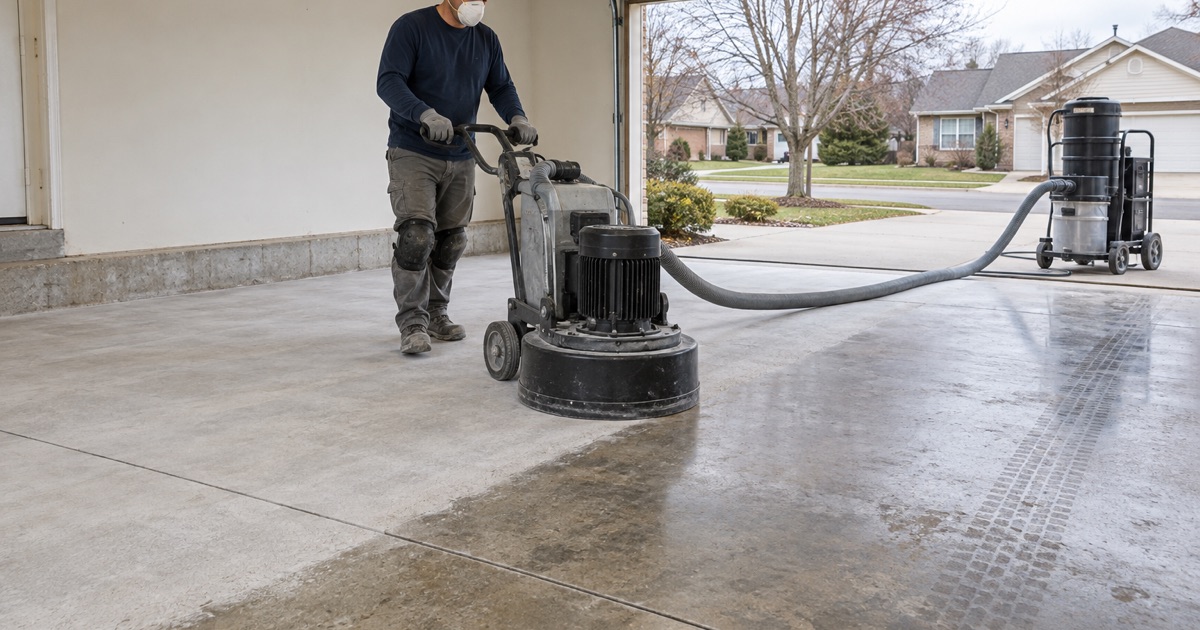
Diamond grinding uses rotating heads fitted with metal-bond diamond segments to cut the concrete surface. It is our main tool for garages, basements and interior commercial floors, because it can remove coatings and flatten high spots while leaving a controlled profile, and it works right up to walls with smaller edge grinders.
The grit and bond of the diamonds are chosen for the job. Coarse segments strip coatings and adhesives quickly, while finer ones refine the surface for thinner coatings or the first passes of a polished floor.
Shot Blasting for Large Open Floors
Shot blasting propels small steel shot at the slab and recovers it through a vacuum, removing the top layer and leaving a uniform texture. It is fast and effective on large open floors such as warehouses and retail spaces, where it can prepare a big area in a short shutdown.
Shot blasting leaves a slightly rougher profile than grinding, which suits thicker coatings and urethane cement systems. Edges and corners still need hand grinding, so most larger jobs use both methods.
Matching the ICRI Surface Profile
The International Concrete Repair Institute rates prepared concrete on a CSP scale from 1 to 10. A thin coating needs only a light profile, while a broadcast system or a thick self-leveling layer needs a rougher one for mechanical grip, so we choose tooling to land on the profile the coating manufacturer specifies.
Too smooth a profile leaves the coating little to hold onto, while too rough a profile on a thin system can telegraph scratch patterns through the finish or leave peaks poking through. Landing in the right range is what turns grinding from a noisy chore into the reason a floor holds.
Removing Old Coatings, Glue and Sealers
Failed Garage Coatings and Paint
Peeling garage coatings, kit floors and paint have to come off completely before a new system goes down, because a new coating bonded to a failing one fails along with it. We grind through those layers to bare concrete and check for areas where the old coating has stained or contaminated the slab.
The way an old coating failed tells us something too. Peeling in sheets near the door often points to poor prep or salt, while blisters in the middle of the floor usually point to moisture, so we read the failure before choosing the new system rather than repeating the same mistake.
Carpet Adhesive, Tile Thinset and Mastic
Basements and commercial spaces often have carpet glue, vinyl tile mastic or ceramic tile thinset left from older flooring. These materials gum up abrasives and need aggressive tooling, and some older black mastics may contain asbestos, so we ask about the age of the flooring and recommend testing before we grind anything suspect.
Sealers and Curing Compounds
Many new slabs are treated with curing compounds or sealers that look like bare concrete but block coatings from bonding. A simple water drop test often shows them, and grinding removes them along with the dense troweled surface so the concrete can absorb primer properly.
Oil and grease stains in garages and shops are a related problem, since they soak deep enough that grinding alone may not remove them. We degrease heavily stained areas and grind again, and where contamination remains we treat it before priming so the coating does not lift in a dark patch later.
Flattening, Repairs and Moisture
High Spots, Lips and Trip Edges
Slab sections that have heaved or settled can leave lips at joints and cracks. Grinding can take down small height differences, smoothing trip edges in a garage or store, though a slab that is still moving or badly out of level may need repair or replacement rather than grinding alone.
Opening Cracks for Repair
Cracks are opened with a crack chaser or grinder so repair material can fill them fully rather than bridging over the top. Stable cracks are filled with materials suited to the coating, while control joints in commercial floors are often filled later with a semi-rigid polyurea joint filler.
Moisture Testing After Prep
Once the surface is opened, we test the slab with ASTM F1869 calcium chloride kits or ASTM F2170 relative humidity probes. Testing after grinding gives more reliable readings, and when the numbers are high, a moisture-mitigation primer goes into the system instead of hoping the floor stays dry.
Dust Control and Clean Work
Capturing Dust at the Tool
Every grinder and shot blaster runs with a vacuum system that captures dust where it is created. That protects the crew and the occupants and keeps fine silica dust out of the rest of the house, office or store.
Keeping Residue Out of Drains
Grinding residue and slurry are vacuumed and bagged, never washed toward a floor drain, sump or storm inlet. Fine concrete dust can clog drains and carries material that does not belong in the DuPage River or the village sewer system.
Scheduling Around Occupied Buildings
Grinding is loud, so commercial prep is often scheduled overnight or on weekends where village construction hours permit. In homes we seal the work area as well as we can and plan the noisiest work during the day.
- 20+ Years of Floor Coating Work
- Moisture Testing in Every Scope
- Free Written Estimates