Plainfield Epoxy Flooring has spent more than 20 years on epoxy-flooring in Crestwood and the rest of the southwest suburbs, and this page is about one problem that rarely gets named: lawn fertilizer stored on a bare garage slab. Many bagged lawn foods carry their nitrogen as ammonium salts, and those salts are hard on concrete. A sealed, coated floor is what keeps them out of the cement paste.
The damage is slow, which is why it gets missed. A torn bag leaks granules into a corner, a pallet left in a damp spot wicks dissolved fertilizer into the surface, and a spreader filled over the floor leaves a scatter that gets swept but never washed. Years later the concrete in that corner is soft, sandy or pitted, and nobody connects it to the spring routine.
We write about it here because the habit is so ordinary. Below we cover where the product comes from, what the concrete research measured, how spills and storage do the harm, and how we build a floor for a garage that holds lawn and garden supplies. We also cover the house and condominium garages that make up most of the residential floors in the village.
Lawn Season Starts at a Garden Center on Cal Sag Road
Where the Spring Bags Come From
Menards lists its Crestwood store at 4701 W. Cal Sag Road, and its store pages name a garden center among the departments, alongside grocery, propane fueling, a rental center and truck rental. Each spring that kind of retail floor sends lawn food home by the bag, and much of it ends up on a garage floor nearby. We have no connection to the store, and we have not seen how it stocks or stores anything.
The village noted the store again this spring, when the March 31, 2026 Committee of the Whole minutes recorded a grand opening for EV stations at the Menards. That detail matters here only as a marker of how much traffic the Cal Sag corridor draws. A busy garden center close to home means bags are bought often, in quantity, and carried straight into the garage.
What the Bag Label Says
Fertilizer bags print a guaranteed analysis, and the nitrogen line often names its sources. Ammonium sulfate and ammonium nitrate are two common ones, alongside urea and slow-release forms. We do not tell anyone what to put on a lawn, because that is not our trade. We only ask what has been sitting on the floor, because the answer changes how we build it.
A homeowner who keeps a few bags a season faces a different risk than one who buys a pallet for a large yard or for several units. Both are worth knowing before a quote. Ammonium salts dissolve readily in water, so the real question is less about dry granules than about what happens when they get wet on the concrete.
Why Spring Is the Time to Look Down
Spring is when the floor shows what the last few seasons did to it. Bags come off the shelf, old pallets get moved, and the gray, crumbly patch under them finally comes into view. That is usually the moment a homeowner calls us, and the right first step is to look at the whole slab before deciding what goes on it.
Looking for epoxy-flooring closer to Northlake? See Epoxy-Flooring in Northlake.
Why Ammonium Fertilizers Are Hard on Concrete
What Ammonium Does to Cement Paste
Hardened cement paste holds calcium hydroxide, and its strength depends on that alkaline chemistry staying intact. Ammonium salts react with it, releasing ammonia and carrying calcium away in solution, which leaves the paste more porous and weaker each time the surface is wetted. The sand and stone stay in place while the binder around them thins out.
Ammonium sulfate adds a second problem, because the sulfate can form expansive compounds inside the paste. That is why concrete in fertilizer storage is studied as its own durability case rather than lumped in with ordinary wear. On a garage floor the result looks like scaling, or a surface that rubs off as grit under a stiff broom.
What a Five-Year Immersion Study Measured
The mechanism is measured, not folklore. Schneider and Chen, in a paper published by the American Concrete Institute as SP-192 in 2000, immersed ordinary and high-strength concrete in ammonium sulfate solutions of 0.1 to 5 percent and ammonium nitrate solutions of 0.1 to 10 percent. They kept the specimens in those solutions for more than five years.
Over that time they tracked strength, weight change and how deep the attacking ammonium nitrate ions penetrated. A separate durability study notes that storing chemical fertilizers in concrete buildings often causes chemical-attack problems, with certain ammonium salts the main cause. Neither study describes a Crestwood floor, and we make no claim that fertilizer has damaged any particular slab here.
Strength Lost From the Surface Down
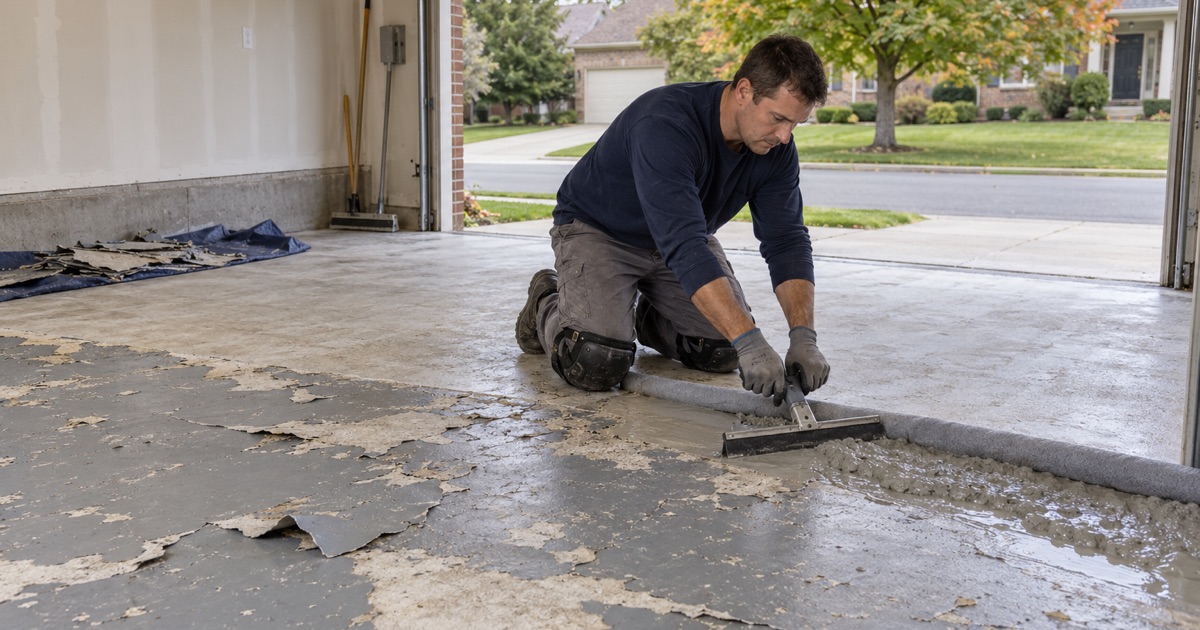
The attack works from the exposed face inward, so a garage slab loses its top layer first, and that top layer is exactly what a coating has to bond to. When we find a fertilizer patch, the softened concrete has to come off before anything goes over it. What is left underneath is usually sound once the weakened paste is gone, though a deep patch may need a repair mortar to bring it back to level.
Torn Bags, Wet Pallets and a Floor That Keeps Salts Out
Spreader Spills and Bags Left Standing
Most fertilizer contact on a garage floor comes from three habits: filling a spreader over the slab, stacking bags straight on the concrete, and leaving a torn bag in a corner. A pallet is the worst of them, because damp wood and condensation under plastic wrap hold a dissolving film against the floor. Once in solution, the salts move into bare concrete through its pores.
Spill cleanup on concrete should start dry. Sweep or vacuum the granules before any water touches them, then rinse what is left off the slab rather than letting a puddle sit. Raising stored bags onto a shelf or into a plastic bin helps a bare floor and a coated one alike, since a coating reduces what can soak in but does not make storage on the floor harmless.
Building a Sealed Surface
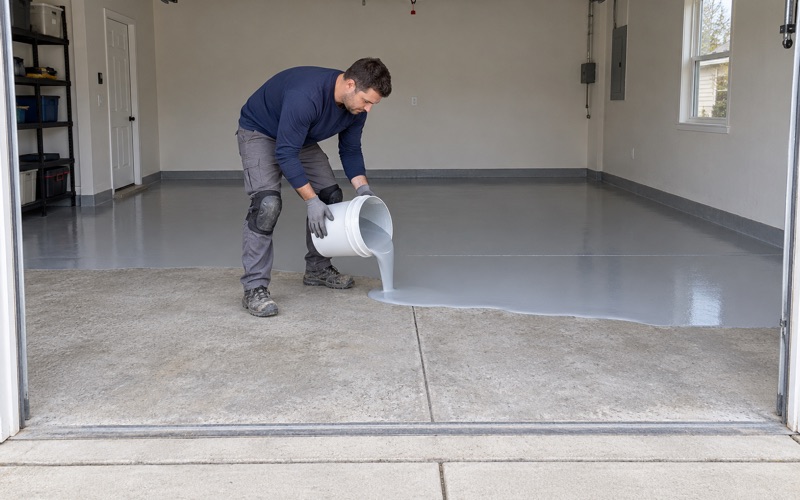
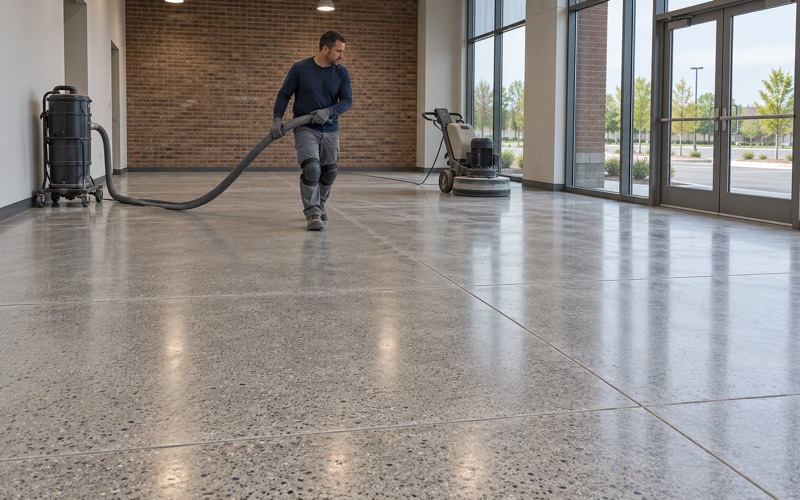
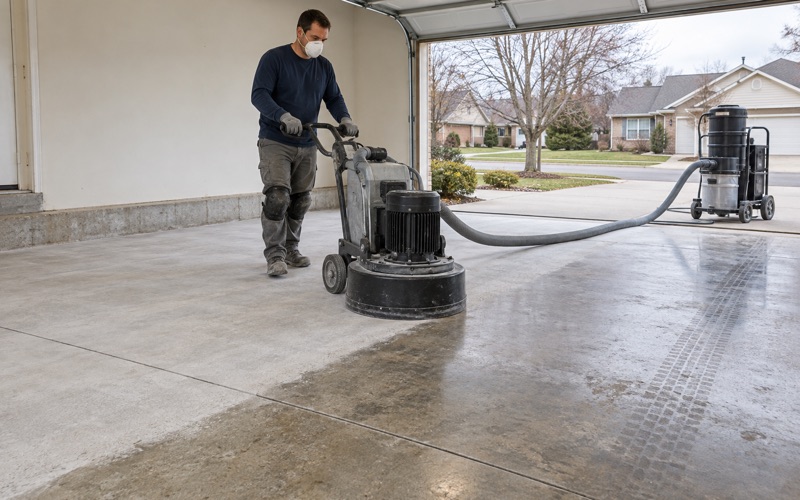
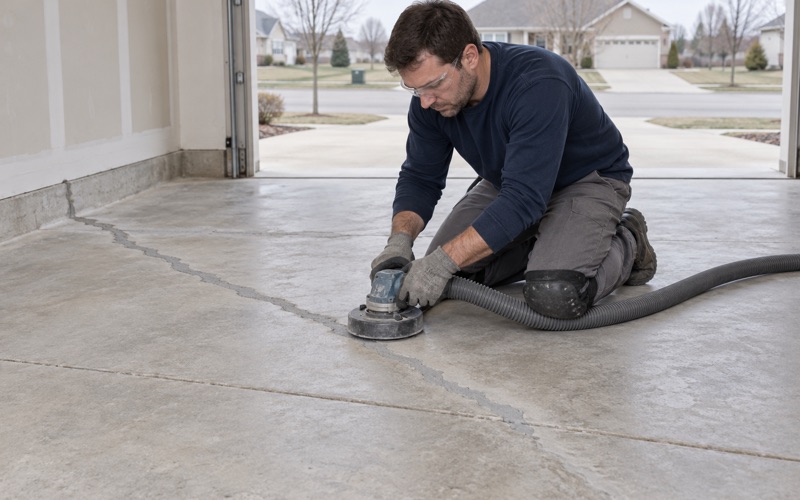
Coating starts by cutting the weakened paste off with grinding equipment until sound concrete shows, and we use no acid on a slab that has already lost paste to a chemical. The cleaned surface is profiled to an ICRI CSP range the primer can grip. Cracks and control joints get a semi-rigid polyurea joint filler so a spill cannot run down into them.
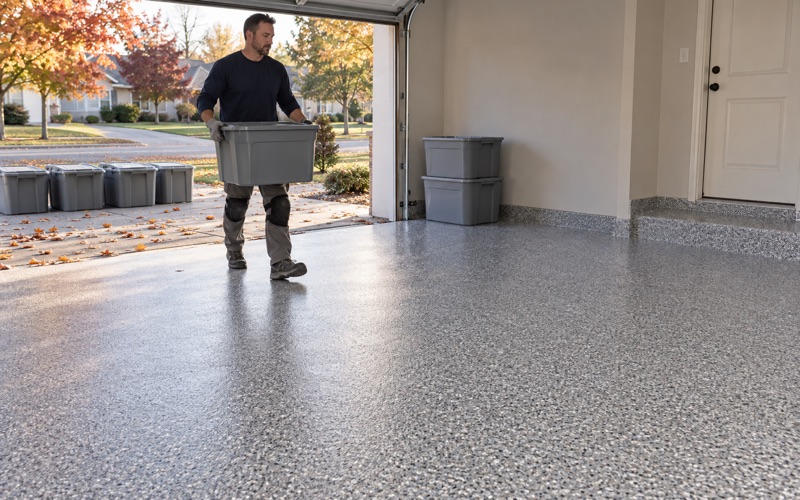
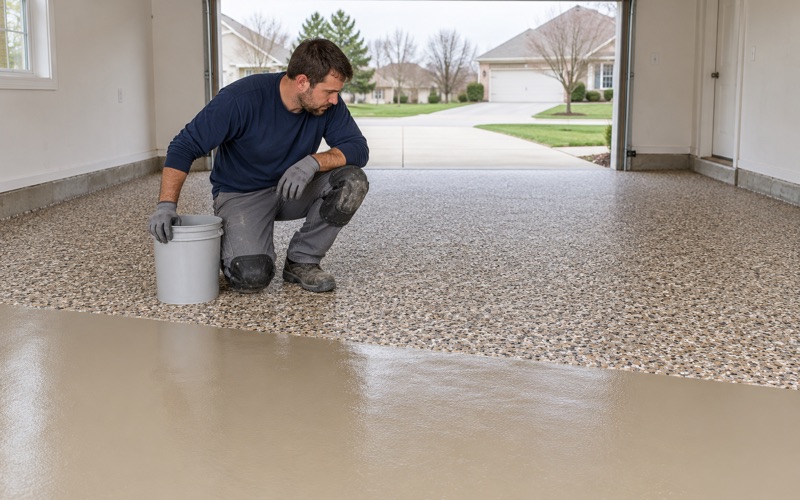
A typical storage-garage build is a 100% solids epoxy base, a vinyl flake or quartz aggregate broadcast for texture, and a polyaspartic topcoat. How well any of it resists a given fertilizer solution is a matter for that product’s data sheet, not a promise we can make for every chemical. We show the sheet for the system we propose, and a spill is still something to clean up promptly.
Moisture Under the Coating
A garage slab that wicks water from below can lift a coating just as surely as a spill can attack bare concrete. On every quote we price moisture testing as its own scope item, so the reading comes before the coating rather than after a blister. A relative humidity probe set into the slab under ASTM F2170 tells us whether a moisture-mitigation primer belongs in the build.
This matters more than usual in a fertilizer garage. Water moving up through the slab can bring dissolved salts from old spills back toward the surface, and a coating laid over that without a suitable primer is the kind of failure that shows within a year or two. We would rather add a day for testing than lose the floor.
Garage Floors in Crestwood’s 1970s Houses and Condominium Buildings
The 1970s House Garage
Crestwood is a village of about 10,800 people in Cook County, and its housing leans heavily on one decade. Census figures count 1,543 units built in the 1970s, the largest of any decade and about 30 percent of the stock, with fewer than 3 percent built since 2010. Most of the detached houses date from the 1950s through the 1970s.
A garage slab of that age has carried decades of whatever its owners stored on it. We expect stains, old paint or sealer, patched cracks and, in a house with a well-kept lawn, a soft patch where fertilizer sat. All of it shapes the quote, because the condition of that concrete decides how much grinding and repair the system needs before the first coat.
Before Work Starts in the Village
Illinois licenses no general, flooring or coatings contractor, so the local rule is the one that counts, and we confirm it before a job goes on the calendar. In Crestwood every contractor registers with the village first, at $100 for a general contractor or $25 for a sub, and files a certificate of insurance naming the Village of Crestwood as additional insured.
The Building and Zoning Department sits at 13800 South Cicero Avenue. Its permit page lists painting and carpeting as exempt but does not mention floor coatings either way, so we ask rather than assume. Some Crestwood addresses print a 60445 ZIP that Midlothian shares, so the village boundary, not the mailing code, settles which department applies.
Condominium Stalls and Association Rules
Condominiums are a large part of Crestwood’s housing, with 1,531 owner-occupied units in buildings of five to 19 units. The three-story, 12-unit building at 5009 135th Street, built in 1972 with assigned off-street parking, and the 12-unit building at 5227 James Lane from 1978 show the type well.
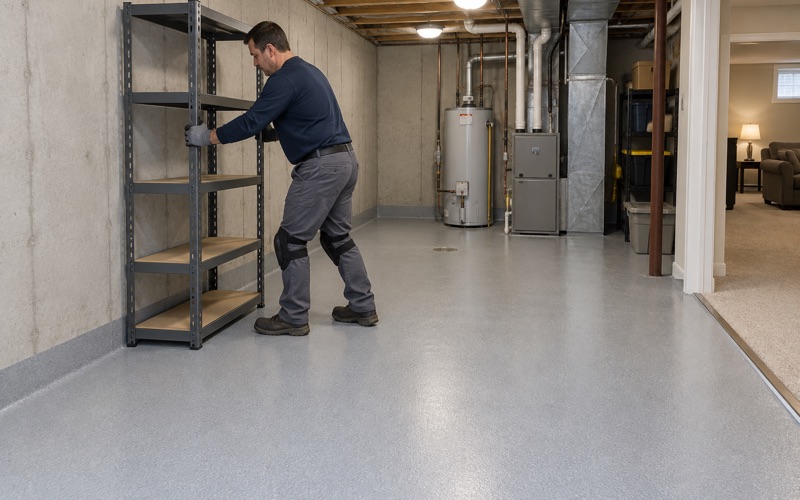
Garage stalls, parking areas and common basements in a condominium are generally association property, so the owner storing lawn and garden products is often not the person who can order a floor. The association’s rules decide that, and we price the work for whoever holds the authority. Where several owners keep lawn supplies in a shared garage, one board decision covering the space is usually simpler than stall-by-stall requests.
- 20+ Years of Floor Coating Work
- Moisture Testing in Every Scope
- Free Written Estimates