
Plainfield Epoxy Flooring installs epoxy garage floor systems in Plainfield, IL, with 20+ years of work on residential garage slabs behind every quote, serving surrounding cities including Shorewood, Minooka, North Aurora, Warrenville and Lemont. A garage floor here has to take hot tires, dripping slush, salt brine and twenty years of freeze cycles, and the coating is only one part of what makes it hold up against that.
The rest is what happens before the first coat. We grind the slab open with diamond tooling, repair the cracks and joints we mapped on the first visit, and measure the moisture coming up through the concrete before choosing a system. Then the proposal names the product, the number of coats and the finished thickness, so you can check the floor you get against the floor you were quoted.
Most garages we coat are attached two- and three-car garages on homes built since 1990, along with townhome garages and a growing number of new-construction slabs. Each one gets the same sequence of prep, test and build, whether the finish is a single solid color or a full flake broadcast with a clear topcoat.
Preparing the Slab Under an Epoxy Garage Floor
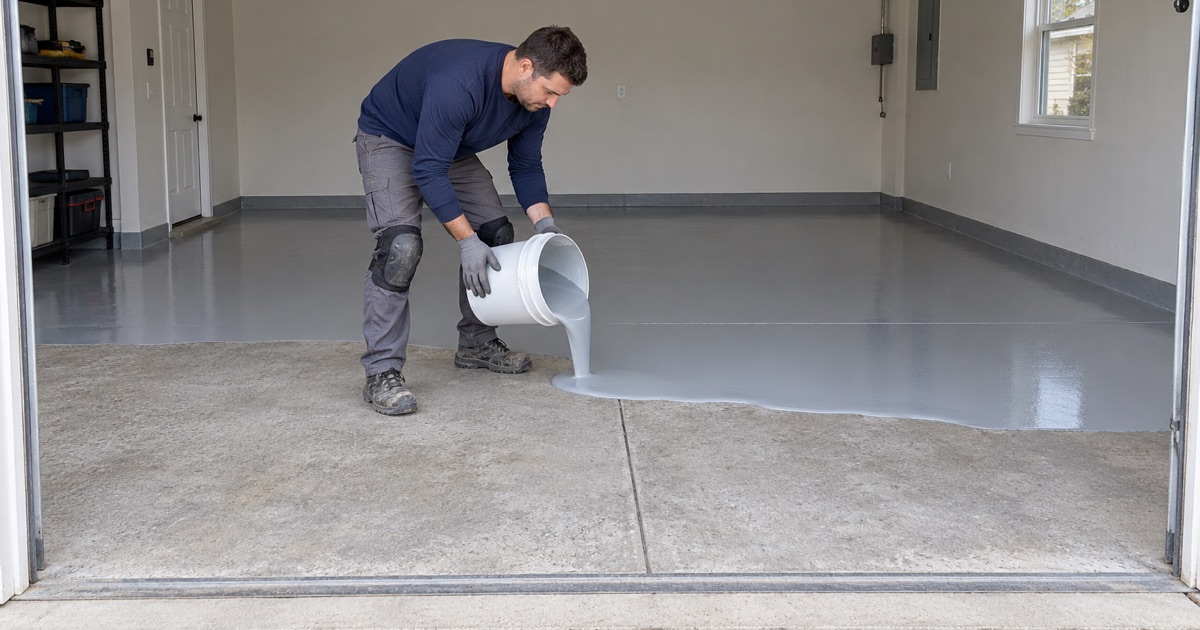
Diamond Grinding Instead of Acid Etching
A garage slab is finished with a steel trowel, which leaves a dense, smooth skin that resin cannot grip, and many older garages add a sealer or old paint on top of that. We grind the whole floor with diamond tooling to an open, porous surface profile on the ICRI CSP scale, matched to the thickness of the system going down.
We do not acid etch a garage floor. Etching leaves salts and residue in the pores, gives an uneven profile from one end of the slab to the other, and does nothing to remove sealers, which is why so many kit floors start lifting near the garage door within a year.
Crack, Joint and Spall Repair
Before grinding we walk the floor and mark every crack, chipped control joint and spalled patch near the apron where salt has eaten into the surface. Stable cracks are opened and filled with a repair material compatible with the coating, and broken joint edges are rebuilt so the finished floor stays flat across them.
Some cracks are not a coating problem at all. A section that has settled, heaved or split with one edge higher than the other tells us the slab is still moving, and we say plainly when a section needs to be cut out and replaced before an epoxy garage floor is worth installing on it.
Measuring Moisture Before Coating
Water vapor moving up through a slab builds pressure under a coating and pushes it off in blisters, and it is the most common reason a garage floor fails that looked fine on install day. We test with ASTM F1869 calcium chloride kits, which read vapor emission at the surface, or with ASTM F2170 in-situ relative humidity probes set into the slab itself.
The ASTM D4263 plastic sheet test is a quick screen we sometimes run alongside, but it only shows whether moisture is obvious, not how much is moving. When the numbers come back high, a moisture-mitigation primer goes into the system as its own layer rather than gambling that the floor will hold.
How the Coating System Is Built
A 100% Solids Epoxy Base Coat
The base of most of our garage systems is a 100% solids epoxy, which means nearly everything rolled onto the floor stays on it as film instead of evaporating away. That builds real thickness in one coat and soaks into the ground concrete, giving the layers above it a strong, continuous bond.
Retail kits are usually water-based and much thinner, which is why they wear through in the tire paths and soften under a hot tire. The difference shows up most clearly after the first winter, when a thin coating has already worn gray where the car turns in.
Flake Broadcast and Solid Color Options
A flake floor is built by throwing colored vinyl chips into the wet epoxy until the surface is covered, then scraping off the loose chips and sealing the rest under a clear topcoat. A full broadcast hides dust, small chips and tire marks well and adds texture underfoot, which is why it is the most requested garage finish we install.
A solid color coating with no chips is simpler and costs less, and it suits a workshop garage where a plain, bright floor makes it easier to find a dropped bolt. Both options get the same prep and the same topcoat choices, so the decision is about look and texture rather than durability.
Polyaspartic and Polyurea Topcoats
The clear topcoat is what the tires actually touch, so it carries most of the wear and chemical exposure. We use polyaspartic or polyurea topcoats over the epoxy base because they hold up well to abrasion, resist the yellowing that plain epoxy shows in sunlight, and keep their gloss in a garage that sits with the door open on summer afternoons.
Watching for Amine Blush
Some epoxies develop amine blush, a waxy film that forms on the surface while curing in cool, humid air. If it is coated over, the next layer can fail to bond, so we check for it between coats and clean it off when it appears, which matters most on damp spring and fall days when the garage air is close to saturation.
Plainfield Garage Conditions That Shape the Floor
A Garage Slab With No Vapor Barrier
The model residential code exempts garages from the under-slab vapor retarder rule in IRC R506.2.3, and Plainfield’s own residential amendment follows suit. It calls for a garage slab at least four inches thick with welded wire fabric, sloped toward the overhead door, while naming a 6-mil vapor barrier only for basement and crawl-space slabs.
That means a garage built to the village text may have nothing between the soil and the concrete to stop moisture. We treat every Plainfield garage as untested until the numbers say otherwise, which is exactly why moisture testing sits in the scope instead of being offered after a failure.
Gas Curbs and the Slope to the Door
Attached garages carry a curb at the walls shared with the house, and the slab slopes toward the overhead door so water runs out rather than toward the home. We coat the curb face and edges cleanly and keep the system thickness even, so a thick broadcast does not fill the slope or bury the curb line the code put there.
Road Salt, Brine and Snowmelt
Winter road treatment in Will County means calcium chloride brine and rock salt carried in under the wheel wells and dripping onto the slab as it melts. On bare concrete that salt water soaks in and breaks down the surface, which is the pitted, scaled patch most older garages show right where the car parks.
A sealed epoxy garage floor keeps the brine on the surface where it can be squeegeed out the door or mopped up. We also recommend a textured finish near the door, because a film of melting slush on a smooth coating is slippery even when the coating itself is in perfect shape.
Young Slabs and New Construction
More than half of Plainfield’s homes were built between 2000 and 2009, and the village still permits hundreds of new houses a year, so many of the slabs we see are either fifteen to twenty-five years old or brand new. An older slab brings wear and salt damage to repair, while a new one brings construction moisture and a hard troweled surface that needs time and grinding before it can take a coat.
Cost, Timing and What the Warranty Covers
Per-Square-Foot Pricing for the System Proposed
We quote an epoxy garage floor per square foot for the system we are actually proposing, not from a national price for a two-car garage. The price moves with how much crack and joint repair the slab needs, whether an old coating or sealer has to be removed, whether moisture readings call for a mitigation primer, and whether the finish is solid color or a full flake broadcast.
Scheduling Around Slab Temperature and Dew Point
Resin cures on the temperature of the slab and on how far that surface sits above the dew point, not on what month it is. A heated garage can often be coated through the winter, but an unheated garage in a deep cold stretch usually waits for spring, and we would rather move the date than install a floor that never reaches full cure.
Warranty Exclusions, Read Out Loud
Garage floor warranties almost always exclude moisture first, then slab movement, new cracks, chemical damage outside the product’s rating and impact from dropped tools or jacks. We go through those exclusions with you before the job is sold, since knowing what is not covered is the part of a warranty that actually matters.
Written Contracts for Every Home Job
The Illinois Home Repair and Remodeling Act sets rules for home repair work, including a written contract on larger jobs and the Home Repair: Know Your Consumer Rights pamphlet. Every garage floor we install gets both before any work starts, along with the proposal that spells out the system build.
- 20+ Years of Floor Coating Work
- Moisture Testing in Every Scope
- Free Written Estimates