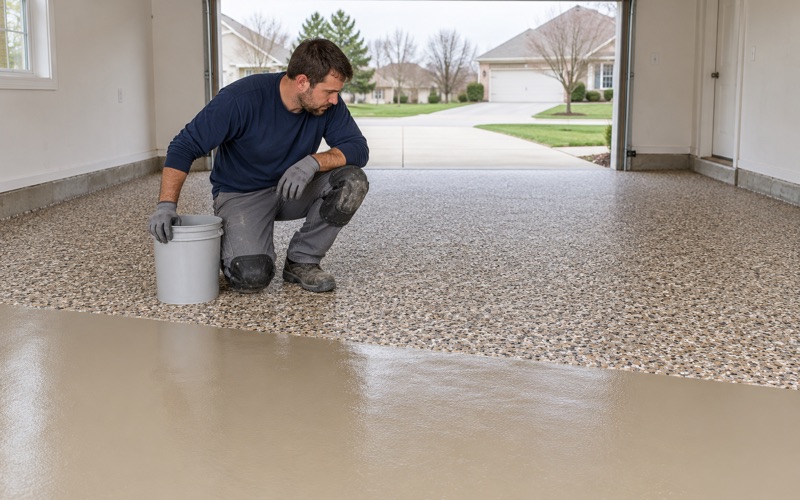
Plainfield Epoxy Flooring handles epoxy-flooring in Hickory Hills with one job especially in mind: the garage or basement floor whose old coating is coming up in sheets, and the question of what to do about it. In more than 20 years of coating concrete we have learned that a peeling floor is rarely fixed by the product that goes on next. It is fixed by what comes off first.
That matters more here than it did a year ago. Under the property maintenance code the city now carries, a flaking floor coating is not only an eyesore or a warranty argument; it reads as a surface defect the code asks an owner to repair, remove or cover. Below we explain how that wording lands on a coated concrete floor and what kind of work actually answers it.
This page is our reading of the model code text, not a statement of how the city enforces it, and we hold no code-official role of any kind. What we can offer is the floor side of the question: why coatings let go, how a failed film is taken down to sound concrete, and why recoating over loose material simply schedules the next failure.
What Hickory Hills’ 2024 Code Says About Peeling Floors
Ordinance #26-05 and the code it adopted
On March 26, 2026, the Hickory Hills City Council approved Ordinance #26-05 by roll call, amending Section 30.01 of Chapter 30, Housing and Property Maintenance, to adopt the 2024 International Property Maintenance Code. The minutes record the adoption itself. Any local amendments the city made to the model text were not something we read, so everything that follows quotes the model code as published.
Model code language is written for every kind of building, which is why it rarely names floors outright. It talks about interior surfaces, walking surfaces and flooring components, and a coated garage or basement slab falls under all three at once. That overlap is what makes the 2024 adoption relevant to anyone looking at a floor coating that has started to lift at the edges.
Peeling paint, in Section 305.3’s own words
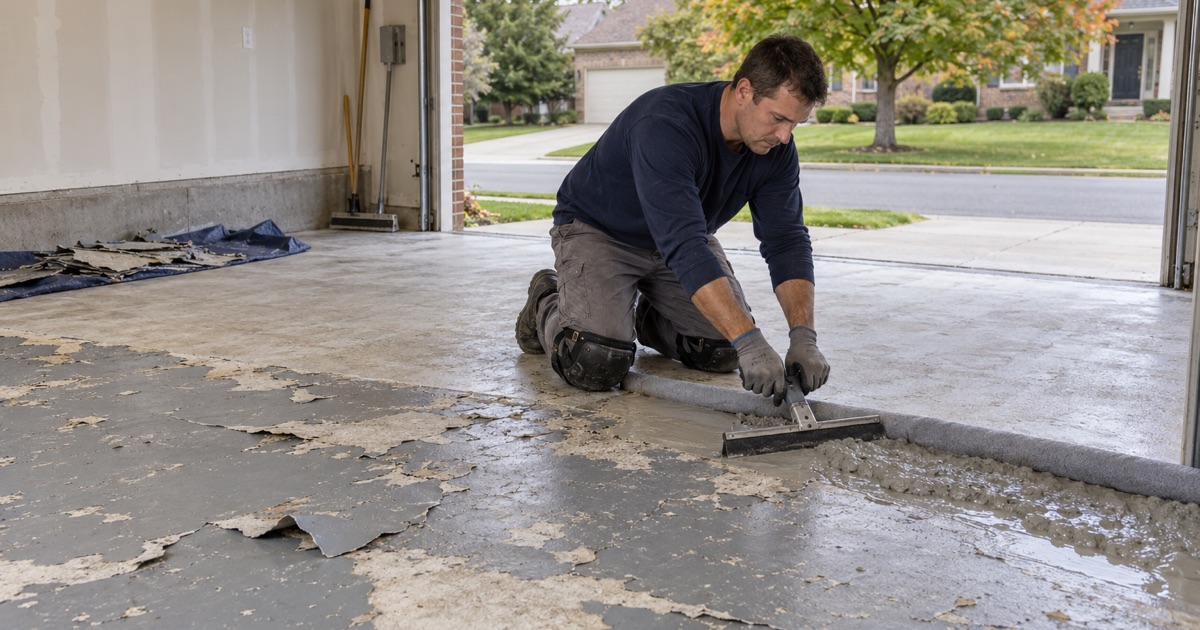
Section 305.3 asks that interior surfaces be kept in good, clean and sanitary condition, and it is blunt about coatings: peeling, chipping, flaking or abraded paint shall be repaired, removed or covered. An epoxy, a one-part garage paint or a porch enamel rolled onto concrete is a paint film in that sense. When it lets go in sheets, it is peeling paint on an interior surface.
The same section adds that cracked or loose plaster, decayed wood and other defective surface conditions shall be corrected. A floor where the film has curled away and the bare concrete underneath is dusting or spalling fits that last phrase comfortably. Read together, the two sentences point at the condition of the surface itself, not at whether the coating once looked good on the day it went down.
A lifted edge is a walking-surface defect
Section 305.4 requires every stair, ramp, landing or other walking surface to be maintained in sound condition and good repair, and Section 304.1.1 lists flooring with defects that affect serviceability among conditions that can be unsafe. A curling coating edge is a small trip lip, and in a garage it tends to sit exactly where people step out of a car carrying groceries.
That is the practical reason the walking-surface section matters on a floor. A peeling patch in a storage corner is unsightly; the same patch at the door threshold into the house, or along the path from the driver’s door, is where a heel or a wet boot catches. We treat those zones as the first priority whenever a floor cannot be redone all at once.
Looking for epoxy-flooring closer to La Grange? See Epoxy-Flooring Services in La Grange.
Owner-Occupants Are Covered, Not Only Landlords
What Section 301.2 says about owners who live there
Many people assume a property maintenance code is a rental-housing tool. Section 301.2 of the model text says otherwise: the owner of the premises shall maintain the structures in compliance, and a person shall not occupy premises as owner-occupant when they do not comply with the chapter. Landlords are covered as well, but the duty reaches the family living in its own house.
In Hickory Hills that describes most households. The Census tenure count shows 4,005 owner-occupied homes against 1,625 rented, and 3,275 of those owners live in detached houses, which usually means a private garage and often a basement slab. Those are the floors that tend to get a coating from a hardware-store kit and then get forgotten until it starts to come up.
Floors poured in the 1960s and 1970s
More than half the city’s housing units date from 1960 to 1979, the years when the population grew from 2,707 to 13,176 and Hickory Hills became a city in 1966. A slab from that boom generally predates under-slab vapor retarder practice, so ground moisture passes up through it freely and pushes on whatever film sits on top of it.
The other thing an older garage carries is history. A floor painted in the 1980s, recoated in the 2000s and patched since has several films of different chemistry bonded to each other rather than to the concrete. When the bottom layer lets go, everything above it lifts together, which is why a sheet peeling off an older garage floor can be surprisingly thick and stiff.
What we can and cannot tell you about enforcement
We have not read any Hickory Hills inspection, citation or floor, and nothing on this page is a prediction of what the city will do. Whether a peeling garage coating ever draws attention is the city’s business, not ours. What the code text does give an owner is a clear standard to measure a floor against before selling, refinancing or simply deciding whether this is the year to deal with it.
Removing the Failed Film Down to Sound Concrete
Reading the old coating before we price the job
Before a number goes on paper we walk the floor with a putty knife and tape: where the film lifts, where it holds, whether it is one coating or four, and what the cracks and control joints are doing under it. If the concrete beneath is scaling or heaved badly enough that a new coating would only frame the damage, we tell you that repair or a new slab comes first.
The pattern of the peeling tells us a lot. Film coming up in the tire lanes after a few hot summers points at hot tire pickup on a coating that was never built for it. Film blistering in the middle of the slab, away from traffic, points at moisture from below. Each cause changes the removal method and the system that should go back down afterward.
Taking the old film off mechanically
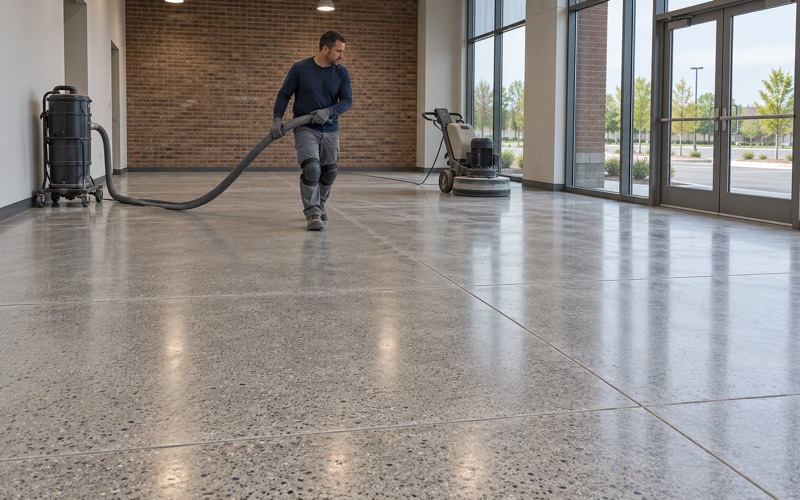
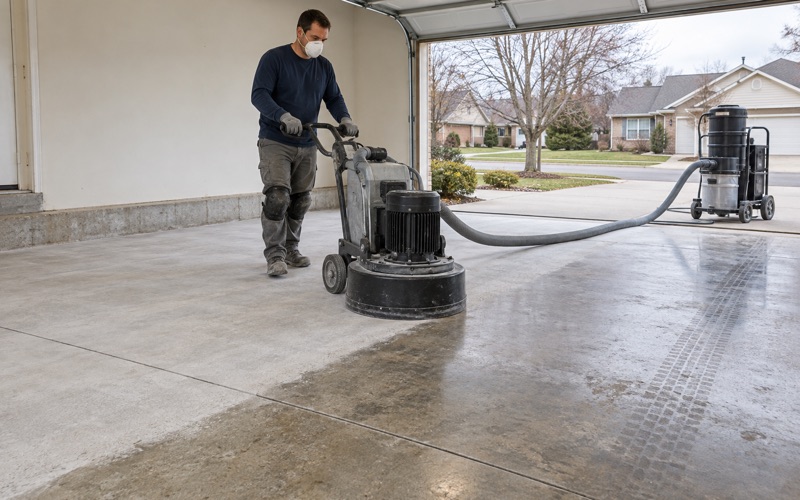
Section 305.3 offers three options, and on a peeling floor only removal holds up for long. We take the failed coating off with diamond grinding tooling, scraping first where the film is thick or rubbery, and open the concrete to a measured ICRI surface profile in the same pass. Chemical washes play no part in how we open a slab; they leave loose film behind and add water to concrete that may already be damp.
The removed material leaves with us. The city license we work under has every contractor haul its own debris, since the city’s hauler does not collect it, and we hand the owner a copy of our insurance certificate before the first grinder is switched on. The floor is vacuumed down to bare concrete, and anything that still sounds hollow under a hammer is cut out and patched.
Testing the bare slab before anything goes back on
Once the old film is gone the slab is finally readable, and moisture testing is written into our scope as its own priced step rather than an extra offered after something fails. On a slab that peeled from below, a quick ASTM D4263 plastic sheet test is only the start; the readings decide whether a moisture-mitigation primer is needed before the build coat.
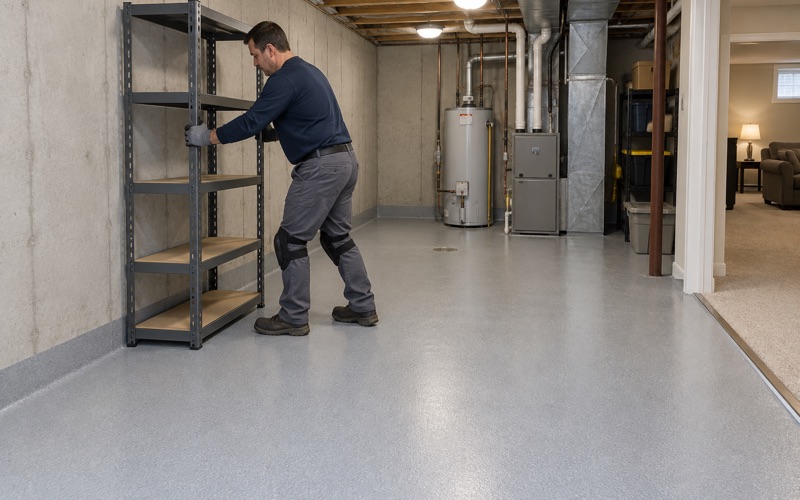
Location within the city matters here too. The city names blocks that flood repeatedly, including the Blueridge subdivision for basement flooding and the 7700 blocks of 98th Street and 96th Place for structure flooding, and a basement slab on a block like that may have been wet more than once. On those floors the test readings carry more weight than the slab’s age or appearance.
Why Another Coat Over a Loose One Fails
The new coat is only as tight as the old one
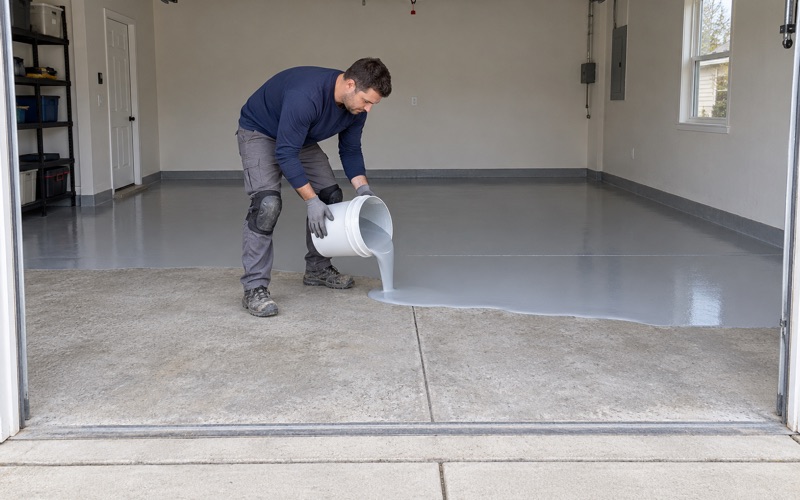
Rolling a fresh coat over a peeling floor is the repair we are asked to quote most often, and the one we decline. A new film bonds to whatever is under it. If that is a loose layer of old paint, the new coat is glued to something already letting go, and when the old layer peels it takes the new one along with it.
Covering is one of the three options Section 305.3 names, but on a floor it only works when the cover is bonded to sound concrete. A coat that buries a curling edge hides the walking-surface defect for a season and then reproduces it, usually thicker and harder to remove. Every recoat over loose material is simply one more layer to grind off later.
Stronger coatings pull harder on a weak base
A 100% solids epoxy builds a thick, rigid film, and a polyaspartic topcoat cures hard and fast. Laid over a weak old film, the stress of that cure pulls at the old layer’s grip on the concrete. A hardware-store coating that sat quietly for years can lift within weeks once something stronger goes on top, and the stronger the new system, the faster a loose base fails beneath it.
What goes back down on a prepared slab
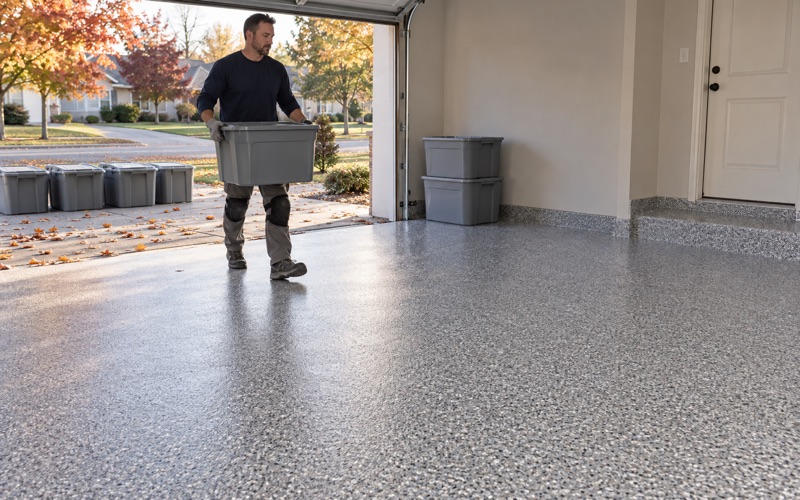
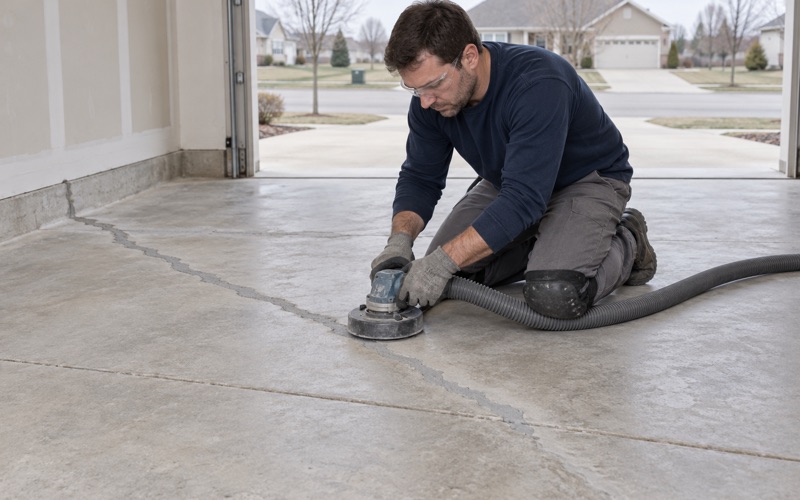
On sound, profiled concrete the choice of system is straightforward: a primer matched to the moisture readings, a 100% solids epoxy body coat, a vinyl flake or quartz aggregate broadcast for texture, and a polyaspartic or polyurea topcoat that stands up to tire heat. Cracks and joints are filled with a semi-rigid polyurea joint filler so the new film does not bridge open edges.
In a garage, the broadcast texture is what keeps the step from car to house door sure-footed when tires shed water and slush. That ties back to the walking-surface section: the point of the work is a floor that stays in sound condition and good repair, not one that looks finished the day the crew leaves and starts curling again two winters later.
- 20+ Years of Floor Coating Work
- Moisture Testing in Every Scope
- Free Written Estimates