Plainfield Epoxy Flooring brings more than 20 years of floor coating work to epoxy flooring in Hinsdale, and this page covers one narrow job: the floor under a nail-trim table. Wherever dogs and cats get their nails clipped, someone eventually cuts into the quick, reaches for a jar of clotting powder and spills some of it. What that powder does to the concrete underneath depends almost entirely on whether the floor is sealed.
Most clotting powders sold for pets are built around an iron salt, and iron salts have a long record of marking porous concrete once they get wet. A bare garage slab, a worn sealer in a mudroom, or a grooming room floor where the old coating has thinned are all open enough to take that mark. An intact resin floor gives the powder nothing to soak into.
So the work we describe here is mostly about choosing the right surface rather than chasing a stain afterward. We look at where the trimming actually happens, how the area gets cleaned, and what color will let a spill be seen before anyone mops it. The same thinking applies whether the trim table sits in a busy clinic or in a homeowner’s garage with one dog and a pair of clippers.
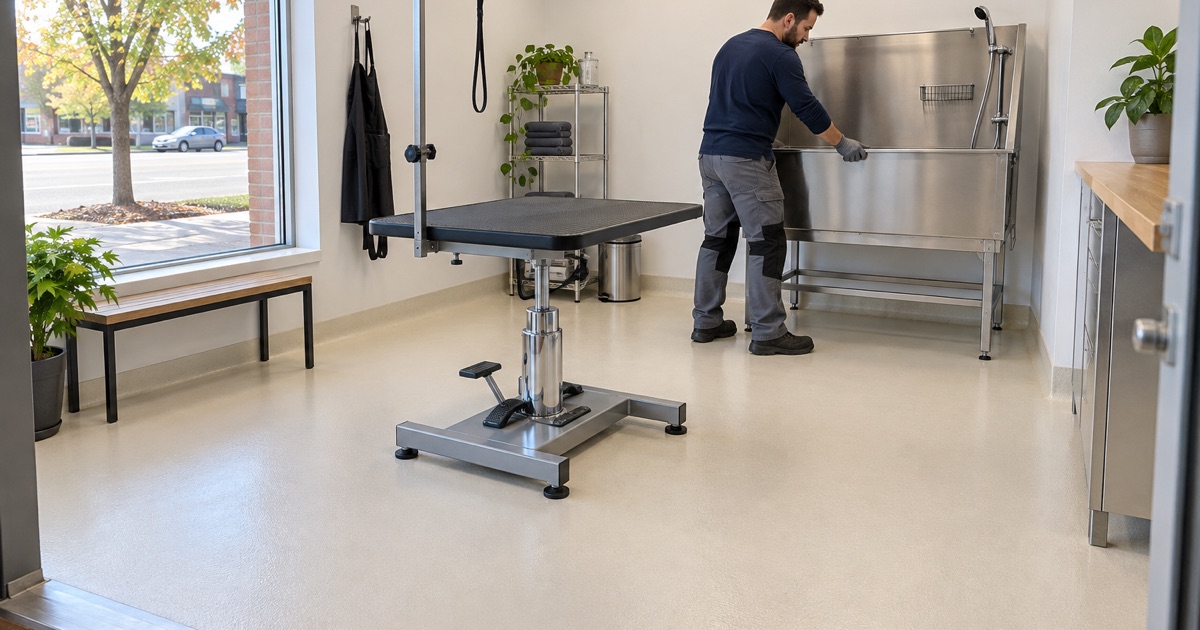
A Grooming Room on North York Road
Hinsdale Animal Hospital and its long days
Hinsdale Animal Hospital, at 724 N. York Rd in the DuPage County part of the village, keeps long hours: 7:00 a.m. to 8:00 p.m. on weekdays, 7:00 a.m. to 3:00 p.m. on Saturday and 9:00 a.m. to 1:00 p.m. on Sunday. Its grooming page lists groomers certified by the National Dog Groomers Association of America, and both dogs and cats come through.
The hospital also offers sedated grooming, supervised by its medical staff and scheduled in advance with the patient fasted. We have no relationship with the hospital and have never seen its floors or its supply shelf, and its own pages do not mention nail trims by name. We use it because it shows what a full grooming operation in Hinsdale looks like, and a room like that is where this problem lives.
Why nail trims put powder on the floor
A nail cut too short bleeds, and the usual fix is a pinch of styptic powder pressed onto the tip. The work happens fast, often with an animal that does not want to hold still, so powder lands on the table, on the paw and on the floor around the base of the table. A little each time adds up in any room that trims nails all day.
Blood comes down with it. On a sealed floor, a dropped pinch and a few drops of blood are a quick wipe. On worn or unsealed concrete, the same spill meets a surface full of tiny pores, and whatever is dissolved in it has somewhere to go. That difference, not the amount of powder, is what decides whether the floor keeps a mark.
Floor work in a building that rarely closes
A grooming area that is open seven days leaves few windows for coating. We plan that work around the hours a business has to keep running, which in a practice with a schedule like this one can mean phasing the job room by room, or using the hours after closing and the stretch between a Saturday afternoon and a Sunday morning. Each phase needs its own cure before animals and carts return.
Cure time is the constraint that shapes the schedule. A room recoated after Saturday closing has to be hard enough for foot traffic, rolling tables and animals by the time the doors open the next morning, so the system is chosen with that window in mind. Where the window is too short for a full build, the room waits for a longer break instead of reopening on soft resin.
Looking for epoxy-flooring closer to Mokena? See Epoxy-Flooring in Mokena.
What Is Actually in a Jar of Styptic Powder
Ferric subsulfate makes up half the formula
One common product, ARC Styptic Powder, lists its makeup on a 2015 safety data sheet: ferric subsulfate at 50 percent, aluminum chloride at 15 percent, ammonium chloride at 4 percent and benzocaine at 0.5 percent. The sheet gives its use as stopping bleeding from clipped nails, docked tails, trimmed beaks and minor cuts on dogs, cats and birds.
Retail listings for the Kwik Stop brand describe a similar ferric subsulfate formula, so this is not one maker’s quirk. Ferric subsulfate is an iron salt, and it is the ingredient that matters for a floor. The aluminum and ammonium salts and the small dose of numbing agent are there for the animal; the iron is what a porous slab is likely to remember.
A yellow-brown powder that partly dissolves
The same sheet describes the powder as yellow/brown and partly soluble in water. That pairing is the floor problem in a sentence. Dry, it sits on top of the surface and can be picked up. Wet, part of it goes into solution, and a solution can wick into any surface that has open pores, hairline cracks or a coating worn through along the traffic path.
Blood makes the mix harder to ignore. A trim spill is rarely powder alone; it is powder, a few drops of blood and often water from a wiped paw. Each of those keeps the iron salt wet longer, and wet is the condition the iron-stain warning below turns on. On a sealed floor that hardly matters, but on open concrete it is the whole story.
What the safety sheet does and does not say
The safety data sheet says nothing about staining floors, and we will not claim it does. What it does address is spill handling, which we come back to below. The staining concern comes from a different label for a different iron salt, and we treat it as a reasoned inference about porous concrete rather than a tested property of any styptic product.
That distinction shapes how we talk with a groomer or a clinic manager. We do not promise that a new floor will erase marks already in the concrete, and we do not call a product harmful to floors when no maker says so. We say that an iron salt, plus water, plus porous concrete is a familiar recipe for discoloration, and a sealed surface takes one ingredient away.
Why Iron Leaves a Rust-Colored Mark, and Why Pickup Stays Dry
What a fertilizer label says about concrete
Brandt Consolidated of Springfield, Illinois, sells a fine granular ferrous sulfate for lawns at 30 percent iron. Its label warns that the product will stain porous surfaces including concrete, wood and metal when exposed to free moisture such as water, and tells users to avoid contact. A Colorado State University Extension answer calls iron stains on concrete from iron fertilizer a common problem.
Anyone who has seen rust-colored freckles on a driveway after a lawn treatment has seen the mechanism. Ferrous sulfate is not the same compound as ferric subsulfate, and nobody has tested a groomer’s powder on a Hinsdale slab. Both are iron salts, though, both dissolve, and porous concrete has no way to tell them apart, which is why we plan trim areas as if the risk is real.
Why the surface decides the outcome
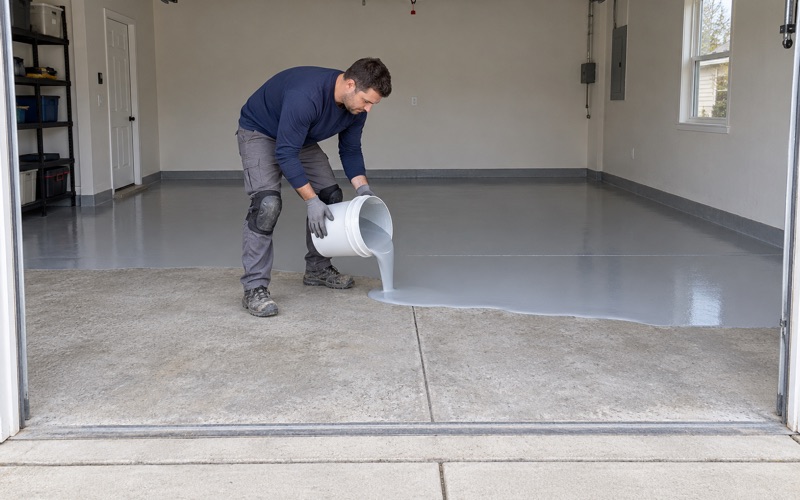
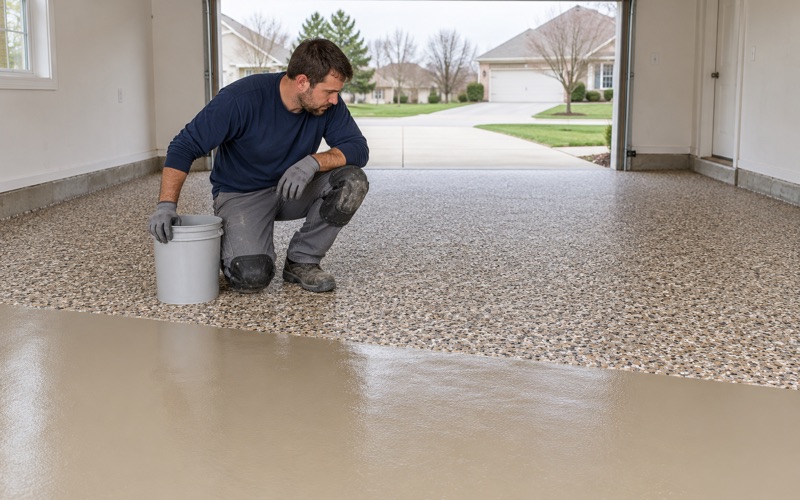
The stain is not a coating failure; it is what happens when color gets below the face of the concrete. Bare concrete, a thin paint that has worn away, or a sealer past its life all leave a path in. A continuous film of 100% solids epoxy under a dense topcoat leaves no path, so the iron stays on top where a cloth can reach it.
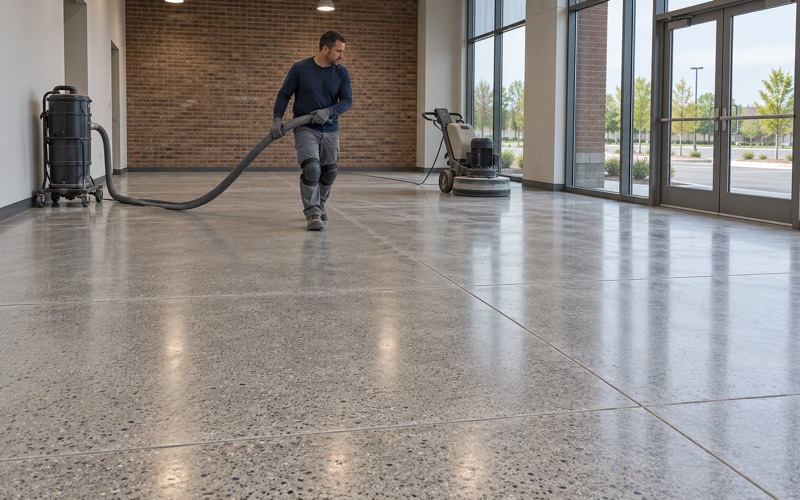
That only holds if the resin is bonded to sound concrete. Our crews profile every slab mechanically to a CSP range on the ICRI scale that the primer can grip, and acid has no place in our preparation. A coating peeling at the edges or lifting near the table legs lets spills creep underneath, and an iron mark sealed under a clear film cannot be cleaned at all.
Do not flush it into the sanitary sewer
The ARC sheet’s accidental-release section is direct: avoid dust formation, contain and collect spillage with non-combustible absorbent material, and do not flush into surface water or the sanitary sewer system. That instruction lines up with what a floor needs anyway. Sweeping or vacuuming the powder up dry keeps it from dissolving, and dissolving is the step that turns a dropped pinch into a mark.
So a trim area is best cleaned with a dry pass first, using an absorbent, a dustpan or a dedicated vacuum, then a damp wipe for the residue and any blood. Reaching for a mop bucket first spreads a solution across the floor. A seamless floor with no grout lines or open joints in the trim zone makes that dry pass quick and complete.
Sealed, Light-Colored Floors for Trim Tables, at the Clinic and at Home
A light, solid-color topcoat that shows the powder
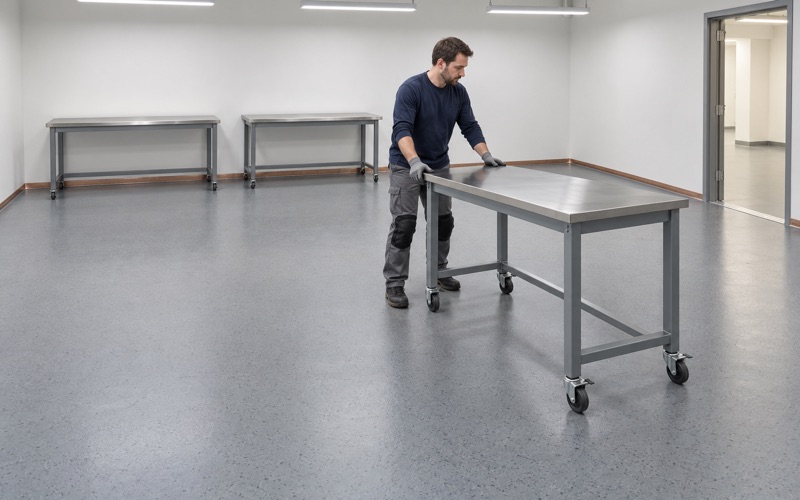
Flake broadcasts and dark speckled finishes hide dirt, which is exactly the wrong trait under a trim table. Yellow-brown powder vanishes against a tan flake. A light, solid-color topcoat in pale gray or a similar shade shows every pinch and every drop, so it gets picked up while it is still dry. We often keep a broadcast finish in the rest of the room and switch to solid color at the grooming station.
The topcoat matters as much as the color. Polyaspartic and polyurea topcoats hold up well under repeated wiping and resist the scuffing a rolling table or stool leaves behind. Even so, no coating is stain-proof; a spill left wet for days on any floor can leave a trace, which is why the cleaning habit and the surface are planned together.
Home grooming in garages and mudrooms
Owners who trim their own dogs usually do it in the garage or the mudroom, where a slip of the clippers does not land on a rug. Hinsdale has 5,087 single-family detached houses, and the garage slab in one of them is commonly bare or carries an aging sealer. A bare slab is the most porous surface in the house, and it is also where tracked-in water sits longest.
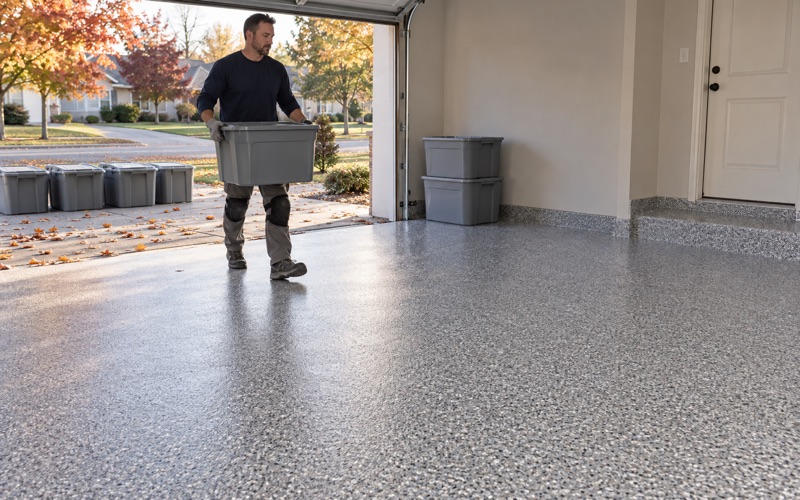
For a garage, we build a full system with a broadcast where the cars park and a solid-color patch where the grooming table stands, so the two uses do not fight each other. A mudroom gets the same sealed, light finish, coved a short way up the wall so powder swept into a corner does not lodge in a gap at the base.
Testing before any resin goes down
Whether the slab is in a grooming room or a garage, we test it for moisture as part of the quoted scope, not as an afterthought once a floor has blistered. Garages are exempt from the under-slab vapor retarder rule under IRC R506.2.3, so a garage slab often has nothing beneath it to slow moisture, and vapor pushing up from below will lift a coating however well it was chosen for powder and blood.
If the test reads high, the answer is a moisture-mitigation primer under the system or a plan to wait, and we tell you which before the job is scheduled. The finished floor should give a groomer, or a homeowner with clippers, a surface where a spill is seen, swept up dry and gone, with nothing left in the concrete to turn rust-colored later.
- 20+ Years of Floor Coating Work
- Moisture Testing in Every Scope
- Free Written Estimates