Plainfield Epoxy Flooring has spent more than 20 years on epoxy-flooring in Justice and the rest of our service area, and the basement jobs we quote now carry a question that did not exist a few years ago. What is the furnace and air conditioner beside this floor running on, and when was it installed? The answer changes which products we bring, how we ventilate and who we call before we start.
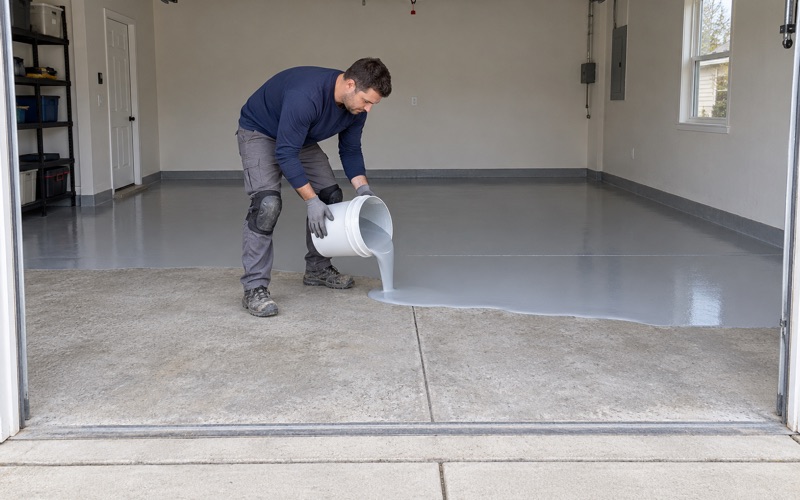
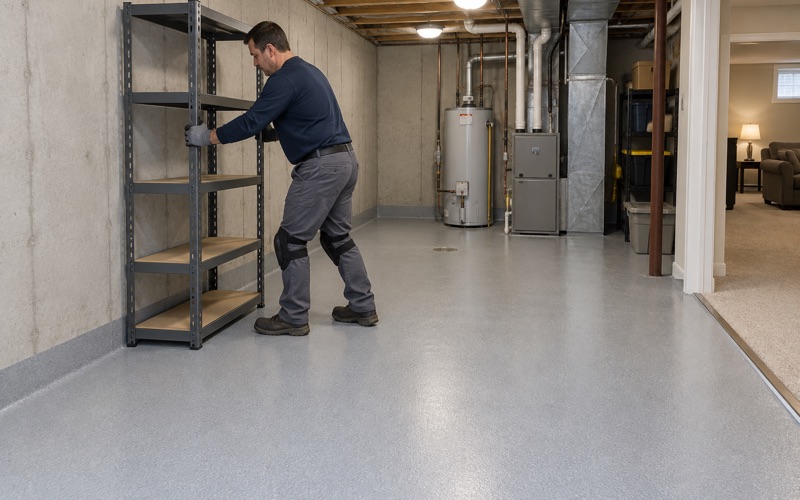
A utility room floor used to be a simple job. Move the boxes, grind the slab, coat up to the base of the furnace and leave. Newer cooling equipment has changed that, because the refrigerant inside it and the small electronic part watching for leaks both deserve respect from anyone working with resin a few feet away.
This page explains what changed, where the sensor sits, how we pick and apply coatings around it, and how the work is split between our crew and the heating and cooling contractor who owns the equipment. None of it makes a basement floor harder to get. It just means the plan is written for the room as it is today.
What changed in Justice furnace rooms on January 1, 2025
The federal line at a GWP of 700
Federal rules under 40 CFR 84.54 took effect on January 1, 2025. From that date nobody may install a residential or light commercial air conditioner or heat pump system that uses a refrigerant with a global warming potential of 700 or greater. Manufacturers and importers face the same cutoff for self-contained products, so the change reaches the equipment itself, not only the installer.
The rule carries one narrow allowance: systems whose specified components were all made or imported before that date may still be installed for a period. For a homeowner the practical effect is simple. A replacement system going into a basement today is more and more likely to be built around one of the newer, lower-GWP refrigerants.
What R-454B brings into a basement
One of those replacements is R-454B, which belongs to the A2L class of refrigerants. A2L means mildly flammable, which is why the equipment around it is built and installed with ignition sources in mind. Lennox installation literature for its air handlers also warns that refrigerants may not carry an odor, so a leak cannot be counted on to announce itself by smell.
Because of that, equipment built for R-454B comes with a refrigerant detection sensor. The sensor is the reason a floor job beside a newer furnace and coil is worth planning differently, even though nothing about the concrete itself has changed.
Heating and cooling work along Archer Road
Justice has its own heating and cooling trade. Climate Change, Inc., at 7550 S. Archer Road, is on the village business list for furnace and air conditioning installation and repair and says it has been at it for over 20 years. Regan Heating on 86th Court and Ajax Heating and Air Conditioning on 88th Avenue are also listed in the village.
We have no relationship with any of those firms and mention them only because they are the kind of contractor whose equipment we now work beside. Whoever installed your system is the person we want to hear from about it, and we would rather ask than guess.
Looking for epoxy-flooring closer to Palos Heights? See Epoxy-Flooring in Palos Heights.
The sensor at the bottom of the air handler
Where the detector actually sits
In one Lennox replacement-part document for an R-454B air handler, the refrigerant detection sensor assembly sits at the bottom channel of an upflow unit. That placement puts the sensor closer to the floor than most of the cabinet, which is exactly the zone our grinders, rollers and squeegees work in.
Other makers place and package their sensors in their own ways, and we do not assume one layout fits every brand. Before quoting, we look at the unit, read its label and ask the homeowner or the installer where the detector is. Knowing that one location shapes the whole sequence of the job.
Powered except for service
The same Lennox document puts it plainly: a refrigerant detection system is installed, and the unit must be powered except for service. A sensor without power is not watching anything. We treat that sentence as a rule for our crew, not as a suggestion to work around when it is inconvenient.
We never unplug the unit, switch off its circuit, bag the sensor or tape over it to get through a coat. If a disconnect is ever needed, that is a service call, and the heating and cooling contractor makes it. We hold no HVAC or refrigerant license of any kind, and we do not touch the equipment.
Vapor and leak detectors: what is known
Fujitsu, writing about a different product, its R32 floor-type indoor units sold in Australia and New Zealand, says hair spray, insecticide and similar vapors may cause false detection, and that units should not be energized right after solvent, paint or spray was used nearby. Its advice is to let the material cure and ventilate the area thoroughly first.
We found no US maker document saying floor-coating vapor sets off a particular American furnace sensor, and we will not claim it does. What the Fujitsu note shows is that gas sensors can respond to vapors they were not built to watch for. That is reason enough to keep solvent out of the room.
Low-odor coatings and clean air while the floor cures
Choosing a system that keeps solvent out of the air
Beside newer heating and cooling equipment we lean toward low-odor, water-based epoxy primers and 100% solids epoxy body coats, which carry little or no solvent to evaporate. Solvent-borne primers and some fast topcoats with a strong odor stay on the truck for these rooms. Where a project calls for a polyaspartic topcoat, we choose a low-odor version and confirm it suits the slab first.
The point is not to promise that any product is invisible to every sensor. It is to keep the room’s air as clean as a resin floor allows, so the detector is watching for refrigerant rather than for our materials. A smaller vapor load also makes the house easier to live in while the floor cures.
Moving air without moving the equipment
A basement in Justice usually has a window well, a stairwell and perhaps a door to the yard. We set up fans that pull air out of the room through those openings rather than blowing across the cabinet. Supply and return registers stay as the heating and cooling contractor set them, because rearranging ductwork is not our work and changes how the system breathes.
Cleaning products follow the same logic. We wipe tools with water where the product allows and keep any solvent rags sealed and out of the room. Mixing happens upstairs or outdoors, never at the foot of the air handler, so the strongest smell of the day stays away from the sensor.
No ignition sources, in the maker’s own words
Lennox also says that the appliance shall be stored in a room without continuously operating ignition sources, naming open flames, an operating gas appliance and an operating electric heater as examples. That warning is the maker’s rule for the equipment, and we follow its spirit on the job site rather than arguing for exceptions.
In practice our crew brings no torch, open-flame tool or portable heater into a room with an A2L system. Whether the existing furnace keeps running during our work is a question for the homeowner and the heating contractor, not for us to settle by shutting anything off.
Who does what: the floor crew and the HVAC contractor
A call before the grinder starts
When a furnace room holds a system installed since January 1, 2025, we ask the homeowner to let the installer know the floor is being done. Some contractors have nothing to add, while others want to note the dates or check the sensor afterward. Either way, they know their equipment and we know the slab, so a five-minute conversation saves guesswork on both sides.
We also leave a clear working margin around the unit’s base. The coating stops short of the cabinet rather than being worked underneath it, because lifting or shifting an air handler to coat beneath it is equipment work. A neat, straight edge at the equipment pad looks better than a floor forced under a machine anyway.
Testing the slab and the water before the coating
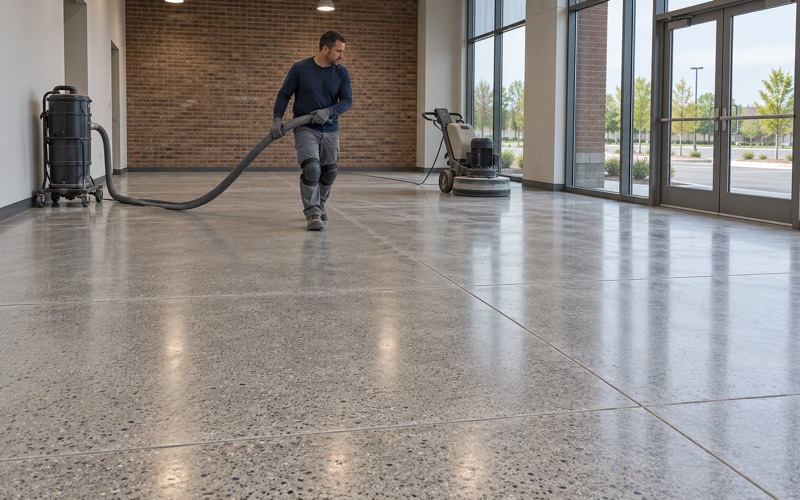
A furnace room floor is still a basement floor, and moisture comes before anything else. We write moisture testing into the scope as its own item, whether the slab is in a house basement or a commercial building, so a reading that calls for a moisture-mitigation primer is known before the first coat rather than discovered after a blister appears.
If the room shows signs of water, we start by finding where it comes from: a sump pit, drain tile, a crack or a window well. A coating does not waterproof a basement, and we tell homeowners that early. Justice names its own flood-prone streets, and a floor near one of those is worth an honest conversation first.
Registration with the Village of Justice
Illinois issues no state license for flooring or coatings work, so the credential that counts here is local. The Village of Justice Building Department, at 8748 W. 82nd Place, runs a Contractor’s Work Permit Program that requires every contractor to be insured, licensed and registered with the village before working there.
Contractors working under a permit must also be bonded, and no building permit issues until all of them are. The permit bond for contractors other than sewer contractors is $10,000, on a licensing year from February 1 to January 31. We confirm that standing with the village before a Justice job goes on the schedule, so the paperwork never holds up the floor.
- 20+ Years of Floor Coating Work
- Moisture Testing in Every Scope
- Free Written Estimates