Plainfield Epoxy Flooring brings 20+ years of slab work to epoxy-flooring in La Grange Park, and the pre-sale job is the one we scope most carefully. A basement or garage floor coated a few weeks before a listing will be walked by buyers, examined by their inspector and set beside the seller’s disclosure report, so the coating has to be described for exactly what it is.
That description is simple to state and easy to blur. A resin floor changes how concrete looks and how it cleans. It does not change what a seller knows about the house, it does not correct a leak, and it does not repair a crack in a foundation. Everything we write into a pre-sale quote starts from those three limits.
We are floor contractors, not advisers on the form. How a seller answers any question on it is for the seller’s attorney or agent to decide, and we do not weigh in. What we can do is leave a clear written record of the slab’s condition before work, a scope that separates finish from repair, and a floor that tells the truth about what lies underneath.
Selling a La Grange Park House: What the Disclosure Report Asks
Leakage, Cracks and Floors on One Form
The form Illinois home sellers fill out is the Residential Real Property Disclosure Report under 765 ILCS 77/35, reproduced by Illinois REALTORS as Form 108 (08/2023). Three of its statements sit squarely on our work: item 3 on flooding or recurring leakage in the crawl space or basement, item 5 on material defects in the basement or foundation, cracks and bulges included, and item 7 on defects in the floors.
The form defines a material defect as a condition that would substantially harm the property’s value or significantly impair the health or safety of future occupants, and a yes or not-applicable answer must be explained. Whether a given crack meets that definition is not our call. We describe what is on a slab in physical terms, such as width, length and displacement, and leave the labels to others.
Knowledge, Not Appearance
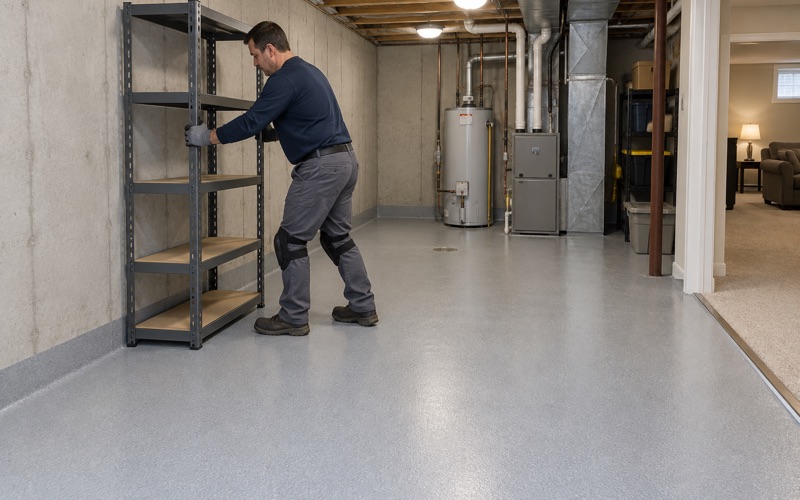
On the report, aware means actual notice or actual knowledge without any specific investigation or inquiry. The questions are measured by what the seller knows, not by what the floor looks like on a showing day. A basement that took water two springs ago is the same basement after a gray flake floor goes down, and the seller’s memory of that water has not moved.
The form also carries a warning in capitals: the fact that a seller is not aware of a condition is no guarantee it does not exist. A buyer’s inspector has every reason to read a basement with that in mind. A coated floor that shows its cracks honestly, with filled joints and a documented history, reads very differently from a fresh surface with nothing on file about what came before.
Corrected Problems and Updates Before Closing
The disclosures exclude previous problems only where the seller reasonably believes they have been corrected. A new coating is not evidence that anything was corrected; it is a finish laid over whatever the slab already had. If a crack was routed and filled or a drain line was fixed, that work stands on its own record, separate from the floor color chosen afterward.
Section 30 also gives the seller a continuing obligation to supplement the report before closing. That matters for timing. A floor that blisters, or a crack that telegraphs through the topcoat, between listing and closing would surface at the worst possible moment, so we would rather find moisture and movement before the coating than have the floor reveal them mid-sale.
Looking for epoxy-flooring closer to Westchester? See Westchester Epoxy-Flooring.
A Coating Is a Finish, Not a Correction
Cracks Stay Cracks Under Resin
La Grange Park’s housing stock makes this question a likely one. Of 5,629 housing units, 2,547 were built in the 1950s, and 72.2 percent of occupied homes are owner-occupied, so a sale here often involves a seventy-year-old slab and a long-time owner who knows its history. Concrete that age has often cracked somewhere, at a joint, a corner or around the floor drain.
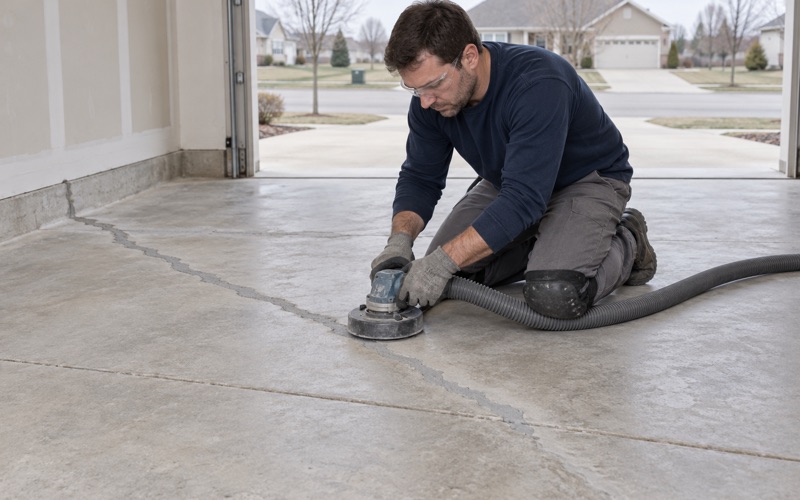
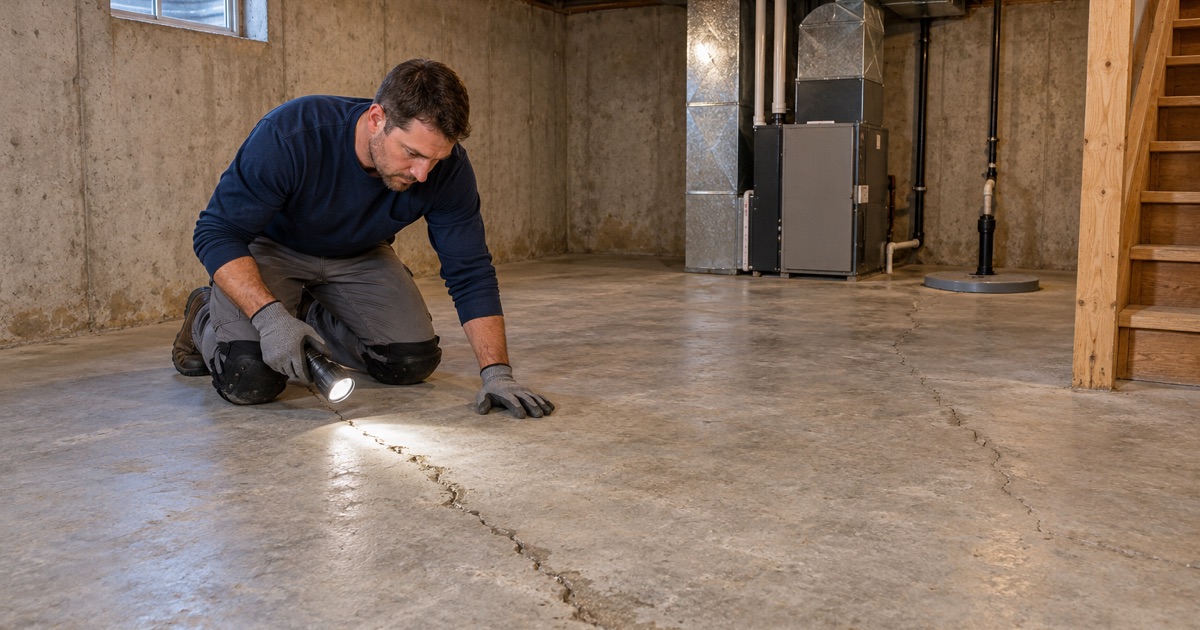
A crack that is still moving will move through any rigid coating laid over it and reappear as a line in the topcoat. A dormant crack can be routed and filled with a semi-rigid polyurea joint filler, but filling it is a repair step written on its own line, not something the coating quietly does on the way down. Displacement or bulging belongs with a structural engineer before it comes to us.
Basement Water Starts at Its Source
Before we price a basement, we want to know how water has reached it, because a resin floor does nothing to stop water. In La Grange Park that question has a local shape: the village’s own 2019 hazard annex says its sewer system is 90 percent combined, surcharges in heavy short-duration rain, and hits the low-lying Homestead and Monroe area hardest.
Backup through a floor drain, seepage at the cove where wall meets floor, hydrostatic pressure pushing up through the slab and condensation on cold concrete each call for a different answer. When Salt Creek runs high along the village’s north and west edges, the annex notes residents’ concern for homes on Edgewood and Brainard Avenues. A coating comes after the water question is answered, never in place of it.
When Plumbing Work Will Cut the Slab
The village runs a Sewer Backup Prevention Program that reimburses half of eligible costs, up to $3,000 for a backflow valve or $5,000 for an overhead sewer, and it counts trenching and concrete floor replacement tied to that work as eligible. For a seller weighing both projects, the order matters, because a basement floor coated first may be cut open by the plumbing job that follows.
Eligibility also hinges on disconnecting any downspout or sump pump from the combined sewer. When a trench has been patched with new concrete, that patch needs its own cure time before it accepts a coating, and the seam between old and new slab is a joint we detail rather than bridge blindly. Plumbing, then concrete, then finish keeps each job visible on paper.
Documenting the Slab Before Anything Goes Down
A Crack Map With Dates and Photos
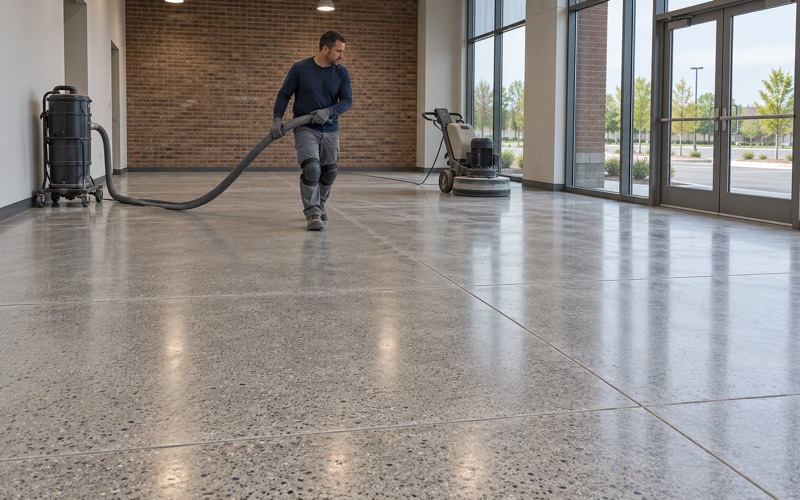
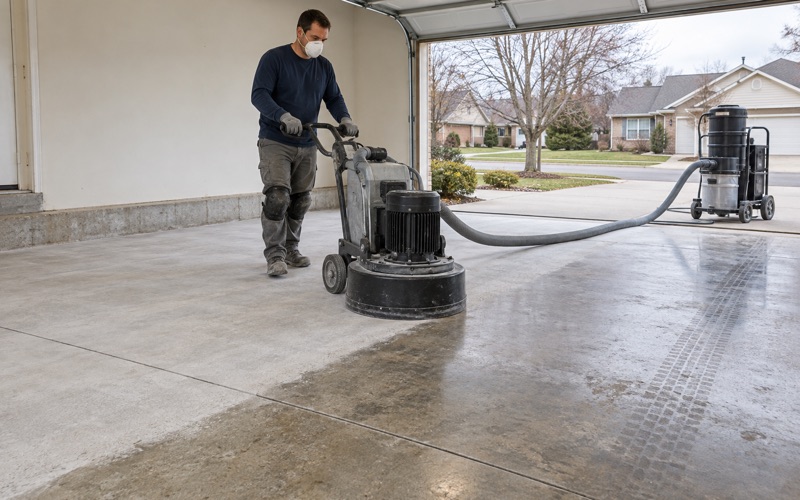
Before any grinding starts, we walk the floor and record every crack, joint, spall and patch on a simple plan of the room, with photographs and a tape measure in each shot. Widths, lengths and any edge that sits higher than its neighbor go on the sheet. That record belongs to the homeowner, and it shows what was there before the coating.
Where the reading tells us a slab is not a candidate for coating yet, because a crack is active, a section has settled or old patches are failing, we put that in writing before quoting any finish. A seller may decide to repair, to leave the floor bare, or to coat later. Each choice is theirs, and none of them depends on a floor that looks better than it is.
Moisture Readings Priced Into the Job
Moisture testing sits in our scope as its own priced line, on a basement or a garage, rather than as an upsell after a floor fails. On a pre-sale basement it is also documentation. We start with an ASTM D4263 plastic sheet taped to the slab as a quick screen, then take quantitative readings where the sheet or the room suggests vapor is moving.
Readings go into the same file as the crack map, dated and located. A slab reading high may still take a coating over a moisture-mitigation primer, but that is a system choice with its own cost and limits, which we explain before the seller commits. A reading that points to liquid water rather than vapor sends the conversation back to the source.
Efflorescence, Old Paint and Other Clues
A slab keeps its own history. White efflorescence along a wall line, a tide mark on the base of the stairs, rust at the floor drain grate and old basement paint lifting in sheets all say something about water, and grinding removes most of that evidence from view. We photograph and note each one before preparation takes the surface away.
Removing the evidence is not the same as removing the cause. That is why the notes travel with the job rather than staying in our truck: a seller, an agent or an attorney may want to know what the floor showed before it was coated, and the honest answer should be on paper rather than in anyone’s memory months later.
Scoping a Pre-Sale Floor Job Honestly
Cracks, Water and Coating as Three Jobs
A pre-sale quote from us separates three kinds of work. Crack and joint repair is one line, with the method and filler named. Anything to do with water, from a drain line to a sump pit or perimeter drain tile, is another trade’s line, and we say so. The coating is the third line, described as a finish and nothing more.
Keeping them apart protects the seller and the next owner alike. A seller can see which items are cosmetic and which touch the house’s condition, and a buyer’s inspector reading the paperwork later finds the same separation. Bundling all three into one price called basement floor would blur exactly the distinction the disclosure report draws, so we never write it that way.
How the Finish Itself Is Described
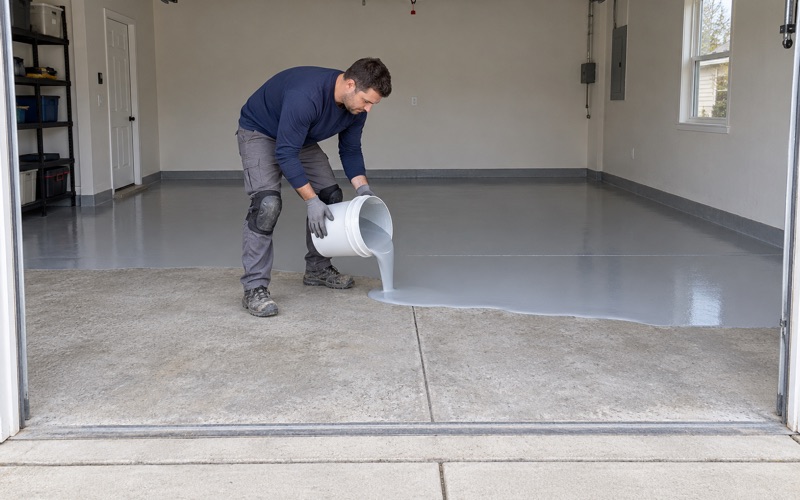
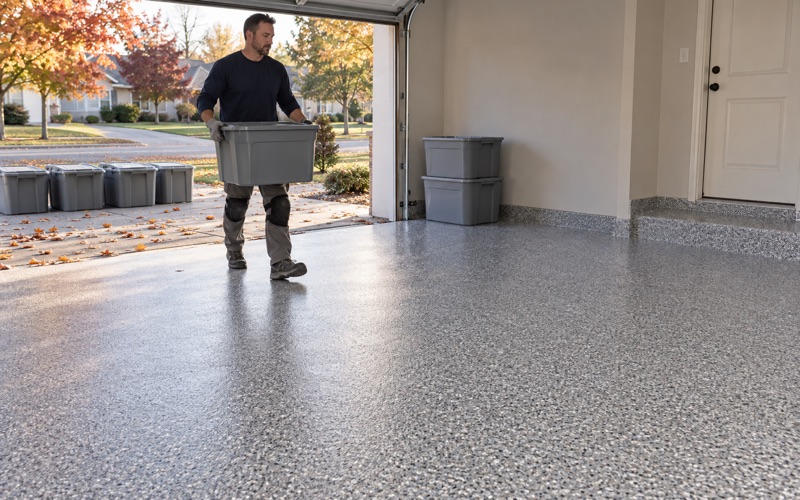
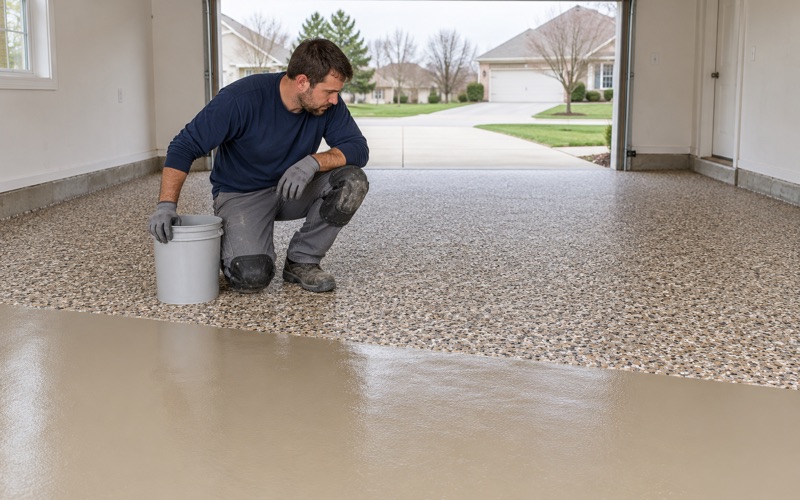
For a pre-sale garage or basement we usually suggest a straightforward system: a 100% solids epoxy base with a vinyl flake broadcast and a polyaspartic topcoat, or a clear sealer over a lithium silicate densifier where a buyer may want to choose their own finish. Either way, joints are honored rather than buried, so a moving joint stays readable as a joint.
The wording matters as much as the materials. Our paperwork calls the coating a decorative and protective finish for the concrete surface, and it says in plain words that the coating does not stop water, does not correct cracks and is not a structural repair. If a listing or a conversation later describes the floor, that language is there to borrow.
Working Back From a Listing Date
Pre-sale floors are often booked late, a few weeks before photos. We work backward from the listing date: assessment and moisture readings first, then any crack repair or plumbing and its cure, then preparation and the coating itself, then the full cure before boxes and furniture come back. A compressed schedule is a reason to simplify the system, not to skip a step.
Sometimes the honest recommendation is to leave the floor alone. A clean, bare basement with documented cracks and a repaired drain can tell a clearer story than a new coating rushed in over open questions. When that is our read, we say it, and the seller decides with their attorney or agent what comes next for the house and its listing.
- 20+ Years of Floor Coating Work
- Moisture Testing in Every Scope
- Free Written Estimates