Plainfield Epoxy Flooring brings more than 20 years of slab work to epoxy-flooring in Lemont, and some of the floors we are asked about here do a job most homeowners never think about. In a commercial service bay, the color of the coating can be part of how a shop keeps people from stepping into an open pit. That turns a style choice into a decision with a rule behind it.
On a lower bay floor, the mark set back from the pit edge has to stay legible through constant tire passes, and the field color around it has to let it stand out. Choosing those two colors together, and building the band into the coating instead of painting it on afterward, is the part of the job this page is about.
We use a lower-bay oil-change shop on 127th Street to show how that plays out, then carry the same idea back to the home garage. Nothing here is a safety review of anyone’s shop. It is a coating contractor’s view of a floor that has to carry a marking and keep it readable.
A Lower Bay on 127th Street and the Rule Behind It
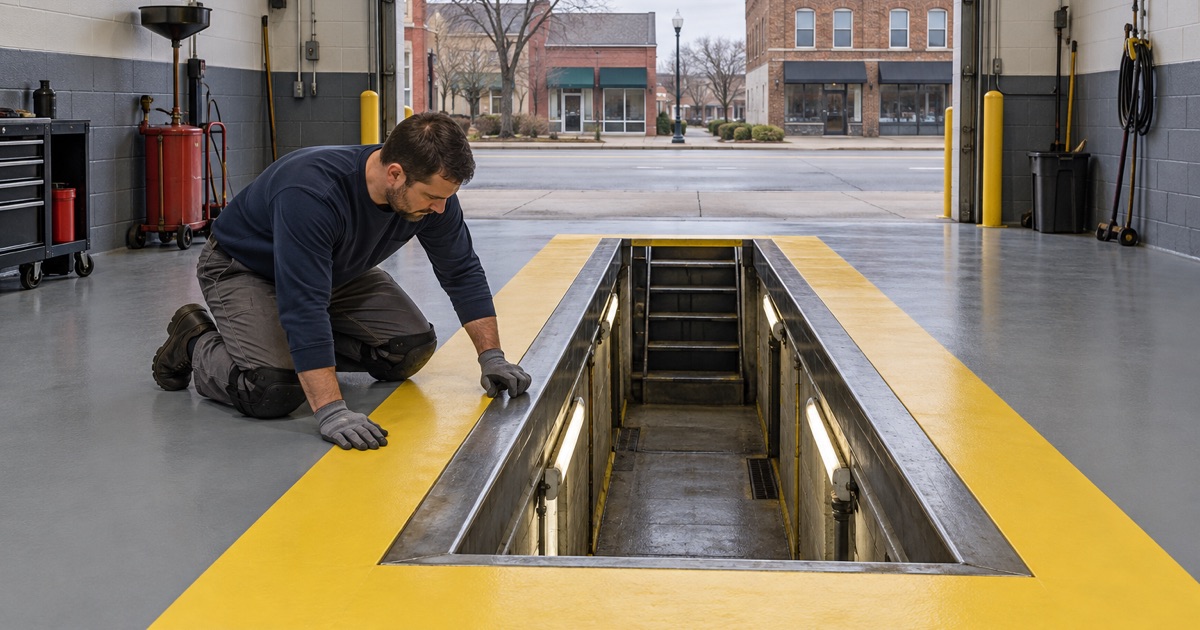
An oil-change shop that works from below
Jiffy Lube Multicare at 15667 W 127th St sits inside the village limits and is open seven days a week, handling oil changes, brake and battery work, tire rotation, fleet oil changes and minor fleet repair. Job postings for that address describe Lower Bay Technicians, which means the oil change is done from a service pit beneath the car rather than on a lift.
We have no relationship with that store or its franchisee, and how it marks its own pits is not something we have seen. Its number of pits and their depth are not published either. We use it because it shows the kind of Lemont floor where the coating plan has to start from the pit, not from the paint chart.
Under 10 feet, with conditions attached
The federal rule that governs this is 29 CFR 1910.28(b)(8). It says a repair, service or assembly pit less than 10 feet deep does not need a fall protection system, such as a guardrail or a cover, provided the employer does three specific things. Skip any one of them and the exemption is gone.
That is why the floor around a lower bay is never just a floor. The rule lets an open pit stay open during the workday only because the surrounding area is controlled, signed and marked. Two of those three conditions live off the slab. The third is painted directly onto it, which puts the coating contractor in the middle of the conversation whether or not anyone planned it that way.
Access, signs and the mark on the floor
The first condition limits access within 6 feet of the pit edge to authorized employees trained under 1910.30. The second is the floor marking, covered in the next section. The third requires readily visible caution signs meeting 1910.145 that read “Caution - Open Pit,” posted where anyone approaching the bay will see them.
None of these are ours to decide. Training, authorization and signage belong to the employer’s own safety program, and we do not certify compliance or design fall protection. What we can do is make sure the floor we install supports the marking the shop has chosen, instead of quietly working against it.
Looking for epoxy-flooring closer to Channahon? See Channahon Epoxy-Flooring.
Six Feet Back, in a Contrasting Color
Where the line actually goes
The marking option in the rule calls for floor markings at least 6 feet from the edge of the pit. That distance is a minimum, so a band placed farther back still satisfies it, while a band that creeps inward during a recoat does not. We lay the line out from the pit edge itself, not from a wall, a column or the old paint.
The six-foot line also moves only when the pit edge moves. If a shop adds a curb, rebuilds a lip or changes the pit opening, the marking has to be laid out again from the new edge. Repainting over the old band’s ghost is an easy way to put a line in the wrong place without anyone noticing it.
What contrast means once the floor is coated
The rule’s wording is that the markings must be in colors that contrast with the surrounding area. On bare gray concrete almost any bright stripe stands out. On a finished resin floor, the surrounding area is our coating, so the field color we pick decides whether the band reads as a warning or blends into the floor around it.
A yellow band on a tan floor, or a gray band on a gray floor with heavy sheen, can be technically present and practically invisible under shop lighting. We talk through the marking color first and then choose a field color that pushes away from it in both hue and brightness. The goal is a line a technician sees without looking for it.
A painted band, a warning line, or both
Floor markings are one of three routes in the rule. A shop can instead place a warning line at least 6 feet from the pit edge on stanchions able to resist a 16-pound horizontal force at 30 inches without tipping, or combine markings and warning lines. Which route a shop takes is its call, not ours.
If stanchions are part of the plan, we want to know before the floor goes down. Bases that sit on a fresh topcoat, or anchors drilled through it, change how that zone should be built. Knowing the layout in advance lets us plan the band, the stanchion footprint and any anchor points as one area instead of patching them in later.
Choosing a Floor Color the Marking Can Contrast With
A solid field, not a busy flake
A full vinyl flake broadcast is popular because it hides dirt, but around a pit it works against the rule. A dense multicolor flake creates its own visual noise, and a painted band laid across it competes with every chip. We usually recommend a solid color in the zone around the band, with flake kept to areas away from the pit.
Where a shop wants grip near the edge, a fine quartz aggregate broadcast under a clear or pigmented topcoat adds traction without breaking up the color field. It keeps the surrounding area uniform, which is exactly what makes the band stand out. The texture is chosen for footing, and the color is chosen for contrast with the band.
Building the band into the system
We treat the marking band as part of the floor system rather than paint added at the end. A typical build is a 100% solids epoxy base, the field color, the band, and a polyaspartic or polyurea topcoat over both. Locking the band under a wear coat keeps it from being the first thing tires scrub away.
Our written scope lists the band as its own line, with its color, its width and the coat that covers it, so a shop manager can see at a glance what keeps the line from wearing through. If the marking color has been fixed by a company standard, we take it as given and build the field around it.
Reading the pit edge before pricing it
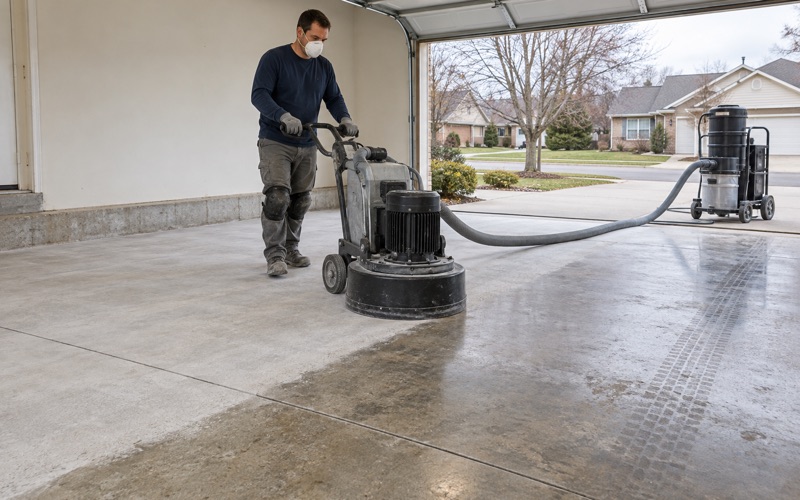
Service bays carry steady vehicle traffic, so the slab is ground to the surface profile the system calls for on the ICRI CSP scale. A band that peels at its edges is worse than no band at all, because it still reads as a line while no longer sitting where the rule needs it.
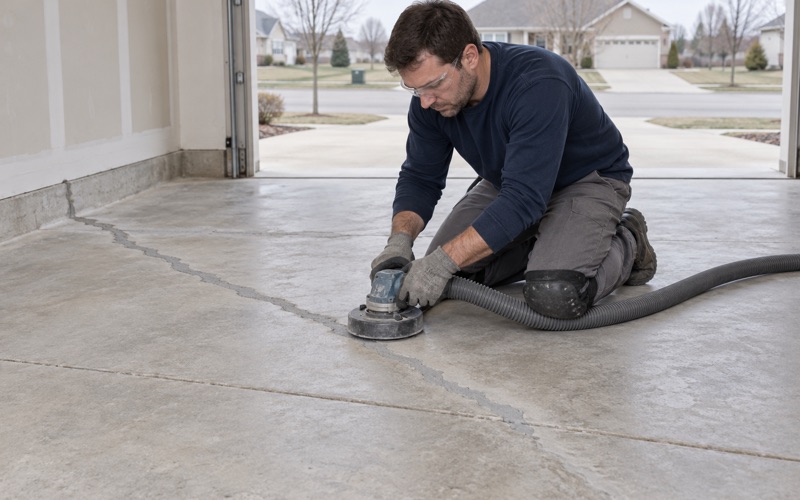
Before we put a price on a pit-side floor, we walk the edge looking at cracks, control joints and any old coating near the lip. A joint can be filled with a semi-rigid polyurea joint filler so the band crosses it cleanly. A crack that is still moving is a slab problem, and the shop hears that from us before any coating is quoted over it.
Keeping the Band Visible, and Working Beside an Open Pit
Recoating before the line wears through
The band takes more abuse than the rest of the floor because every car crosses it on the way in and out. Hot tire pickup and turning wheels wear the topcoat first, and fluids wiped up near the pit add to the scuffing. A marking that has faded to a smear no longer contrasts with anything.
The Lemont store lists hours of 7:00 a.m. to 7:00 p.m. on weekdays, 8:00 a.m. to 6:00 p.m. on Saturday and 10:00 a.m. to 4:00 p.m. on Sunday. A shop open that many days leaves its quiet time at night and after a short Sunday, so band work at a place like that is fitted into those closed hours and the bay reopens on time.
Inside the six-foot zone as a crew
When we coat beside an open pit, our crew is inside the same 6-foot zone the rule controls. That means working under the shop’s authorization and within its own procedures, not treating the bay as an empty room. We coordinate with whoever runs the floor before any grinder starts.
The Lemont store’s own page says customers may stay in the car or wait in the lounge, so a shop like it can have people near the bay who are not technicians. For a coating crew that means taping off the work, keeping our equipment out of any walking path, and never leaving a wet band where an unaware visitor could step onto it.
The same idea in a Lemont garage
Most Lemont homes were built after 1990, so the typical garage floor is a 1990s to 2010s slab. Where one steps down to the house door or drops to a lower level, the same principle carries over: a contrasting edge where the floor changes height is easier to see than a uniform flake.
About 15 percent of the village’s housing units are single-family attached, and a townhome garage commonly opens onto a step into the unit. A solid-color strip along that step, set in a shade that stands apart from the garage field, follows the logic of the pit band at home scale: the change in level should be visible before a foot reaches it.
- 20+ Years of Floor Coating Work
- Moisture Testing in Every Scope
- Free Written Estimates