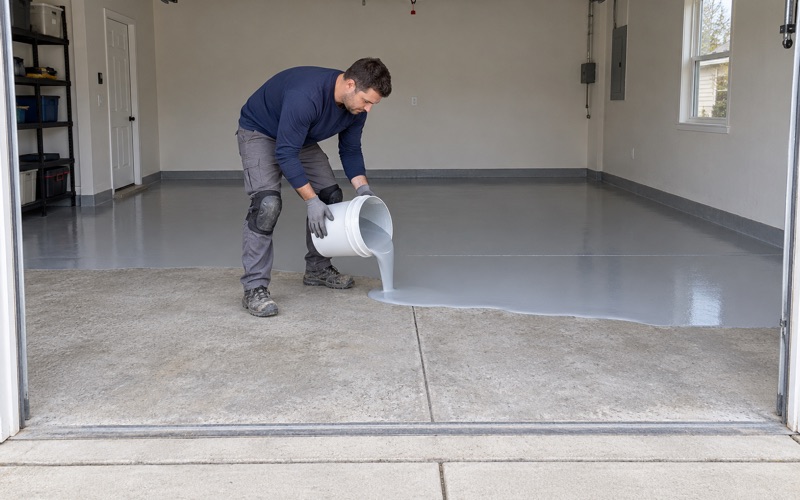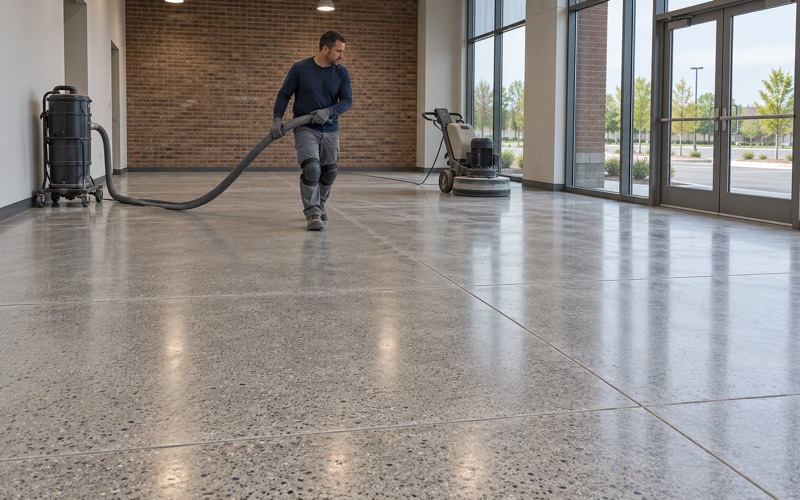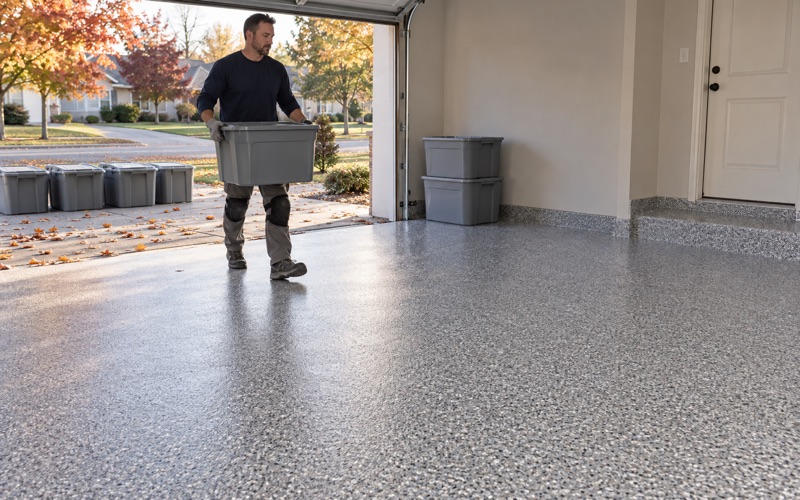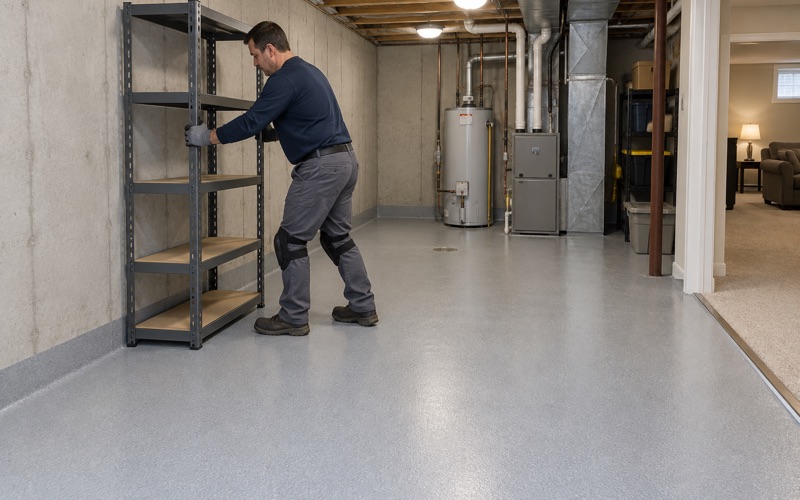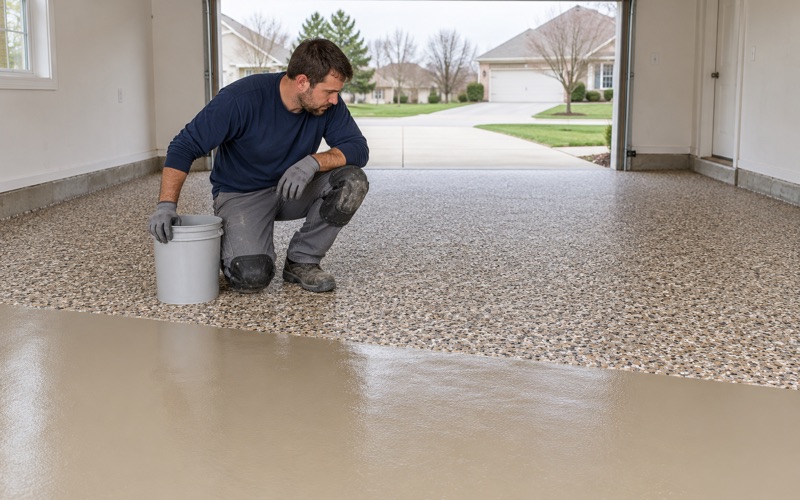
Plainfield Epoxy Flooring has spent more than 20 years on epoxy flooring in Lyons and across our service area, and the garages here ask for something specific. In Lyons, the home garage is often where the family car gets its oil, brakes and coolant done, so we plan the floor as a work surface first and a finish second.
That changes the questions we ask on the first visit. We want to know which fluids get changed on this floor, where the car sits while it is apart, whether someone spends time under it on a creeper, and how the floor gets cleaned afterward. Those answers choose the resin, the topcoat, the color and the texture more than any brochure does.
Below, we cover what the village code says about car repair at home, the fluids a working garage floor has to shrug off, the color and texture choices that make a dropped part easy to find, and a cleanup routine that keeps spills on the floor and off the driveway. It is written for owners who actually turn wrenches in their own garage.
What the Lyons Code Calls Minor and Major Repair
The Village of Lyons speaks to home car repair directly, in Section 13-12-2 of its code, Residential Garages and Driveways. That section sorts repair work into two classes. We are not reading it as lawyers, but it is the clearest description we have found of the work a residential garage floor in this village is likely to carry.
Minor Repair: Fluids, Tires, Wipers and Lights
The code defines minor automotive repair as fluid replacement, tire, wiper and light changes, plus all other repairs not involving a major disassembly of a motor vehicle. That list reads like a normal weekend in a Lyons garage: an oil change, a coolant flush, winter tires going on, a burned-out headlight swapped before the next commute.
Minor work is short, but it comes around often, and repetition is what wears a floor. A drain pan tipped twice a year, a drip of washer fluid at every refill, a tire rolled across the same patch each spring and fall. We design the coating for the repeat visit rather than the single event.
Major Repair Goes Inside
Major automotive repair, in the code’s wording, consists of all repairs involving a major disassembly of a motor vehicle, and all such repairs must be conducted entirely within an enclosed building. For most homeowners, the enclosed building closest to hand is the garage. An engine opened up, a transmission dropped or a suspension rebuilt ends up on that slab, sometimes for weeks.
We give no legal advice on the code, and a new floor changes nothing about what the village allows on your property. The section is simply why we treat Lyons garages as working bays. For any question about what the rule means for your own project, the Village of Lyons Building Department at 4200 Lawndale Avenue is the office to ask.
Your Garage Is the Repair Bay
Lyons is a Cook County village of 10,817 people, home to the Chicago Portage National Historic Site, and it is largely a village of houses. It has 2,765 single-family detached homes, and owners live in 2,079 of them. Wherever one of those houses has a garage, the slab under it is the bench, the parts table and the place the car comes apart.
A floor built only for parking has to take tires and the odd drip. A floor built for repair has to take a hot drain pan set straight down, a fender laid on a moving blanket, a dropped wrench, and a person on their back for an hour at a time. We scope the coating for that second job.
Looking for epoxy-flooring closer to Bellwood? See Epoxy-Flooring Services in Bellwood.
The Fluids a Home Repair Bay Actually Sees
Every fluid in a car meets the garage floor sooner or later. The useful question is not whether a coating resists chemicals in general, but whether it holds up to these fluids for as long as a spill sits before someone wipes it. In a home garage that is usually minutes, and we choose systems for that realistic case.
Motor Oil, Transmission Fluid and Gear Oil
Petroleum oils are the most common spill and the easiest for a sound system to handle. A 100% solids epoxy base under a polyaspartic or polyurea topcoat sheds motor oil and transmission fluid when they are wiped up during the same work session. The weak points are the edges and any pinholes left by poor preparation, so those get our attention before anything is rolled out.
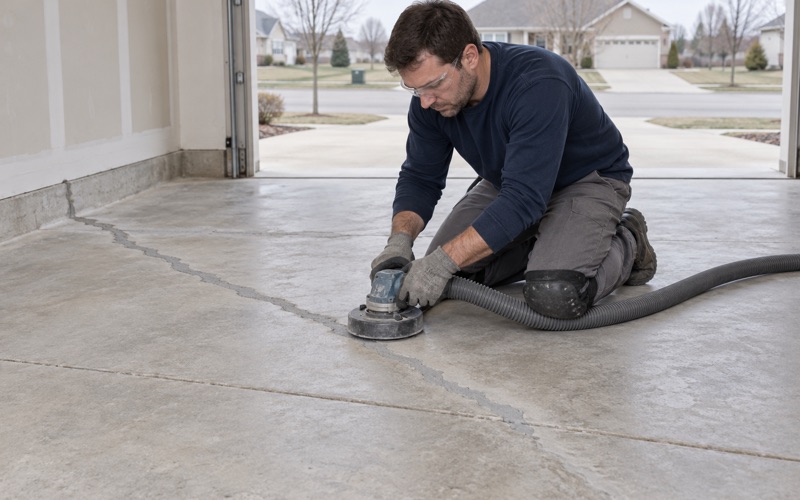
That is where reading the existing floor pays off. Much of the housing here is old: 1,131 of the village’s housing units were built in 1939 or earlier, and another 798 in the 1950s. An older garage slab tends to carry cracks, patches and sometimes a tired prior coating, and we walk the whole floor and look at each of those before we put a number on the job.
Coolant, Brake Fluid and Washer Fluid
Glycol coolant is slick and sweet-tasting, which draws pets, so a nonporous surface that lets you lift every drop is worth having. Brake fluid is the harsher of the two. Glycol-based brake fluid is known for attacking paint, so in the corner where brakes get bled we lean toward a topcoat with stronger solvent resistance, and we tell owners to wipe it first.
Washer fluid is mostly water and methanol and rarely harms a cured coating, but on a smooth gloss it turns the floor into a skating rink. Battery acid from a cracked case is the rare event worth its own mention: neutralize it with baking soda, rinse it with water and dry the area rather than letting it sit.
Winter Brine Rides In on the Tires
A car brought in for repair in January brings the road with it. Calcium chloride brine and rock salt come in on the tires and wheel wells, melt into puddles under the car and dry into a white crust. We choose the topcoat and finish the edges with that salt in mind, because a car on stands may sit in one spot for days while the brine works.
Salt crust also hides small parts and fresh drips, which undoes the point of a light floor. A squeegee and a rinse bucket used every few days in winter keep the work zone readable and stop brine from drying into the texture under a car that is not going anywhere soon.
Color, Texture and a Creeper
Most garage coatings are sold on looks. On a Lyons repair floor we choose color and texture for how the floor behaves while a car is apart: whether you can find a dropped clip, whether a creeper rolls, and whether a new leak shows itself before it spreads across the bay.
A Light Work-Zone Color
Dark charcoal flake hides everything, and that is exactly the trouble. A light gray solid, or a fine, light vinyl flake blend, in the area where the car sits for repair makes a dropped 10-millimeter socket, a cotter pin or a fresh drip visible at a glance. Some owners keep a darker border along the walls and the door and go light only in the work zone.
A light floor also tells you which fluid is leaking. Red transmission fluid, green or orange coolant and amber brake fluid read clearly against light gray, so the source is easier to trace before the part goes back together and the car goes back on the road.
Fine Texture That Still Lets a Creeper Roll
A coarse quartz aggregate broadcast gives excellent grip, but it is hard on creeper wheels and on the back of the person lying on one. In the repair zone we tune the texture down to a fine aggregate carried in the topcoat: enough to stop a shoe skating on a film of fluid, smooth enough for creeper wheels and a mop to move freely.
The finish we steer owners away from is a glassy, untextured gloss. It photographs well and looks great on the day it cures, but the first coolant spill on it turns a routine job into a fall waiting to happen, and a home mechanic is usually working alone.
Mapping the Work Zone Before We Coat
Before we coat, we ask the owner to stand where the car usually sits and show us where the drain pan goes, where parts get laid out and where the creeper runs. Those zones decide where the light color, the fine texture and any tougher topcoat go. A garage with a bench along one wall lays out differently from one where the car comes in nose-first to the back.
Cleaning Up Without Hosing It Out the Door
Plenty of garages get cleaned with a hose and a push broom, aimed at the driveway. On a floor that sees fluid changes, that habit carries oil and coolant out the door and toward the street. A sealed, seamless floor makes a better routine easy, because the fluid stays on the surface where it can be lifted rather than soaking in.
Absorbent First, Then a Wipe
For a fresh spill, slide a pan or pad under the source at once, then spread granular absorbent or shop towels over whatever reached the floor. Lift it, bag it, and take the used fluid to a recycler. The coating does not hold a spill in place; it only keeps the fluid on top long enough for you to pick it up.
Keep a small kit by the bench: absorbent pads, a bag of granules, a roll of shop towels and a box of nitrile gloves. Having it within arm’s reach is what turns a 30-second wipe into a habit, rather than a chore left for Saturday.
A Mild Cleaner and a Mop
After the absorbent, a pH-neutral cleaner in warm water and a microfiber mop take off the remaining film. Strong solvents, full-strength citrus degreasers and acid cleaners can dull a topcoat over time, so we leave owners a short list of what to use and what to skip. Wring the mop into a bucket, never onto the driveway.
Moisture Under the Slab Comes First
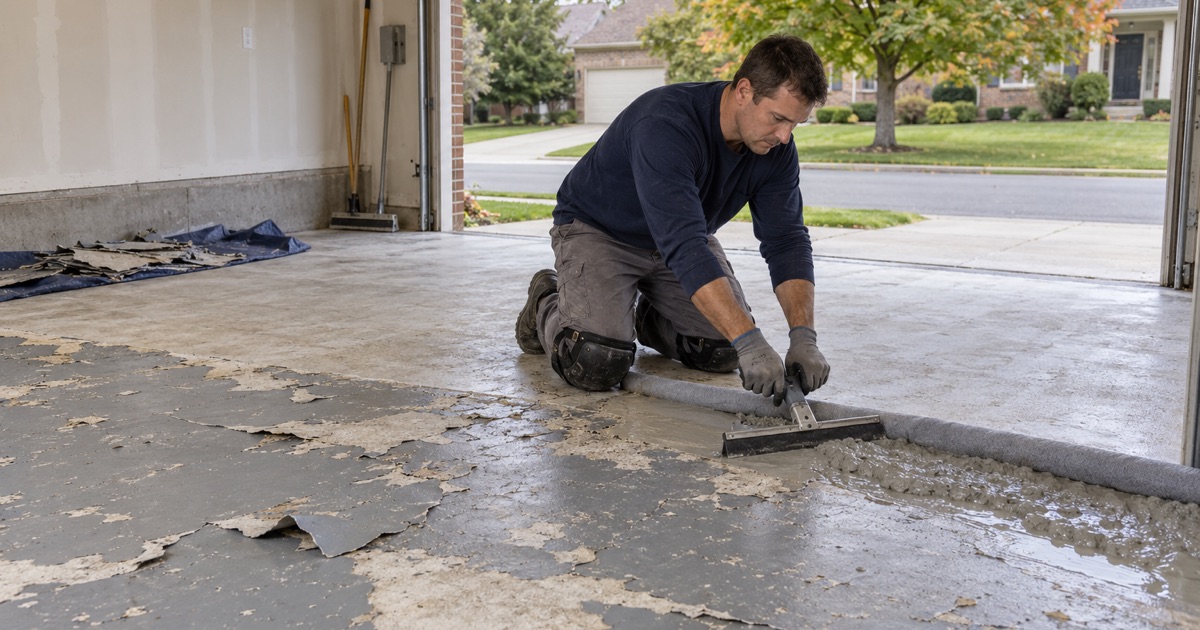
None of this matters if the coating lets go from below. An older garage slab may or may not have a vapor retarder under it, and nobody can tell by looking, so moisture testing is its own priced line in every garage scope we write. If the readings call for it, a moisture-mitigation primer goes down under the base coat, which costs far less than lifting a blistered floor later.
A blister under a car that is up on stands for a month is the worst-timed failure a home repair floor can have. We would rather find the moisture on day one and plan around it, and we share the readings with you before you decide on a system.
- 20+ Years of Floor Coating Work
- Moisture Testing in Every Scope
- Free Written Estimates