Plainfield Epoxy Flooring creates metallic epoxy floor finishes for homes and businesses in Plainfield, IL, with 20+ years of coating experience behind the hand work these floors demand, and we install them in surrounding cities including Shorewood, Minooka, North Aurora, Warrenville and Lemont. A metallic floor uses pearlescent pigments suspended in clear epoxy, moved by hand while the resin is wet to create a marbled, almost liquid look that no other coating produces.
That look is also the most demanding finish we install. Every flaw in the slab, every high spot and every roller mark becomes part of the pattern, so a metallic floor needs more grinding, more flattening and more care during installation than any flake or solid color system.
We make sample boards in the colors you are considering and agree on the general movement, contrast and gloss before work begins. The written proposal then names the base coat, the metallic layer and the topcoat, with the finished thickness, so the floor can be checked against what was quoted.
How a Metallic Epoxy Floor Is Built
Grinding and Flattening the Slab
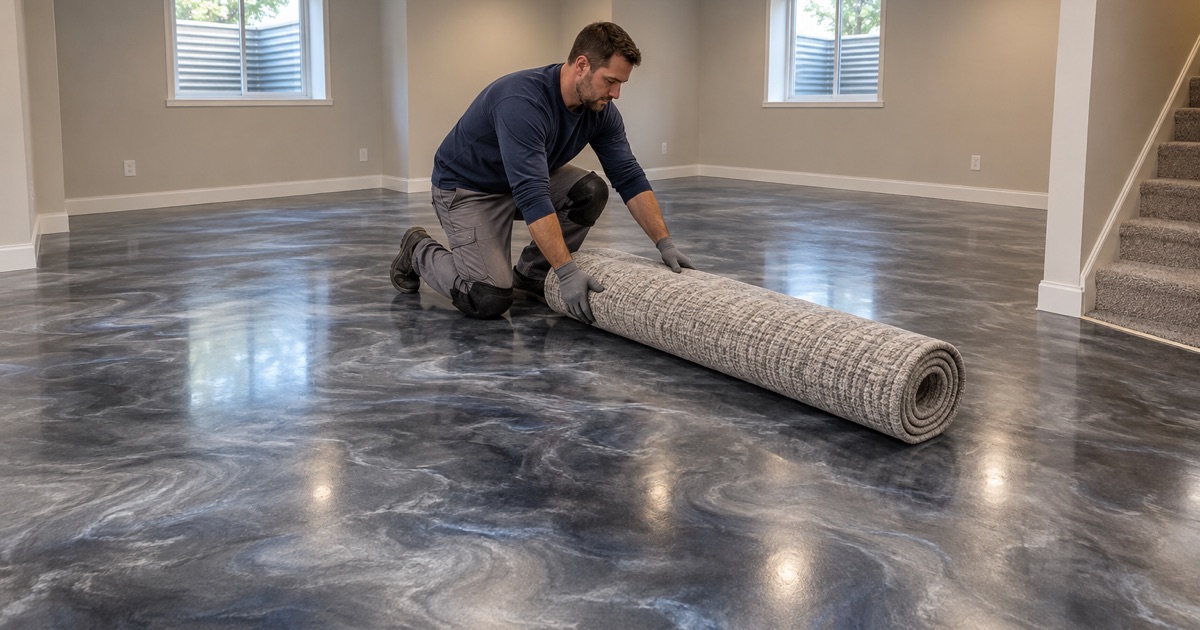
A metallic floor magnifies whatever is underneath it, so we diamond grind the slab more thoroughly than for most coatings, removing high spots, old coatings and any trowel ridges. We never acid etch, because it does nothing to flatten a floor and leaves uneven texture that would show through the finish.
The dust is collected at the grinder through vacuum shrouds, which matters in a finished basement or occupied office. Grinding residue is vacuumed up rather than washed toward a floor drain.
Crack and Joint Preparation
Cracks and control joints have to be filled and ground flush, because a metallic finish settles into any dip and outlines it in the final look. Stable cracks are filled with a compatible material, and joints are either filled or honored with a deliberate line in the design, so they do not read as accidental flaws.
Where a crack is still moving, we say so before quoting. A metallic floor over an active crack will eventually show it, and the original pattern cannot be matched in a patch.
Primer and Solid Base Coat
After grinding, we apply a primer and a solid-color base coat, usually in black, gray or a tone that sets off the metallic pigments. That base layer seals the concrete so air does not bubble up through the metallic coat and gives the pigments a consistent background.
The base color also changes the final look. A dark base gives deeper, more dramatic movement, while a light base reads softer and brighter, which is why we show both on sample boards.
Placing and Working the Metallic Layer
The metallic layer is poured and spread while wet, then worked with rollers, brushes, sprayed solvent or air to move the pigment into swirls, veins or a lava-like flow. The working window is limited, so our crew plans the pattern, the order of colors and the direction of movement before the first bucket is mixed.
This is the step where experience shows most, because the pattern has to stay consistent across the whole room while still looking natural. We keep crews in the space until the resin has started to set, so footprints and stray marks can be corrected before it cures.
UV-Stable Topcoat
A clear polyaspartic or polyurea topcoat protects the metallic layer from scratches, chemicals and ultraviolet yellowing. Standard epoxy ambers in sunlight, which would dull the colors over time, so the topcoat is chosen for clarity and color stability as much as toughness.
Sheen is chosen at this stage too. A high-gloss topcoat gives the deepest, most liquid look, while a satin topcoat softens reflections and hides fine scratches and dust, which many owners prefer in a busy family room or office.
Residential Metallic Epoxy Floors
Finished Basements and Family Rooms
Basements are the most popular place for a metallic floor in a house, turning a plain slab into a finished living space without carpet over cool, sometimes damp concrete. Before a basement metallic floor is installed, we test the slab for moisture with ASTM F1869 calcium chloride kits or ASTM F2170 relative humidity probes, because vapor coming through the slab will cloud or lift the coating.
When readings are high, a moisture-mitigation primer goes under the base coat as a separate layer. When the basement has active water problems, those have to be solved first, since a coating is a finish and not waterproofing.
Garages, Man Caves and Home Bars
Some owners choose a metallic finish for a show garage, a man cave or a home bar, where the floor is part of the look. In a working garage the floor has to stand up to road salt, calcium chloride brine and hot tires, so we use a thicker topcoat and explain that a metallic floor will show wear and scratches more readily than a flake system.
Matching Colors to the Room
Metallic pigments come in a wide range, from silver, copper and bronze to blues, greens and deep charcoal. We look at cabinets, wall colors, lighting and how much daylight reaches the floor, then make sample boards, since metallic pigments shift noticeably under different light.
We also recommend viewing the boards in the actual room at different times of day. A copper tone that looks warm beside a window can read brown under recessed lights in a windowless basement, and seeing that before installation is far easier than living with it afterward.
Commercial Metallic Epoxy Floors
Showrooms and Dealerships
Showrooms and dealerships use metallic floors to make a space look premium while still handling foot traffic and display vehicles. We schedule the work around the hours the business needs to stay open, including overnight and weekend windows, and choose topcoats that hold their gloss under bright lighting and frequent cleaning.
Offices, Salons and Retail Spaces
Offices, salons, boutiques and restaurants with front-of-house seating often choose metallic finishes for their visual impact. These floors need a topcoat rated for rolling chairs, foot traffic and cleaning chemicals, and we specify each layer around how the space is actually used.
Where a restaurant or food business wants a metallic finish, the floor has to pass county health department plan review: Will County for the Will County part of Plainfield and Kendall County for the Kendall County part. We confirm the finish materials meet that review before any work is scheduled.
Logos, Borders and Multiple Colors
Commercial clients sometimes want a logo, a border or several colors divided by saw-cut lines. We plan these details before the metallic layer goes down, since the pattern has to be built in one continuous working window, and we align lines with the slab’s existing joints so cracks do not cut through the design.
Planning a Metallic Floor Project
Scheduling Around Slab Conditions
Metallic epoxy needs stable temperatures, a slab surface comfortably above the dew point and enough working time for the pigments to flow. A cold slab slows leveling, while humid air over a cool floor can leave haze or amine blush, so we schedule installation against conditions on the day rather than the calendar.
Pricing a Metallic Floor
We price metallic floors per square foot for the exact system proposed. Grinding and flattening, crack repair, the number of pigment colors, logos or borders, and the choice of topcoat all move the number, and the proposal lists each so you can see where the cost comes from.
Illinois limits the volatile organic compound content of floor coatings under 35 Ill. Adm. Code Part 223 Subpart C, and that rule applies to the installer as well as the manufacturer. Every product in a metallic build is chosen to fall within those limits.
Warranty Terms and Exclusions
Metallic floors carry warranties like other coatings, and they share the same exclusions: moisture first, followed by slab movement, new cracks, impact damage and chemicals beyond the product’s rating. We go over those before the job is sold, so the coverage is clear from the start.
- 20+ Years of Floor Coating Work
- Moisture Testing in Every Scope
- Free Written Estimates