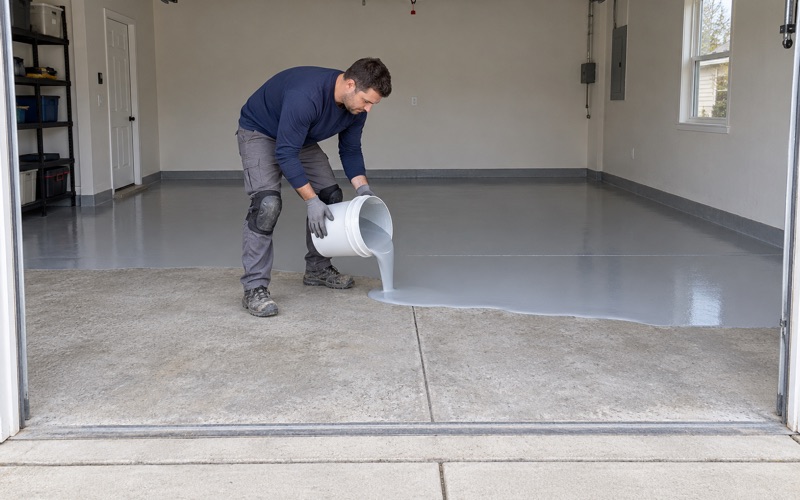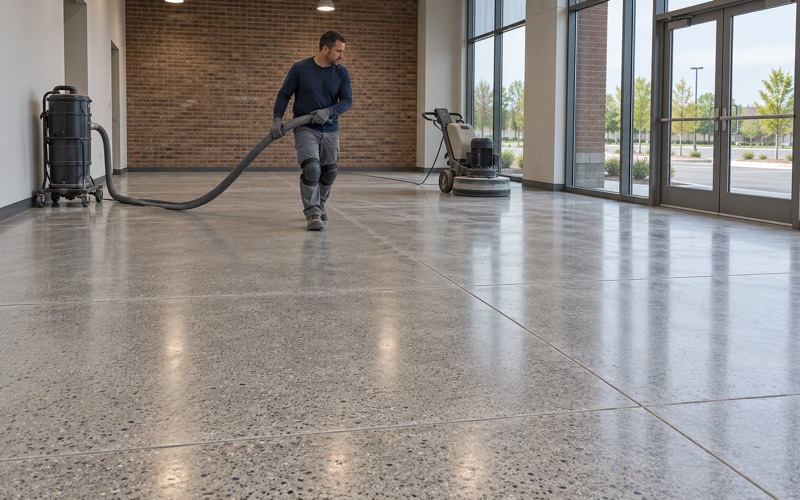
Plainfield Epoxy Flooring brings more than 20 years of experience to epoxy-flooring in Minooka, and every job starts the same way: we open the concrete mechanically with a diamond grinder or a shot blaster, never with acid. A properly profiled slab is what lets a 100% solids epoxy or a urethane cement grab the concrete, and a skipped profile is where most peeling floors begin.
Before we price anything, we read the cracks, the joints and whatever coating is already down, and we tell you plainly if the slab needs repair or replacement first. Moisture testing sits in the written scope as its own line, whether the floor is a garage, a basement or a warehouse, because a blister found after the job is a test that should have happened before it.
Our proposals name the product, the system build and the finished thickness, so you can hold what went down against what was quoted. Pricing is per square foot for the system we actually propose, not a national per-garage number. The same discipline applies on an industrial floor, where the question is often less about looks and more about what the floor puts into the building’s air and onto its product.
Stainless Sheet on Twin Rail Drive and the Carbon Steel Problem
What gets processed on Twin Rail Drive
Minooka sits in Grundy, Kendall and Will counties, and its industrial side includes a stainless steel warehouse at 801 Twin Rail Drive, in Aux Sable Township, Grundy County. North American Stainless, part of the Acerinox group, lists two processing lines there: a Multi Blanking Line and a Slitting Line, both handling sheet from 0.023 to 0.130 inch thick and up to 60 inches wide.
The blanking line lists PVC film applied to the top side only, paper interleave on sheet 36 to 60 inches wide, and skids from 1,000 to 10,000 pounds. Film and interleave both exist to protect a finished surface. We have no relationship with the company and have not seen its floors, but the product it handles tells you what any floor under that kind of work has to do.
Why carbon steel ruins stainless
Stainless steel and carbon steel do not mix in a shop. The Specialty Steel Industry of North America warns that tiny carbon steel particles will be embedded in the surface of stainless, and it says that, ideally, a shop should have a separate area where only stainless steel is fabricated. It also warns against steel wool or grinding wheels that have already touched carbon steel.
The Australian Stainless Steel Development Association made the same point in a December 2024 guide: grinding or polishing carbon steel produces fine particles that spread unless there is proper local extraction, and carbon steel and stainless should not be processed in the same workspace. That is a warning about dust, and dust has to land somewhere. In most buildings, it lands on the floor.
Keeping sheets off the floor
SSINA’s shop guidance says plates and sheets laid out for use should be off the floor and divided by wooden planks, stored vertically in racks, and that racks should be protected to prevent iron contamination. The floor, in other words, is not trusted as a clean surface. Forks forced between plates and slipping chain slings are named for the damage they cause as well.
ASSDA adds boots to its list of contaminant carriers, alongside pencil marks and sooty flames, and recommends wood, plastic or carpet as protective materials. Boots matter for a floor contractor because they connect the floor to everything else. Whatever grit sits on the slab rides on soles to the racks, the skids and the operator stations, which is why floor condition belongs in the housekeeping conversation.
Looking for epoxy-flooring closer to North Aurora? See North Aurora Epoxy-Flooring.
The Floor as a Source of Grit and Iron
How a bare slab sheds dust
Unsealed concrete wears at the surface. Forklift wheels, pallet jacks and foot traffic break down the weak top layer, and a pitted or dusting slab holds fine grit in every pore and joint. In a building handling stainless sheet, that grit can end up on skids, on interleaf paper and on the underside of sheets, which is exactly what the industry guidance is trying to prevent.
A sweeper does not fix this, because a dusting slab keeps producing new dust as it wears. Sweeping moves the fines around and scrubbing pulls more out of the open surface. The problem is the concrete itself, and the fix is to close it. Until then, every cleaning round only buys time.
What a sealed, non-dusting floor changes
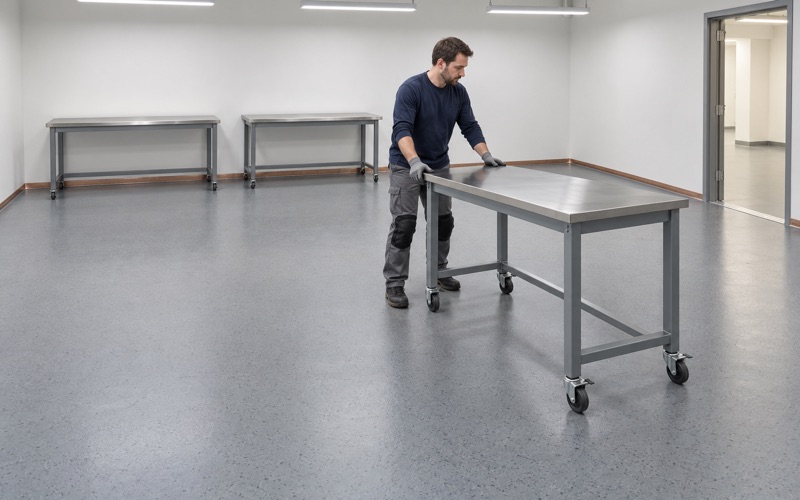
A sealed, non-dusting floor gives housekeeping something to work with. A 100% solids epoxy or a urethane cement system closes the surface so there is no weak paste to break loose, and what lands on it can be swept and scrubbed off rather than ground in. Where a full coating is not the right call, a lithium silicate densifier hardens the top of the slab and cuts dusting.
We are careful about what we promise here. A coating is one piece of contamination control, alongside separate stainless areas, protected racks and clean handling, and it does nothing to the steel itself. What it does is take the floor off the list of places grit keeps coming from. Any claim beyond that belongs to the people who run the plant’s quality program.
Joints, cracks and the edges of the slab
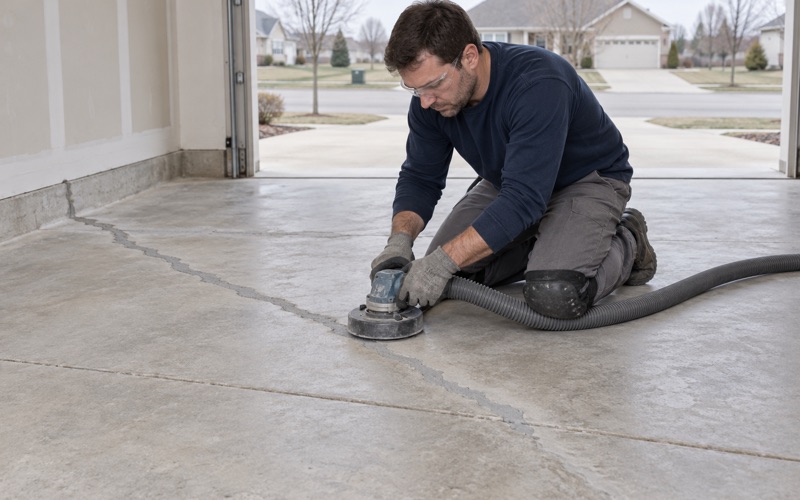
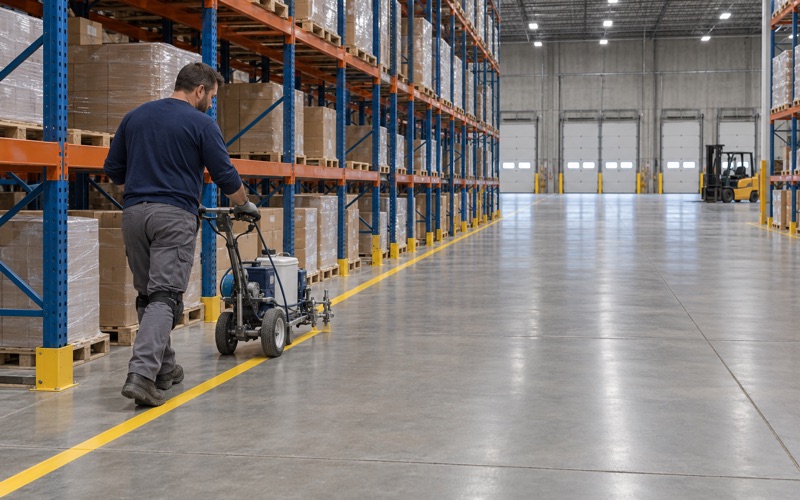
Dirt collects where the slab is broken. Open saw cuts, spalled joint edges and cracks hold grit that no scrubber reaches, so we read every joint and crack before quoting. Joints under forklift traffic get a semi-rigid polyurea joint filler, set flush, so the floor has no trough for fines to settle into and no edge for a wheel to chip.
Some slabs are past coating. Heavy spalling, slabs that move, or old coatings failing across most of the floor can mean repair or replacement first, and we say so in the proposal rather than coating over it. Moisture testing goes in the same scope, using ASTM F2170 in-situ relative humidity probes or ASTM F1869 calcium chloride tests, before any resin is chosen.
Floor Work Without Leaving Iron Behind
Why the prep is the risk point
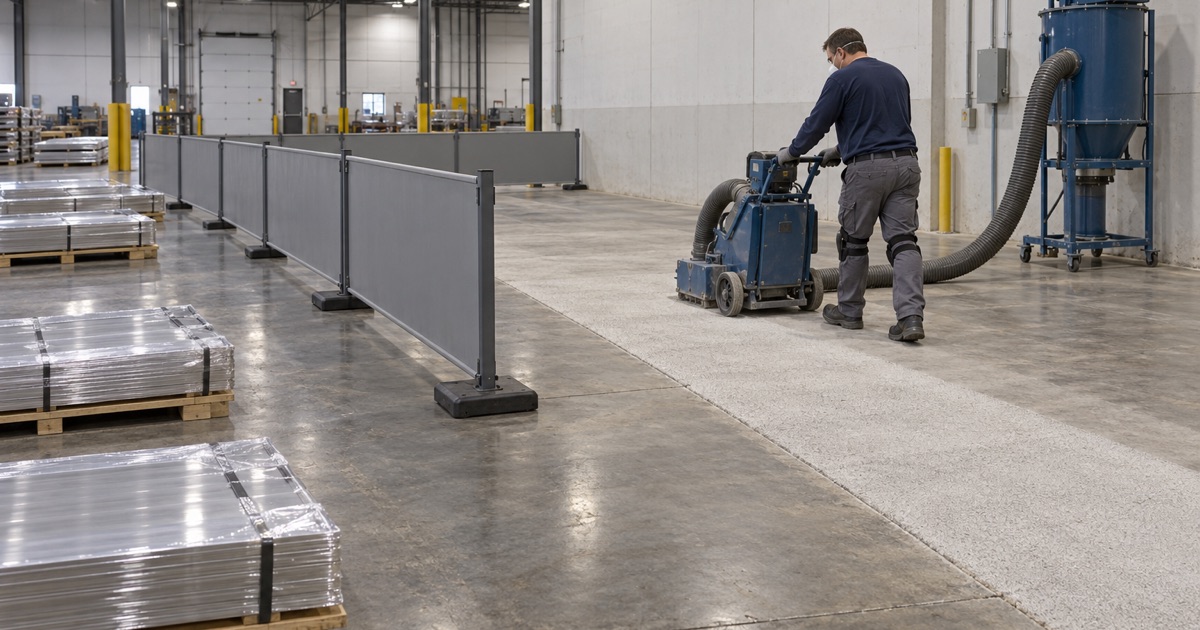
Our prep is mechanical, and in a building that handles stainless, that is where the risk sits. Steel-shot blasting, carbon-steel grinding segments and equipment dragged across the floor can all leave iron fines behind. In an ordinary warehouse that is a cleanup chore. In a stainless processing building it is the exact contamination the plant spends its days keeping out.
So the method is agreed with the plant before we arrive. Which areas close, which lines keep running, where equipment is staged and how it is cleaned are all settled in writing. We do not assume a method is acceptable because it works in a parking garage or a distribution center, and we do not start until the plant’s own people have signed off.
Containment and vacuum at the tool
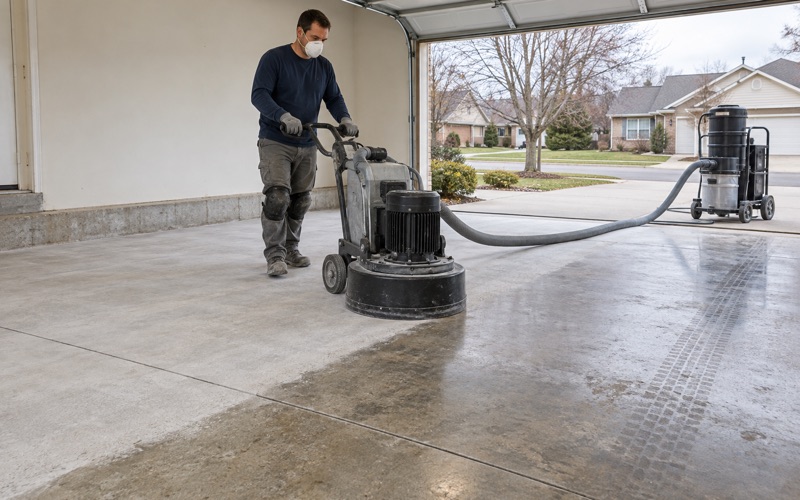
Work zones are closed off from production with barriers, and every grinder and blaster runs with vacuum at the tool, so dust is captured where it is made rather than chased afterward. That matches the ASSDA point about local extraction. Grinding dust is bagged and hauled out, and it is never washed toward a floor drain or a storm inlet.
Where shot blasting is the right profile tool, the blaster recovers its own shot, and the zone is magnet-swept and vacuumed before anyone calls it clean. Diamond grinding puts no loose steel media on the floor, but worn segments still shed fines, so it gets the same capture and cleanup. We choose the tool against the target ICRI CSP profile and the building, not habit.
Clean before the lines restart
Before a zone goes back to production, it is vacuumed, wiped down and walked with the plant’s people. Edges, rack bases and the undersides of guards are where fines hide, so that is where we look first. The new floor then cures on a schedule set by slab temperature and the dew point spread at the slab surface, not by the calendar.
Industrial floors are scheduled around the hours a building has to keep running, which often means overnight and weekend windows. Our coatings are chosen within the Illinois VOC limits for architectural coatings, which bind the installer as well as the manufacturer. And because Illinois licenses no flooring or coatings contractor, we register with the Village of Minooka before any permit issues.
Stainless at Home: Garages and Basements in Minooka
Stainless workbenches and appliances in the garage
The same logic reaches a home garage that holds a stainless workbench, a stainless refrigerator or a tool chest beside the angle grinder. Grinding carbon steel near stainless at home spreads fine particles exactly as it does in a shop. A sealed floor that does not dust is easier to keep clean, and it keeps grit from tracking onto everything else.
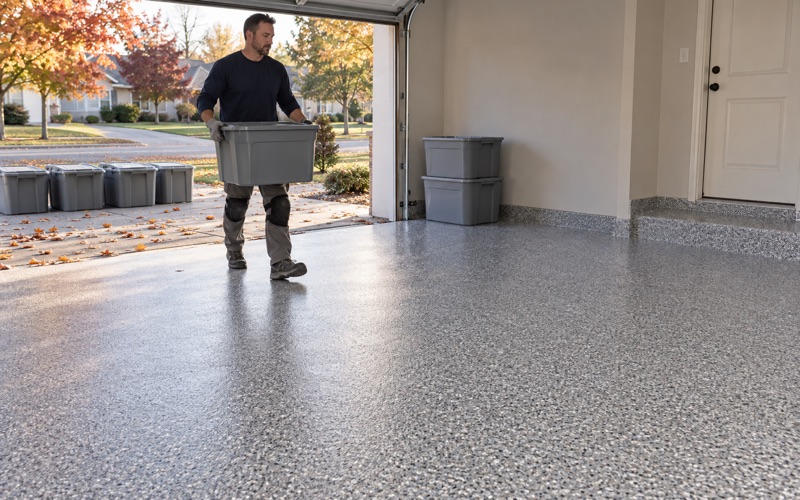
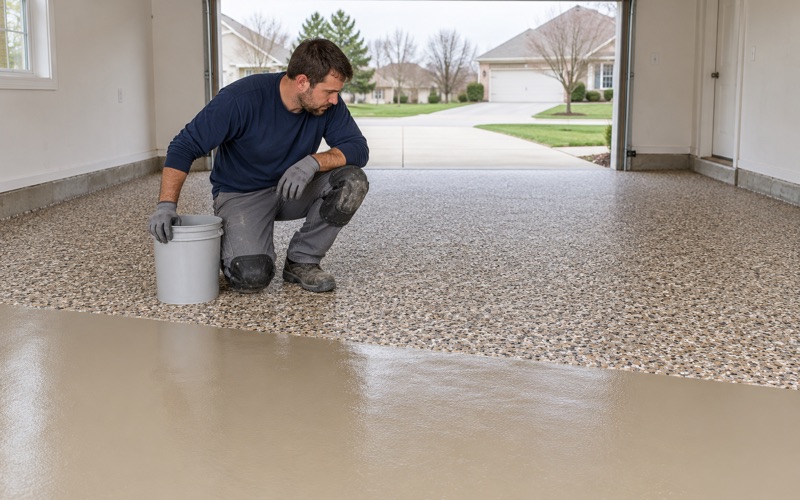
For the garage itself, we build for the calcium chloride brine and rock salt an Illinois winter tracks in on the tires, with a 100% solids epoxy base, a vinyl flake or quartz aggregate broadcast, and a polyaspartic topcoat that resists hot tire pickup. The slab is diamond ground first, and we say plainly when an unheated garage has to wait for spring.
Houses built in the 2000s
Minooka’s housing is mostly young and mostly owner-occupied. Census estimates put 3,780 of 4,126 units in owner hands, and 1,982 were built from 2000 to 2009, the largest single decade by far. The typical residential job here is likely the garage of a 2000s detached house whose original slab has started to dust, stain or flake.
Every home job gets a written contract and the Home Repair: Know Your Consumer Rights pamphlet before work starts, as the Illinois Home Repair and Remodeling Act requires. Warranty exclusions are read out before the job is sold, with moisture named first, because a garage slab with no vapor retarder under it can push moisture into a coating years after it goes down.
Basements, water and radon
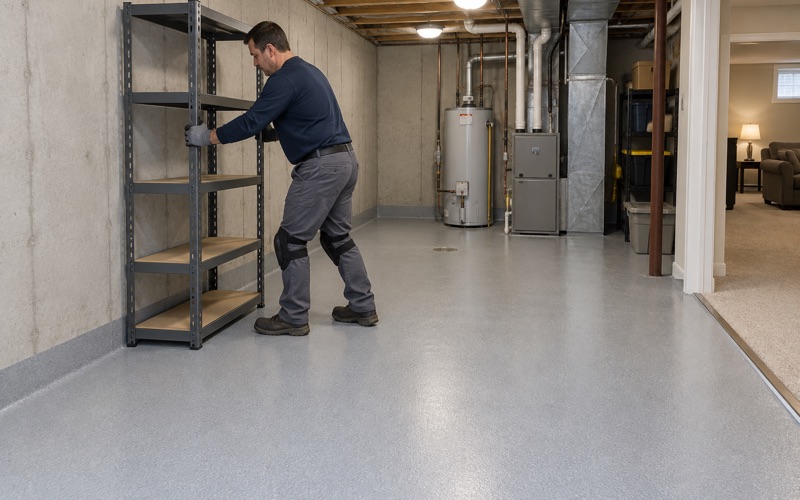
Basement floors start with where the water comes from. In April 2013, Aux Sable Creek flooding put basements underwater at the south end of the Bonita Vista subdivision, and Cemetery Road residents were evacuated. A coating is not waterproofing, so sump pits, drain tile and hydrostatic pressure get looked at before we test the slab and pick a moisture-mitigation primer.
Radon is the other basement question. Grundy County Health Department has said at least 38 percent of buildings tested in the county exceeded the 4 pCi/L standard, and most Minooka homes predate the 2013 Illinois passive radon-pipe requirement. We do not sell a floor coating as radon reduction. That work takes an IEMA radon mitigation license, and we point you toward it.
- 20+ Years of Floor Coating Work
- Moisture Testing in Every Scope
- Free Written Estimates