Plainfield Epoxy Flooring has spent more than 20 years on epoxy flooring in Mokena and across Will County, and the question food businesses bring us is rarely about color. It is about how the floor gets cleaned. A bakery, a deli prep room or a café kitchen needs a surface that suits the cleaning methods the rules allow, and that should be settled before any coating is chosen.
Flour is the clearest case. It lands on the floor every working day, it is fine enough to work into any texture it meets, and the FDA Food Code limits how it may be removed. A finish that looks tough but holds flour in its grooves turns every closing shift into a fight with the floor. We would rather pick a surface that gives the dust up easily.
This page walks through what the Food Code says about dustless cleaning, when routine cleaning is supposed to happen, and which finishes cooperate with a damp mop or a vacuum. It also covers a smaller version of the same problem: flour tracked across a home garage or a basement baking room. The rules differ there, but the behavior of fine powder on a slab does not.
A La Grange Road Bakery and Flour on the Floor Every Day

Fleckenstein’s at 19225 La Grange Road
Fleckenstein’s Bakery opened in Mokena on November 11, 1977, started by Bob and Joan Fleckenstein, and the owner has described it as the first retail business on that stretch of La Grange Road. In 1983 it moved one block north to 19225 La Grange Road, which remains the flagship store after a second location opened. It is the clearest local example of a scratch bakery.
The bakery’s own site lists breads, cakes, cookies, desserts, donuts, pies and paczki, and credits Ray Fleckenstein as a Certified Master Baker. Paczki Day is its busiest day of the year, which the owner described in 2018 as all hands on deck, with prepaid orders picked up at the back of the bakery during the morning. We have no connection to the shop; it simply shows the kind of floor this page is about.
Flour settles on every surface, the floor included
Any bakery that mixes from scratch puts flour into the air every time a bag is opened, a bench is dusted or dough is turned out. Much of it ends up on the floor, where foot traffic presses it into whatever texture the surface offers. Add a little water from a mop or a dropped bowl and the powder becomes a paste that dries hard in seams and grooves.
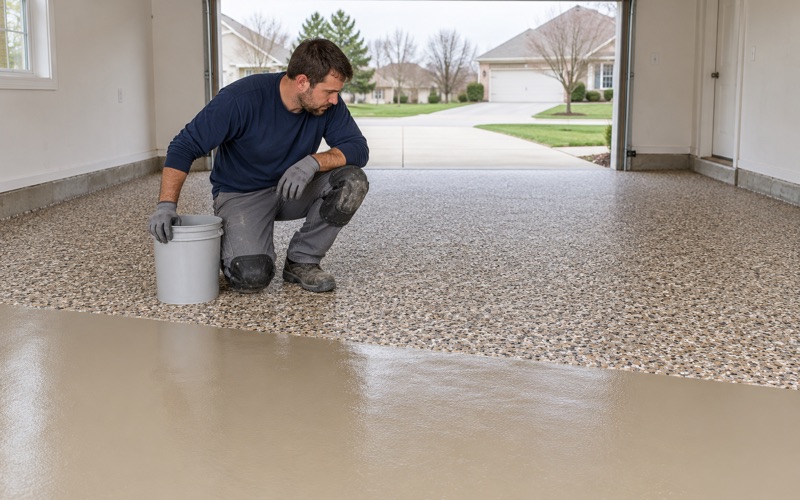
That is why a bakery floor gets judged differently from a garage floor. A garage coating is chosen to resist hot tire pickup and oil drips; a bakery coating is chosen for how readily it lets go of a fine, sticky powder under the cleaning tools the code permits. The same epoxy chemistry can serve both rooms, but the texture and topcoat decisions point in opposite directions.
Why the floor decision starts with cleaning
Owners often ask us for the toughest floor available, and toughness does matter near ovens, mixers and rolling racks. On a food floor, though, the inspector’s questions and the closing crew’s hours both turn on cleanability. If a surface cannot be cleaned by the methods the Food Code allows, in the time the shop has once the doors are locked, it is the wrong surface, however long it might last.
Looking for epoxy-flooring closer to Western Springs? See Epoxy-Flooring Services in Western Springs.
Dustless Only: What Section 6-501.13 Allows
The four methods the code names
FDA Food Code 2022, section 6-501.13(A), says only dustless methods of cleaning shall be used, and it names them: wet cleaning, vacuum cleaning, mopping with treated dust mops, or sweeping using a broom and dust-arresting compounds. A plain dry broom is not on that list. Sweeping flour with one lifts it back into the air, where it drifts and settles again on benches, equipment and anything left uncovered.
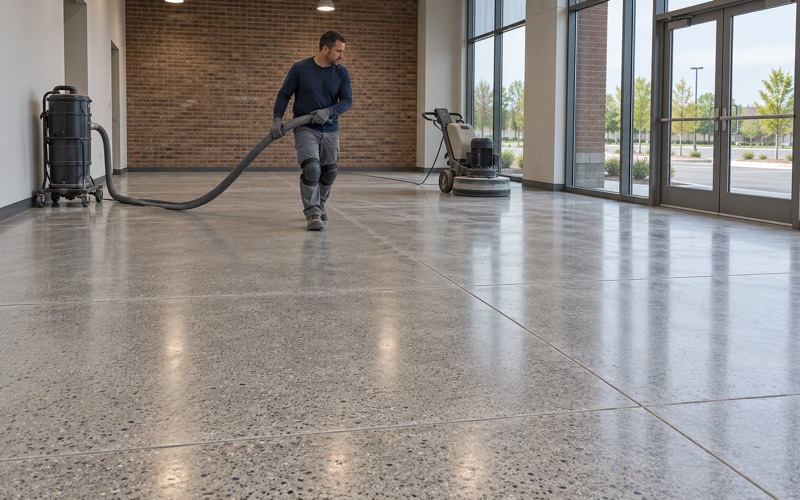
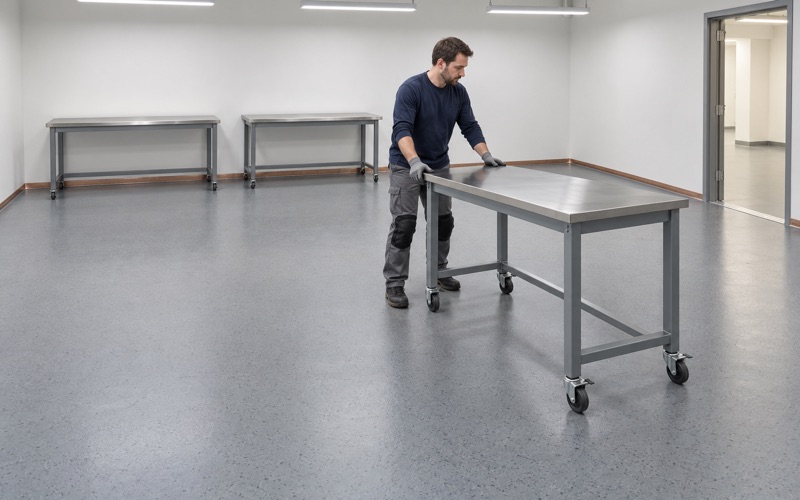
Each allowed method treats a floor differently. Wet cleaning and damp mopping want a surface that sheds water and does not hold paste in its texture. A vacuum wants a floor even enough that the head stays close and lifts the powder. Treated dust mops glide best on a closed, level topcoat, and they drag and skip rather than collect when they meet a rough, open broadcast.
Spills between scheduled cleanings
Section 6-501.13(B) carves out one exception: a spill between normal cleaning times may be cleaned without dust-arresting compounds. A bag that splits mid-morning or a tray of sugar that hits the tile line can be handled on the spot. The floor still has to give that spill up quickly, which is one more reason to avoid a texture that traps whatever lands on it.
We raise this because owners sometimes assume any midday cleanup breaks the rules. It does not, as long as the routine cleaning follows the timing the code sets. What matters for the finish is that a quick wipe or a spot vacuum actually removes the material, instead of pressing it into a valley for the closing crew to find hours later.
What may not be spread on a food floor
Section 6-501.17 bars sawdust, wood shavings, granular salt, baked clay and diatomaceous earth on floors, except for spot cleaning of spills. Old shop habits fade slowly, and a handful of absorbent tossed on a wet patch is one of them. On a food floor that is not allowed as routine, so the surface has to stay manageable without a layer of something underfoot.
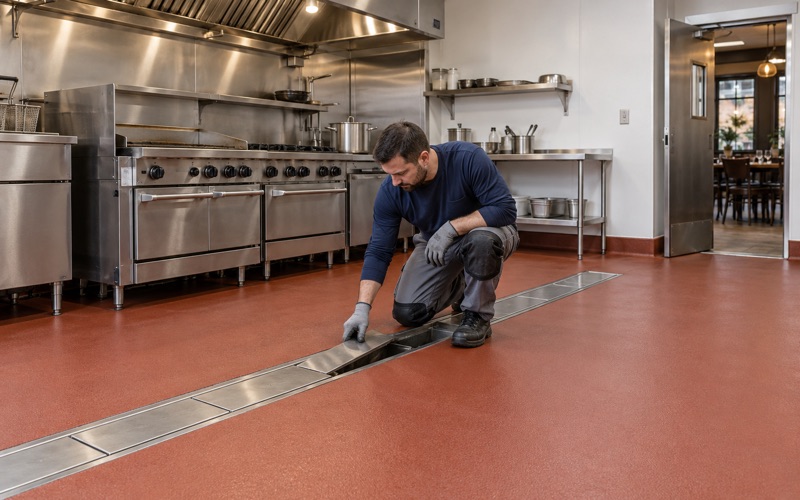
The rule also shapes how we look at edges and drains. If nothing granular can be left down to soak up drips near a sink or a proofer, the floor around them needs to move water toward the drain rather than letting it pool. Slope, drain height and the coating’s edge at the drain body are details we check during the site visit, before any build is proposed.
A Finish That Gives Flour Up to a Damp Mop
Fine and sealed, not a coarse broadcast
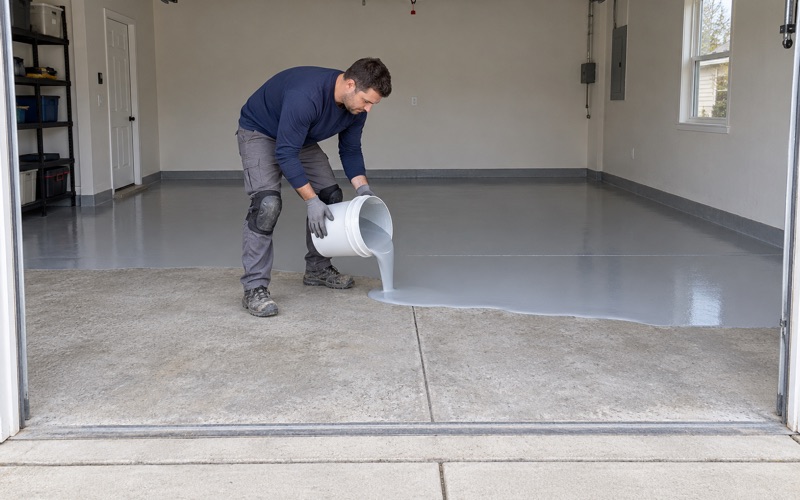
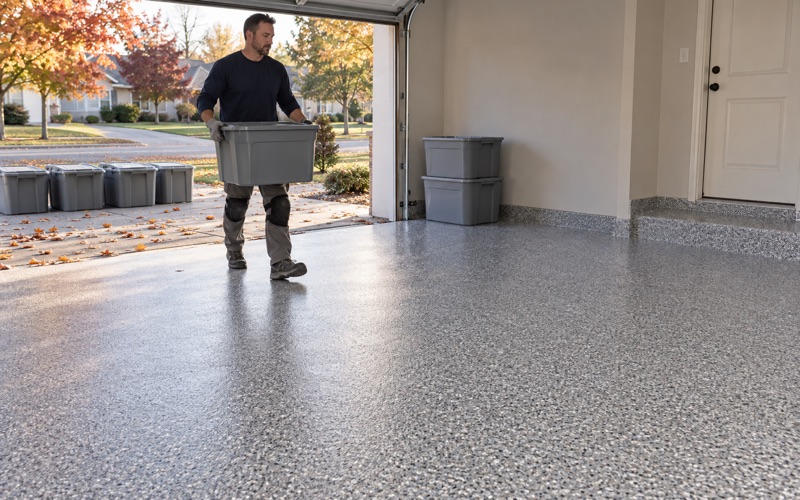
Many commercial epoxy systems are built with a quartz aggregate broadcast for texture, and many garage floors carry a vinyl flake broadcast. A coarse, open broadcast holds flour in every valley between the grains. For a bakery we lean toward a fine broadcast locked under a full topcoat, or a smooth 100% solids epoxy, so the surface reads as closed to a mop head and a vacuum.
The texture decision is not ours alone. An owner may have reasons to want more profile in one particular spot, and we will talk that through. Our point is narrower: every step up in texture is a step up in what the closing crew has to lift out by hand, and that trade should be made on purpose rather than carried over from a garage specification.
Joints, cracks and the wall line
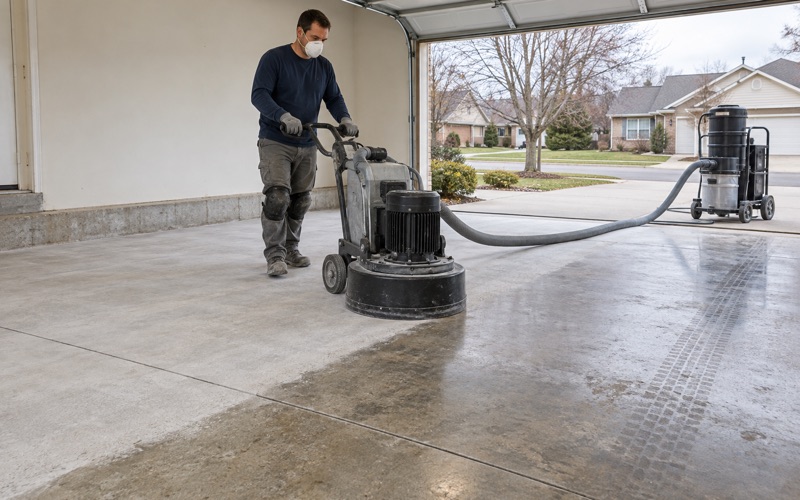
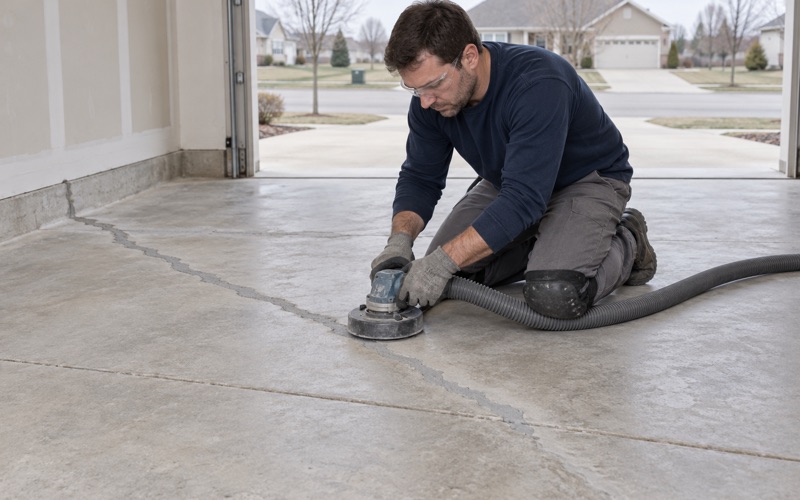
Flour finds seams. Saw-cut control joints, hairline cracks and the gap where the floor meets the wall all collect powder that a mop skims straight past. Control joints get a semi-rigid polyurea joint filler, cracks are repaired before any coating goes down, and the system turns up the wall as a cove so the corner becomes a curve rather than a crevice.
FDA Food Code 6-201.13 addresses coved floor and wall junctures in food establishments, and the cove is the detail that lets a dustless method work right to the edges. A vacuum wand or a damp mop can follow a curve. Neither can reach the bottom of a square joint packed with months of old flour and dried mop water.
Choosing the build with plan review in mind
Near ovens and proofers a bakery floor takes heat and humidity, and around the wash sinks it takes hot water and detergent. Depending on those loads we may propose a 100% solids epoxy under a polyaspartic topcoat, or urethane cement where temperature swings are the bigger concern. Either way, the final coat is picked for a closed, low-texture surface that cleans by the methods section 6-501.13 names.
In Will County, the Health Department’s Environmental Food Safety program conducts plan reviews, openings and routine inspections at food service operations and stores. When a food business is building out or remodeling, we write the floor scope so it can go straight into that review package, with the layers, cove height and intended cleaning method spelled out before a reviewer has to ask.
Cleaning After Closing, and When Floor Work Fits In
Section 6-501.12(B): clean when the least food is exposed
Section 6-501.12(B) says that, except for spills or accidents, cleaning shall be done during periods when the least amount of food is exposed, such as after closing. For a bakery that usually means the full wet clean or vacuum happens once the cases are emptied and covered. The finish has to take that nightly routine for years, detergent and hot water included.
That nightly cycle is also where a poor texture shows its cost. A crew working after closing has a set amount of time before heading home, and every extra pass over a grainy broadcast is time the shop pays for. A floor that releases flour on the first damp pass shortens the shift, which is the real return on choosing the finish carefully.
Closed Mondays and the work window
Listings show Fleckenstein’s closed Mondays, a common pattern for bakeries that work the other six days. For any food business, the closed day is where floor work has to fit, because grinding and coating cannot happen around open product. We plan shop and kitchen jobs around those dark days and overnight hours, so the room is back in service when the staff walks in again.
A single closed day does not suit every build, and we will say so before the job is booked. Sometimes the answer is phasing the floor in sections over several closed days, starting with the back of house and finishing at the counter. Sometimes it is a faster-return topcoat such as polyaspartic. Either way, the schedule is agreed before the grinder arrives.
Flour at home: the garage or basement baking room
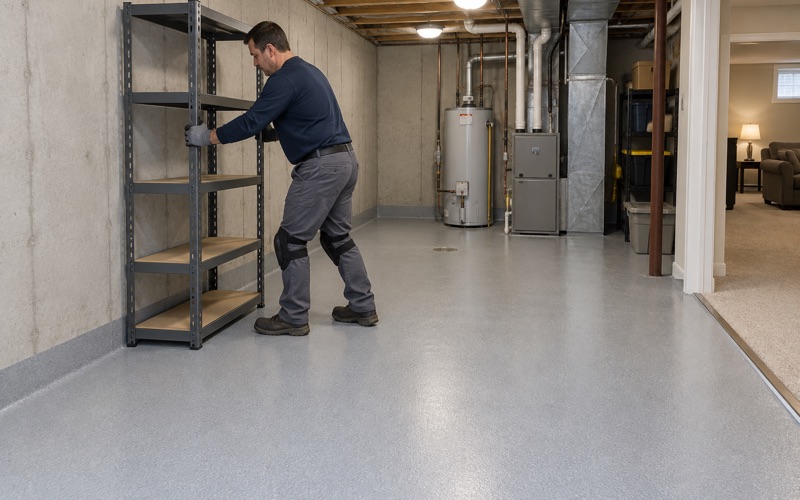
Mokena’s housing is young: 66.1 percent of it was built since 1990, and most residential floors here are 1990s and 2000s garage slabs. Home bakers who set up a second freezer, a stand mixer and a flour bin in the garage or basement track the same powder across bare concrete, which soaks it up and never quite comes clean.
A smooth, sealed coating with a coved edge lets that corner wipe clean the way a bakery floor does, without the commercial rules attached. Before a basement or garage slab is coated, we test it for moisture as a priced part of the scope, because vapor rising through the concrete is what lifts a coating, and it costs far less to know beforehand.
- 20+ Years of Floor Coating Work
- Moisture Testing in Every Scope
- Free Written Estimates