Plainfield Epoxy Flooring has more than 20 years behind it, and our work on epoxy flooring in Morris starts from one question: what happens to this floor when it fails? On most slabs the answer is cosmetic. On some, a coating that lets go sheds flakes, edges and grit onto a surface where loose material causes real trouble, and those are the floors this page is about.
A hangar is the clearest case. Aircraft engines can pull in loose items from the floor in front of them, and a chip of failed coating belongs in the same category as a dropped washer. That changes what a good result means. Appearance comes second; the measure is whether the system stays locked to the concrete for years of tires, tow bars and foot traffic.
The same standard carries over to shops and garages around town, where a flaking floor is a nuisance rather than a hazard. Below we cover the airport, what the federal safety guidance on foreign object debris says and does not say, how we prepare a slab so the coating holds, and how private hangar owners, tenants and homeowners can each judge a proposal before signing it.
Morris Municipal Airport and the hangar floor
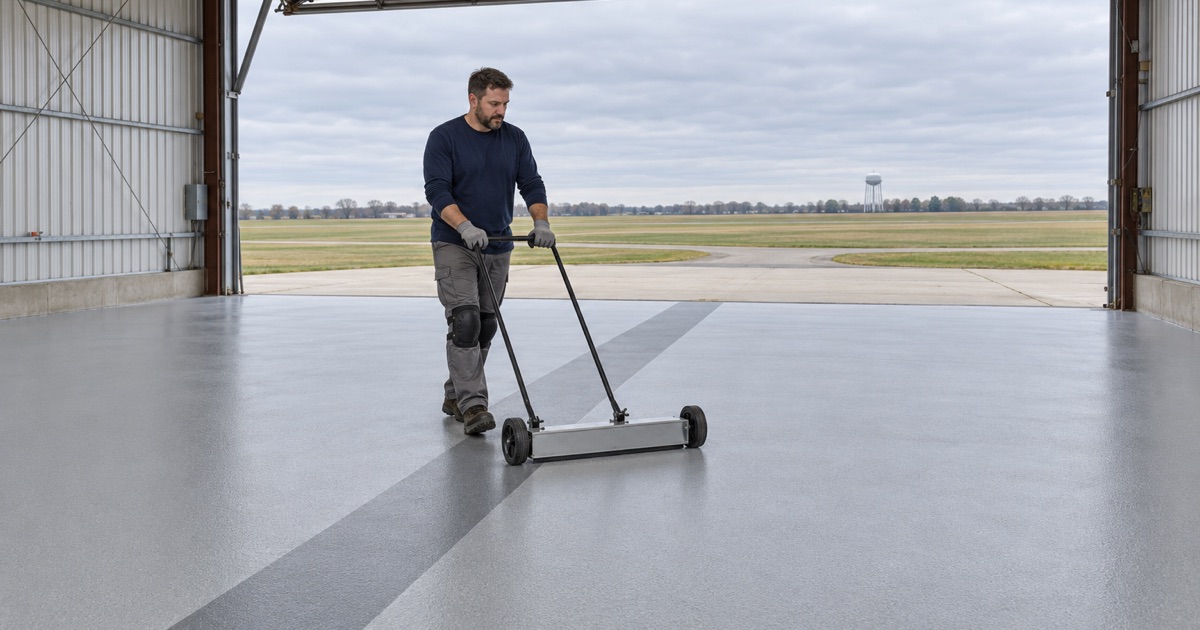
A city-owned field inside Morris on Route 47
Morris Municipal Airport, also named James R. Washburn Field and listed by the FAA as C09, is owned and operated by the City of Morris. It sits on Route 47 north of Interstate 80, and its coordinates fall inside the city limits in Saratoga Township. That puts a working general-aviation field within the city’s own boundaries, run by the same government whose Building and Zoning Office handles local permits.
The field’s numbers describe a busy small airport rather than a hub. It had 59 based aircraft in 2020, 54 of them single-engine, and handled about 116 operations a day, and current FAA data puts runway 18/36 at 5,501 by 75 feet of asphalt. The fixed-base operator sells 100LL and Jet-A fuel and offers parking, a lounge and courtesy cars.
Hangars, tiedowns and hangar leasing
Aircraft at C09 are kept in hangars or on tiedowns, and the airport lists hangar leasing and sales among its services. That means the floors under those aircraft belong to a mix of people: the city as owner, private parties who hold or buy hangar space, and tenants who rent a bay. Each has a different say in whether a floor gets coated and who pays for it.
AirNav lists airframe and powerplant service at the field as none, so we treat these hangars as storage and owner space rather than a repair shop floor. Even so, people cross them daily with their attention on an airplane rather than the ground, and the slab is where anything dropped, shed or worn loose ends up waiting for the next tire or intake.
Daily FOD walks start at the floor
The National Transportation Safety Board’s alert on foreign object debris suggests daily FOD walks in hangars, on ramps and on runways to find and remove loose items. A FOD walk is simple: someone covers the floor on foot and picks up anything that does not belong. How well it works depends partly on the surface, because a sound, intact floor makes stray objects easy to see and easy to sweep.
A floor that is breaking down works against the walk. Every pass turns up fresh flakes, the edges of a lifting patch keep feeding new pieces, and a crew can sweep the same bay clean on Monday and find it littered again by Wednesday. At that point the floor is not the stage for debris control. It is a source the walk has to keep chasing.
Looking for epoxy-flooring closer to Manhattan? See Epoxy-Flooring Services in Manhattan.
Paint chips on the NTSB’s debris list
What safety alert SA-054 says
Safety Alert SA-054, issued in June 2016 under the title Control Foreign Object Debris, lists examples of FOD: tools, hardware, eyeglasses, keys, portable electronic devices, paint chips and metal shavings. It warns that debris can be ingested into an engine or interfere with critical flight systems, and it points readers to the FAA’s advisory circular on airport FOD management. The current edition, AC 150/5210-24A, was issued in February 2024.
It matters just as much to be clear about what the alert is not. It is a maintenance safety alert that never mentions, rates or requires floor coatings, and we will not sell a coating as a compliance measure. What it does do is name paint chips as debris, and that is the line a floor contractor working near aircraft should take seriously.
When the coating itself becomes the debris
The alert describes one accident airplane whose fuel filter held debris that resembled paint chips after a recent repaint. That case involved the aircraft, not a floor, but the lesson transfers. Any coating that delaminates, whether from a wing or a slab, breaks into thin, hard pieces that are small enough to travel. On a hangar floor those pieces sit exactly where tires roll and propellers turn.
Floor coatings usually fail in recognizable ways: edges lifting at control joints, blisters that rupture and leave a ring of loose film, and patches that peel off in sheets where the bond was never good. Each of those is a supply line of paint chips. That is why we judge a hangar job on whether the coating is still attached, not on how it looked the day it cured.
Bare concrete dusts, too
Leaving a hangar slab uncoated does not solve the problem. A worn or weak concrete surface dusts under traffic, giving off a fine grit that settles on everything and is tracked from bay to bay. It does not show up as obvious chips, so a FOD walk can miss it, but it is still loose material on a floor where loose material is the enemy.
For an owner who wants bare concrete, a lithium silicate densifier can harden the top of a sound slab and cut down on dusting without adding a film that could later peel. Where a full coating is the better fit, the same logic applies in a different form: whatever goes down has to be tied into the concrete well enough that it never becomes the next thing on the floor.
Bond first: preparation, moisture and a build that stays put
Opening the slab before anything touches it
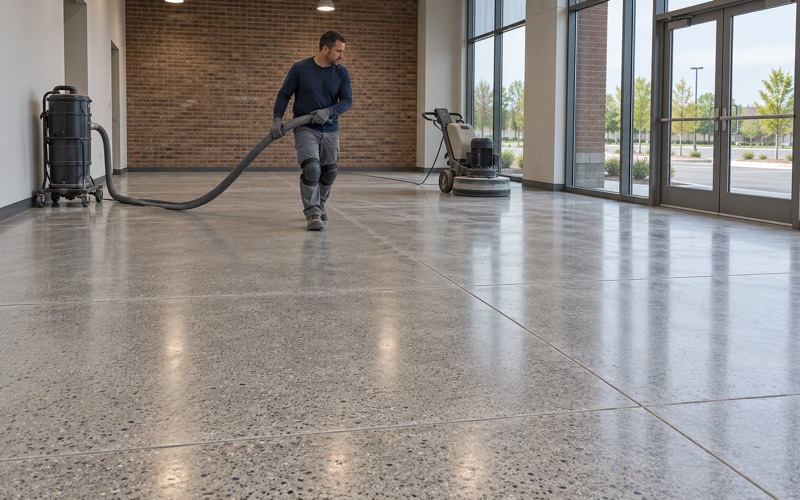
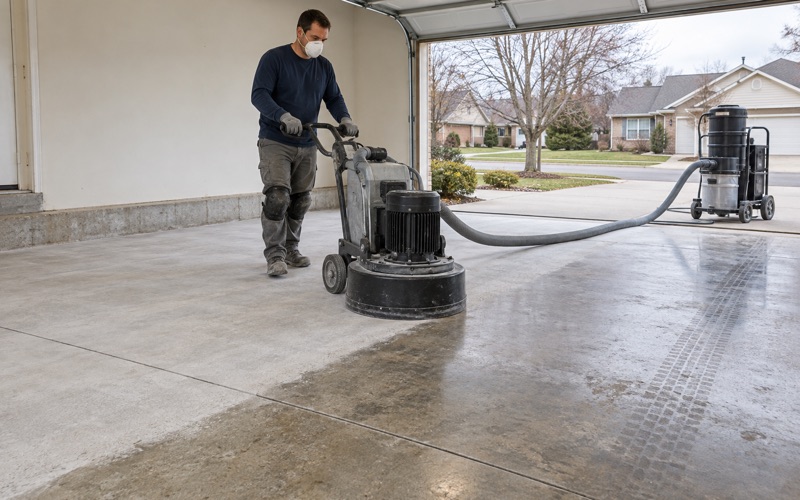
Bond is decided before a drop of resin is mixed. We open every slab mechanically, cutting through laitance, sealers and old film until there is clean, profiled concrete to grab, and we do not rely on acid to do that job. The target is an ICRI surface profile matched to the system’s thickness, so a thin sealer and a heavier build are not prepared the same way.
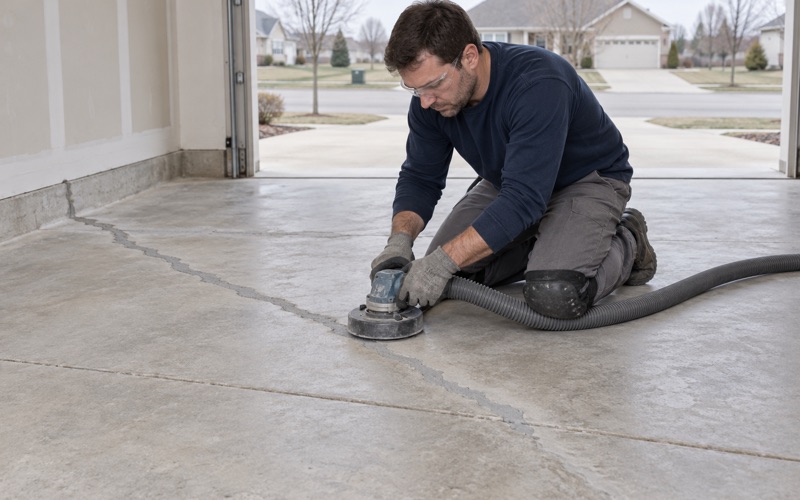
Before that, we walk the floor and read it. Old coating that is already lifting, cracks that have moved, and control joints packed with debris all tell us what the slab has been through, and they go into the quote as named work rather than surprises found halfway through grinding. Saw-cut joints get a semi-rigid polyurea filler so their edges stay supported under wheels.
Moisture testing on wet Grundy County ground
The ground around Morris gives every reason to test. The county soil survey places the Morris vicinity in associations that list wetness as the main limitation, several rated severe or poor for dwellings, with high water tables on level land and creek-bottom soils that flood nearly every year. Moisture pushing up through a slab is one of the most common reasons a coating blisters and lets go.
So moisture testing is written into our scope as its own line, priced before the job is sold, on a hangar slab as much as a basement. Depending on the floor, that can mean a plastic sheet check under ASTM D4263 as a first read and quantitative testing where the results decide the primer. When readings run high, a moisture-mitigation primer goes into the proposal from the start.
A system built for tires, tow bars and tugs
Once the slab is open and dry enough, the build has to suit what rolls across it. Aircraft tires pivoting in place, tow bars dropped on the floor and powered tugs all put shear and impact on the surface. A 100% solids epoxy base gives the thickness to absorb that, and a polyaspartic or polyurea topcoat adds abrasion resistance and helps guard against hot tire pickup.
Broadcast aggregate is a choice to weigh carefully in a hangar. Quartz can give grip around wet entry areas, but every particle has to be fully locked into the resin, because a loose broadcast is debris of another kind. Curing also needs attention in a large unheated building, where amine blush can form if the slab sits too close to the dew point while the epoxy sets.
Private hangars, T-hangar tenants and a workshop at home
Owners of private hangar space
If you own or are buying hangar space at the field, the floor may be your decision to make, within your agreement with the city. We start by looking at the existing surface and talking through how the bay is used, then build the scope around that rather than a standard package. A bay that only stores an airplane asks less of a floor than one where the owner spends every weekend on upkeep.
Timing matters for an owner who flies. A hangar floor is out of service from the first pass of grinding until the coating has cured hard enough for tires, so we plan the work around when the aircraft can be parked elsewhere on the field or tied down outside, and we tell you before starting how long the bay will be closed.
Tenants who lease a bay
A tenant renting a T-hangar is in a different position. The slab belongs to someone else, so before any coating goes down the lease terms and the owner’s approval come first; we can give you a written scope to bring to that conversation. If permission is not on the table, keeping the bare floor swept and walked daily is still the cheapest debris control there is.
We will also be direct about what we have and have not done here. We have not inspected any hangar floor at Morris Municipal Airport, we have no arrangement with the airport or its operator, and nothing on this page describes a past job at the field. Any assessment we give starts from your own floor, seen in person.
A home workshop or garage in town
The bond-first standard holds for a home shop or garage across Morris, where the stakes are lower but the failure looks the same. The housing stock runs older than in many neighboring towns, with more than a quarter of units built before 1960, and an older slab often carries a sealer, paint or patch work that has to come off before anything new will hold.
Homes near the Illinois River need one plain statement. The city’s plan notes moderate annual flooding along low-lying land by the river and a substantial floodplain on its south side, and a floor coating is not flood protection. Where a slab sits in that low ground, our moisture readings weigh even more heavily on whether a coating belongs there at all.
- 20+ Years of Floor Coating Work
- Moisture Testing in Every Scope
- Free Written Estimates