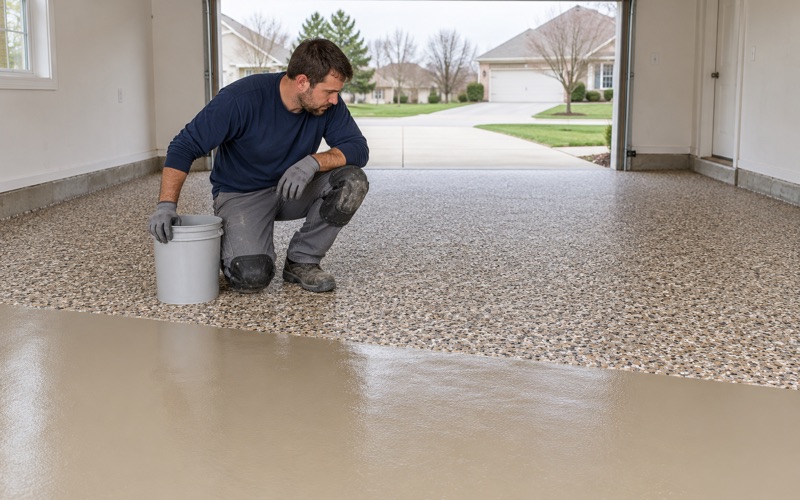
Plainfield Epoxy Flooring has spent more than 20 years on epoxy flooring in North Aurora and the rest of the Fox Valley, and the part of the job we plan most carefully here is the part nobody sees in the finished photos: the water. Degreasing, stripping and grinding all make waste, and on most garage jobs that waste wants to leave through the overhead door.
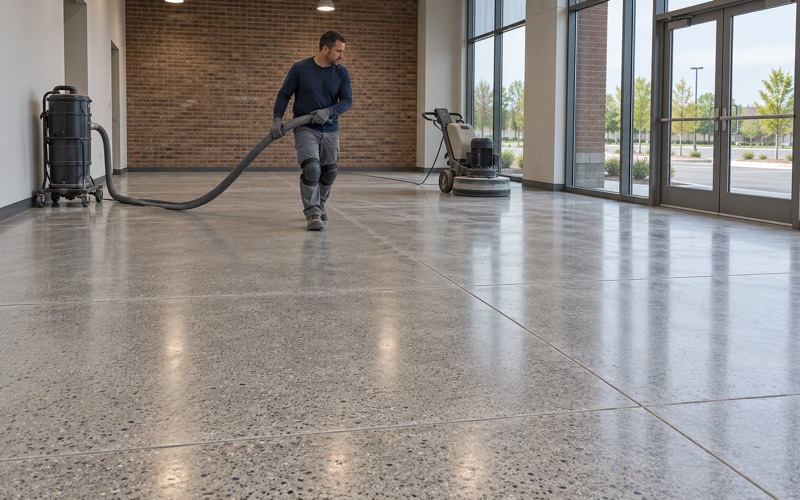
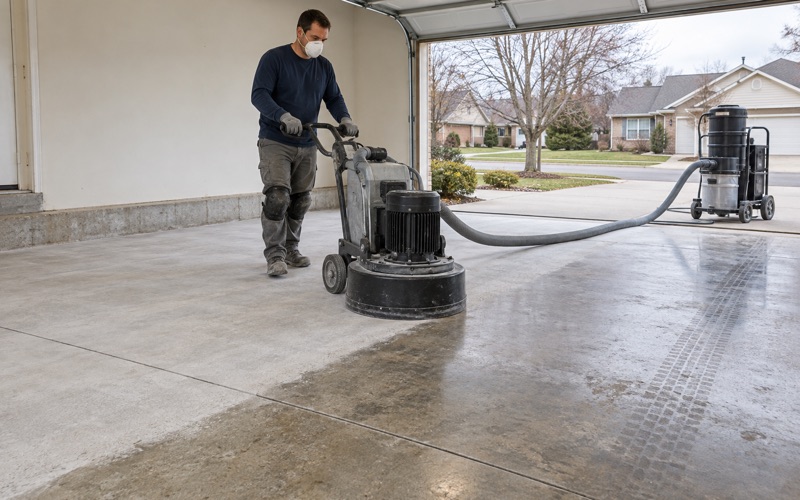
We open every slab mechanically with a diamond grinder or a shot blaster, with the dust pulled into a vacuum at the tool, and we do not acid etch. That one choice removes most of the rinse water a coating job used to make. What is left, we catch with a wet vacuum, berms and absorbent and carry out with the rest of the job’s waste.
The rest of the scope is written down before we start. Moisture testing is a line item, the proposal names the product, the system build and the finished thickness, and the warranty exclusions are read out with moisture named first. A homeowner can check what went down against what was quoted, line by line.
Where a North Aurora driveway drains, and the rule that covers it
A garage apron is the top of a drainage path. In North Aurora that path runs from the driveway to the gutter, into a street inlet and through the village storm sewer system, and it ends in the Fox River or Blackberry Creek.
The storm sewer is not a treatment line
The sanitary line from a house goes to the Fox Metropolitan Water Reclamation District for treatment. The storm sewer under the street does not. It carries rain, snowmelt and anything else that reaches an inlet straight to a receiving water, and in this village the receiving waters are the Fox River, which runs north to south through town, and its tributary streams.
That makes the end of a driveway a different place than it looks. A bucket of gray rinse water poured on the apron is not going somewhere to be cleaned. It is going to the river, carrying whatever was in it, and no step in between takes anything out.
Outfalls the village logs by name
North Aurora is an MS4 community under the Illinois EPA general stormwater permit, ILR40, permit number 0401. Its 2023-24 annual report, signed February 20, 2024, lists the storm sewer map’s discharge points to the Fox River and tributary streams, and logs outfalls to the Fox River or Blackberry Creek.
The Public Works Director dry-weather screened outfalls to the Fox River on February 7, 2024, including a 60-inch reinforced concrete pipe near the intersection of Oak Street and Monroe Street, and found no illicit discharges. Dry-weather screening is the check for exactly what a careless prep job would put in a pipe: flow that is not rain.
What the ordinances say
The village adopted an illicit discharge detection and elimination ordinance approved May 16, 2016, and its code states it is unlawful to discharge to any natural outlet without an NPDES permit. A garage-floor contractor holds no such permit, and neither does the homeowner, so the plan has to be that nothing from the job reaches an inlet.
Ordinance 2001-73 addresses construction wastes, naming chemicals and concrete truck washout among the materials that may harm water quality. The village also adopted the Kane County Stormwater Ordinance by reference in 2019. We read those as describing the waste a coating job makes, and we plan the job around them.
Looking for epoxy-flooring closer to Warrenville? See Epoxy-Flooring in Warrenville.
What a garage-floor job washes out the door
Most of the water on a floor-coating job is created by the method, not by the floor. Change the method and most of the waste disappears before it exists.
Degreaser rinse and an old etch step
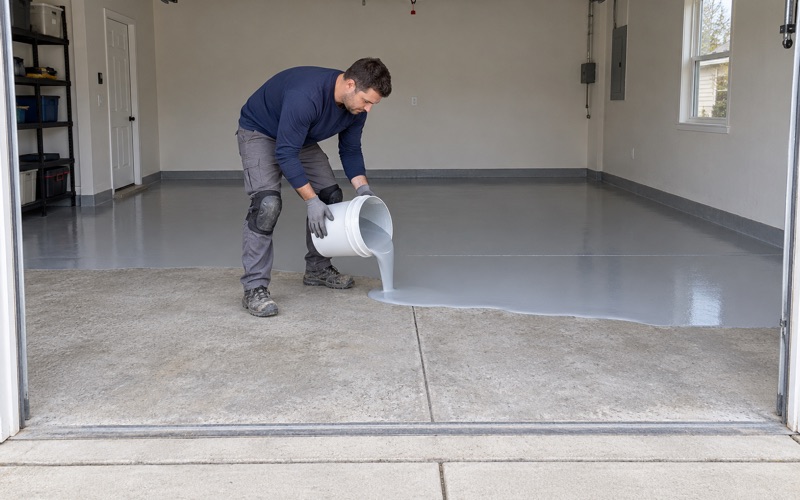
A garage slab in North Aurora has years of oil drips, tire residue and winter salt in it, and the old habit was to scrub with degreaser and hose it out the door. That rinse carries the degreaser and everything it lifted, and on a sloped garage floor it heads straight for the apron.
Acid etching added a second rinse on top of the first, plus a neutralizing wash. We do not acid etch at all. A ground surface reaches a measurable ICRI CSP profile without any rinse, which is why it bonds more reliably and why our jobs make so much less water to begin with.
Grinding slurry
Wet grinding cuts dust by flooding the floor, and the result is grinding slurry: water loaded with fine concrete paste, sand, and whatever coating or sealer the diamonds took off. Left alone it dries into a gray crust on the driveway, and rinsed off it goes into the storm sewer as a cloud of fines.
We grind dry, with the shroud on the grinder connected to a dust extractor, so the material comes off as dust in a bag rather than slurry on a slab. Grinding dust is collected at the grinder and never washed toward a floor drain or a storm inlet.
Stripping an old coating
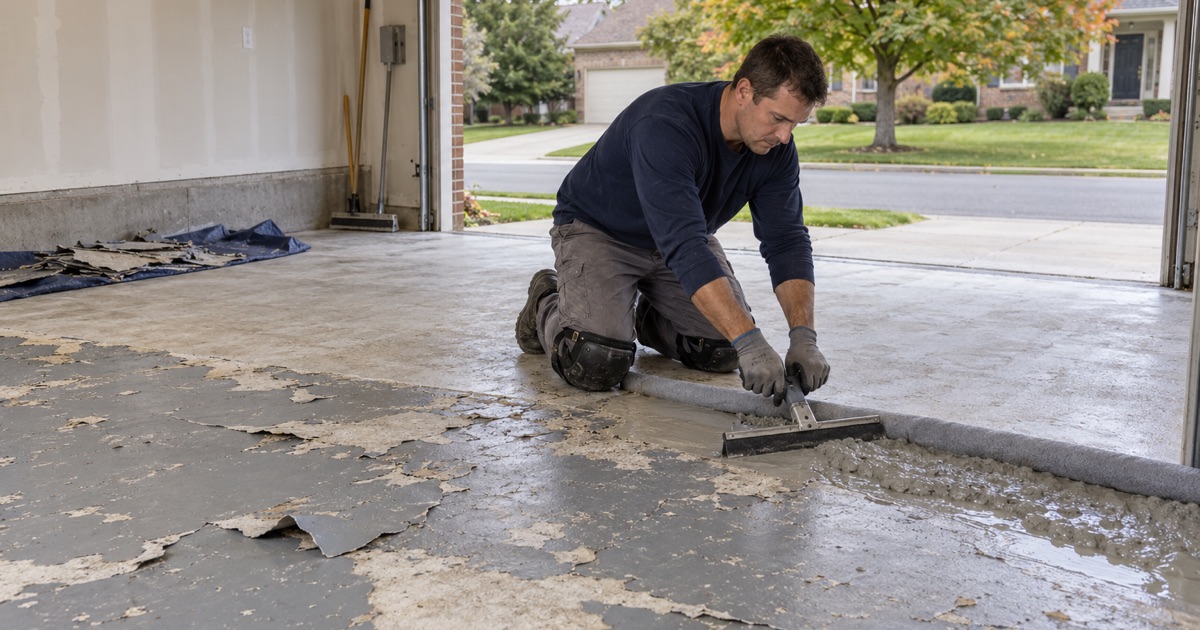
A failed coating, a peeling store-bought kit or an old paint layer has to come off completely before a new system can bond. Chemical strippers turn that into a sludge that has to be scraped and rinsed, and the rinse is the worst water on the job, because it carries the stripper and the softened old coating with it.
We remove old coatings mechanically, with the same vacuum-attached grinder or a scraper, and the debris is swept and vacuumed up dry. If a spot does need a solvent or a wet clean, it is worked in a small area and picked up before it moves.
Dry prep, wet vacuums and berms
The goal on a North Aurora job is simple to state: by the time we leave, nothing from the floor has gone past the garage door. The methods below are how we keep it that way.
Vacuum-attached grinding and shot blasting
Diamond grinding and shot blasting both open the slab without water. The grinder’s shroud and the blaster’s recovery system feed a dust collector, the shot is separated and reused, and the concrete fines end up bagged. A slab prepped this way is clean, dry and ready for a moisture test the same day, with no wet surface to wait on.
Dry prep also means the moisture reading reflects the slab and not our cleanup. A floor that was just hosed down cannot give an honest ASTM F2170 relative humidity reading or a fair ASTM F1869 calcium chloride test, and those results decide whether a moisture-mitigation primer goes into the system.
Catching what water there is
Some jobs still need a wet step, such as spot cleaning a deep oil stain or washing a floor that a car has been parked on through a winter of brine. When that happens, the work stays inside a berm laid across the door, and a wet vacuum picks the water up while it is still on the slab.
Absorbent goes down on anything oily, and the recovered water is containerized rather than dumped. It leaves with the job’s other waste. We do not hose a garage out toward the street, and we do not tip a bucket into a yard, a gutter or the inlet at the curb.
Why a coating is not the protection here
A new floor makes later cleanup easier, because spills sit on a sealed surface instead of soaking into bare concrete. That is a maintenance benefit for the owner, not a stormwater measure, and we do not describe it as one. The village’s rules are about what leaves a property, and the coating does not change that.
What changes it is how the floor is washed afterward. A sealed garage floor cleans up with a mop and a small amount of water, picked up with a squeegee and a wet vacuum, rather than a hose and a push broom aimed at the driveway.
Basement drains, permits and the paperwork before a North Aurora job
The storm side is the part of the job this village’s permit tracks most closely, but it is not the only thing we settle before a start date. Basement floors, permits and contracts each get their own conversation.
A basement floor drain is a separate question
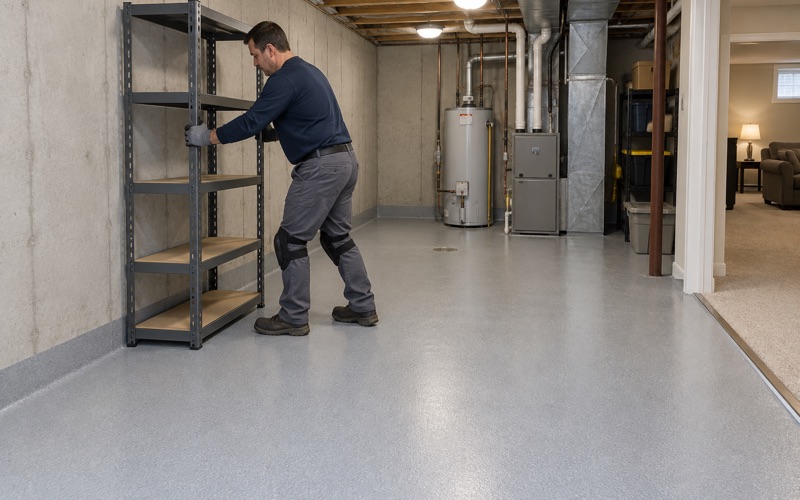
In a basement there is no driveway to drain to, and a floor drain is the obvious place for rinse water to go. We treat that as a separate question rather than a convenience. The sanitary system that serves North Aurora is treated by Fox Metro, and it is not a place for grinding fines or stripper residue either.
So a basement job is prepped the same dry way, and any water is vacuumed up rather than squeegeed toward the drain. Before quoting a basement floor we find out where any water in the slab is coming from, because a coating is a finish, not a fix for water moving up through concrete.
Permit-free, but not paperwork-free
The Village of North Aurora’s building and zoning page lists flooring and painting among projects that do not require a permit, and it states that contractor registration is not required, apart from state roofing and plumbing licenses for those trades. A floor coating on its own is permit-free here. Slab replacement, driveways and structural work are on the permit list.
Illinois issues no state license for flooring or coatings, so we confirm each village’s own rules before scheduling, and in North Aurora that check comes back simple. Every home job still gets a written contract and the Home Repair: Know Your Consumer Rights pamphlet before work starts, as the Illinois Home Repair and Remodeling Act requires.
Slabs, cracks and when to wait
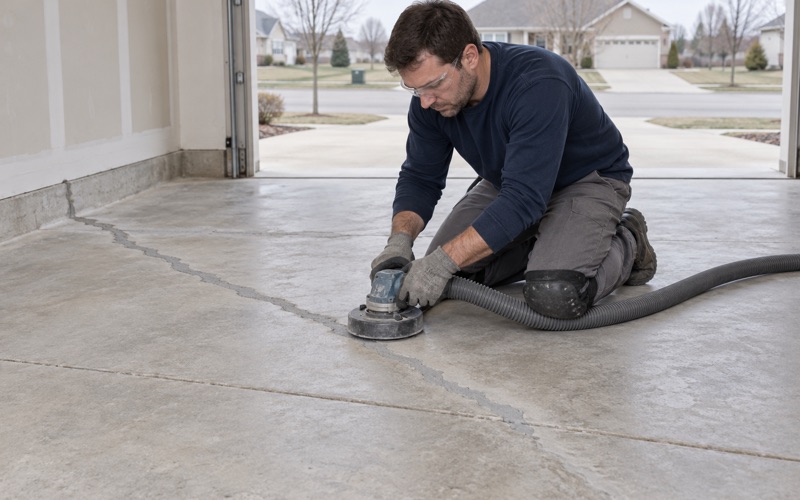
Half of North Aurora’s homes were built in 2000 or later, which puts many garage slabs at roughly 15 to 25 years old. We read the cracks, joints and any old coating before quoting, and if a slab needs repair or replacement before it can be coated, we say so plainly and price the floor per square foot for the system actually proposed.
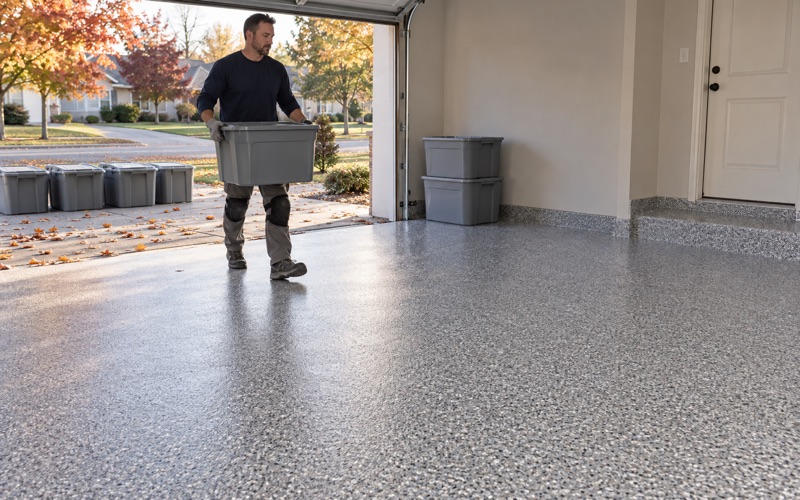
Garage systems are built for the calcium chloride brine and rock salt that ride in on tires all winter, usually 100% solids epoxy under a polyaspartic topcoat with a flake or quartz broadcast. Curing is scheduled against slab temperature and the dew point spread, and when an unheated garage is too cold, we tell the owner it has to wait for spring.
- 20+ Years of Floor Coating Work
- Moisture Testing in Every Scope
- Free Written Estimates