Plainfield Epoxy Flooring handles epoxy-flooring in Northlake with more than 20 years in the trade behind it, and the warehouse work here usually starts with a question most coating quotes skip. Who owns the slab when the lease ends? A tenant can put down a floor that serves the operation well for the whole term and then pay to have it taken back out. We plan coatings, lines and anchor locations around the day the keys go back.
That planning changes the product list from the first conversation. A floor that has to come off cleanly, or stay on with the owner’s blessing, is a different specification from one a building owner will keep for decades. We size the system to the term the tenant actually holds, and we tell a tenant early when the cheapest floor to install would be the most expensive one to hand back.
Owner-occupied shops and garages sit at the other end of the same decision, and we cover them near the end of this page. Most of what follows is about large leased buildings, because that is where a floor choice made in the first month decides a bill that arrives years later. The clauses we quote are samples from filed industrial leases, not Northlake rules, and your own lease is the document that governs.
Leased Bulk Warehouses on Northwest Avenue

Grand Warehouse and the Northlake III Building
Northwest Avenue is lined with bulk distribution buildings, and one of them shows the pattern clearly. Grand Warehouse & Distribution, listed at 599 Northwest Ave, occupies a 2006 build-to-suit in Duke Realty’s Northlake III, which grew by 51,884 square feet in 2017 to 229,604 square feet. That is a landlord’s building with a tenant’s operation inside it, which is exactly the arrangement this page is about.
We have no relationship with Grand Warehouse or its landlord, and we have not read that lease. The point is the structure, not the company. When a tenant expands into added square footage in a building someone else owns, every line, sealer and rack anchor in the new space becomes something the tenant may have to account for when the term ends, on top of the original floor.
The Slab Belongs to the Landlord
In a leased bulk building the concrete is part of the real estate, while the striping, coatings and rack anchors are the tenant’s improvements for as long as the term runs. That split is why two floors that look identical on move-in day can carry very different costs at the end. One was laid with a plan for surrender, and the other leaves the tenant working through a landlord’s punch list.
Our survey of a leased slab therefore records more than wear and cracks. We note the existing lines, previous sealers and anchor patterns the tenant inherited from whoever leased the space before, and we photograph them before work begins. If the move-in condition is ever disputed at surrender, the tenant then holds a dated record of what the floor carried before we touched it.
Who Signs Off in Northlake
Floor work inside the City of Northlake runs through the Building Department, and every contractor and subcontractor must be registered there: a $100 license good for one year from issuance, a $10,000 bond and a certificate of insurance naming the city. Illinois issues no state license for coatings work, so we confirm our Northlake registration is current before a warehouse date goes on the calendar.
Where a coating question touches fire code, it goes to the Northlake Fire Protection District, which is a separate district rather than a city department. The landlord is the third party with a say. In a leased building that signature often matters most, because it decides whether the floor work is an approved alteration or an item the landlord can later ask to have reversed.
Looking for epoxy-flooring closer to Alsip? See Epoxy-Flooring Services in Alsip.
What a Lease Says About the Floor at Move-Out
Striping Removed With No Residual Staining
Sample floor-return clauses collected from filed industrial leases are blunt about lines. One reads, “All floor striping in the Premises shall be removed with no residual staining.” Paint soaks into bare concrete, so getting it out is a grinding job, and the faint ghost of an old aisle is exactly what the words no residual staining are written to catch when a landlord walks the floor.
That is why we ask how lines will come off before we discuss how they go on. A line painted on raw concrete has to be ground out at surrender, which takes a thin skin off the slab along every aisle. A line captured inside a coating system comes off with that system, or stays where the landlord has agreed to keep it, and making that choice costs nothing on day one.
Stains, Tire Marks and a Broom-Swept Floor
Other sample clauses ask for a surrender free of “floor striping, forklift marks, oil and other stains, stickers and signs (including paint or tape),” and one asks only for the warehouse floor in “a broom swept-like condition.” Bare concrete takes oil and tire rubber into its pores, where no sweeper reaches. A sealed or coated surface holds those marks on top, where an ordinary scrubber can lift them.
One landlord work letter in the same sample set reads, “Remove yellow striping, dirt and oil and apply clear sealer on floor,” and charged the tenant $36,600 for it as part of tenant improvement rent. That figure belongs to that lease alone. It still shows that floor return is a line item landlords price, which is why we would rather a tenant settle the floor’s end state with the landlord at the start.
Racking-Bolt Holes and Cracks Filled With Epoxy
Rack anchors leave holes, and one sample clause asks for a floor “swept with no racking bolts and other protrusions or holes left in floor.” Another reads, “Cracks and racking bolts must be repaired with an mm-80 (or other reasonably approved equivalent) epoxy.” A building with long rows of pallet rack can carry hundreds of racking-bolt holes, each one cut off, cleaned and filled before the keys go back.
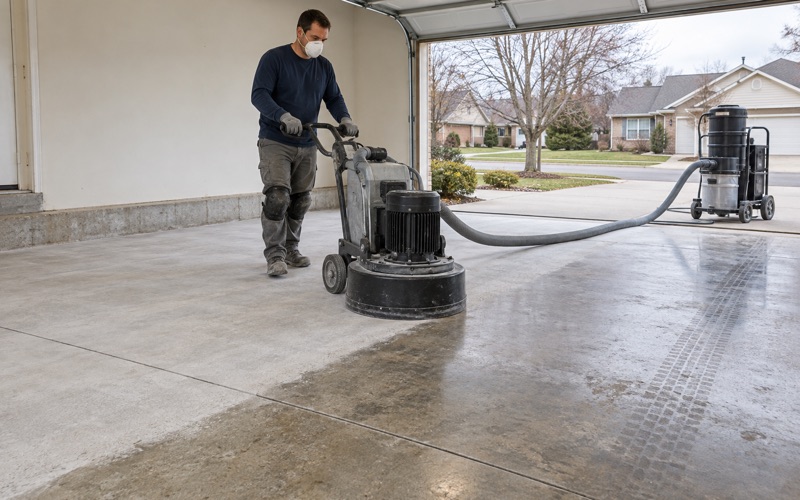
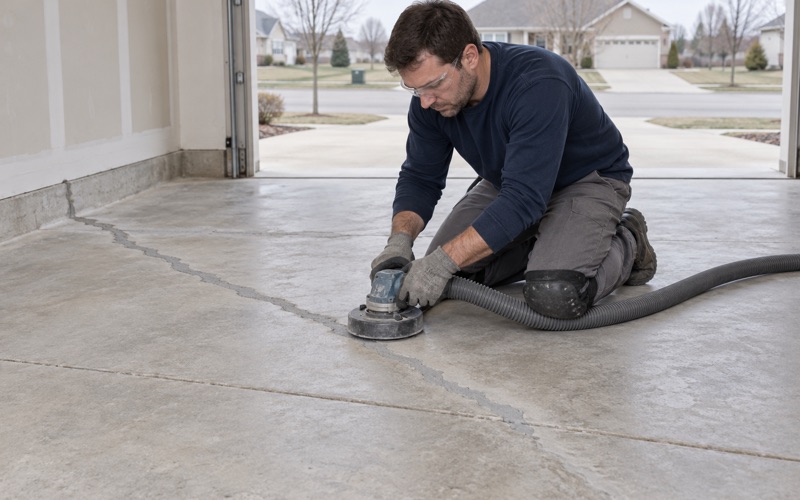
We fill those holes with a rigid epoxy and grind each fill flat with the surrounding concrete, so a pallet jack rolls across without a bump and the repair reads as one surface. Cracks get the same care, opened clean and filled rather than skimmed over. Where a coating will remain with the building, the fills go in beneath it rather than sitting as patches on top.
Planning the Coating at Move-In
The Landlord’s Written Consent Comes First
Before any coating goes onto a leased slab, we ask the tenant to obtain the landlord’s written consent naming the system, the line plan and what happens to both at surrender. A coating installed without that letter can turn into an unapproved alteration the landlord may want removed. With it, the tenant knows in advance whether the floor stays, comes off, or simply gets cleaned when the term ends.
We give the tenant a plain description the property manager can review: which resin goes down, how the surface is prepared, and how the floor would be taken back to concrete if the landlord asks. Some landlords welcome a sealed floor because it protects their slab, while others want bare concrete returned. Either answer is workable, provided it is in writing before we start.
Lines Chosen for How They Leave
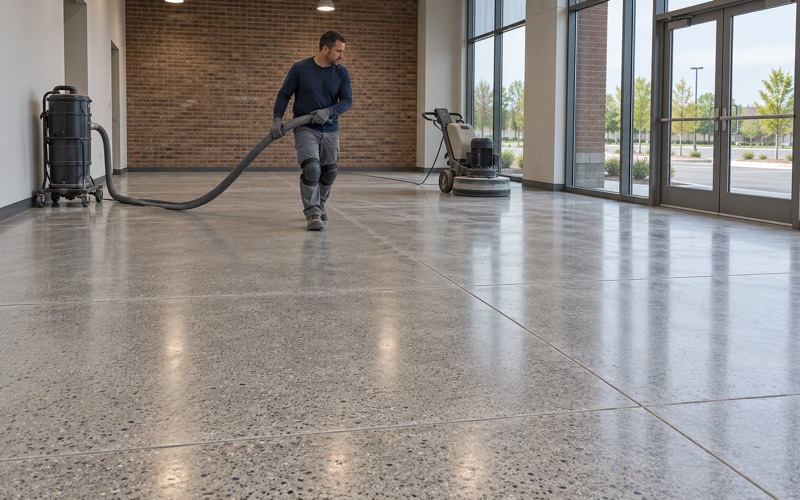
For a tenant who needs lines and a landlord who will accept a coated floor, the plan that hands back most cleanly lays the color inside the coating system rather than on bare concrete. The slab is ground to a profile, the base coat and lines go down together, and a clear 100% solids epoxy or polyaspartic topcoat seals over them. At surrender the whole system either stays by agreement or comes off as one layer.
When the landlord would rather have bare concrete back, the opposite plan can cost less overall: no full coating, lines painted directly on the slab in a color the landlord accepts, and removal by grinding budgeted from the start. Either way the decision is made once, written down and priced against the term, instead of being discovered during a walkthrough.
Working Around a Running Dock
A tenant moving into a Northwest Avenue building often has trucks booked before the floor is finished. We schedule grinding, coating and cure in overnight and weekend windows, zone by zone, so receiving keeps moving while the next bay cures behind a barrier. A fast-return polyaspartic topcoat can shorten the time each zone sits out of service, where the slab conditions allow it.
Owner-Occupied Shops and Garages: The Floor Is Yours to Keep
A Different Calculation for Owners
Not every Northlake floor is leased. Of the city’s 4,277 occupied housing units, 3,020 are owner-occupied, about 70.6 percent, and an owner with a private shop or garage faces none of the surrender math above. The floor is theirs to keep, so the system can be chosen for the years they plan to stay rather than for a clean exit.
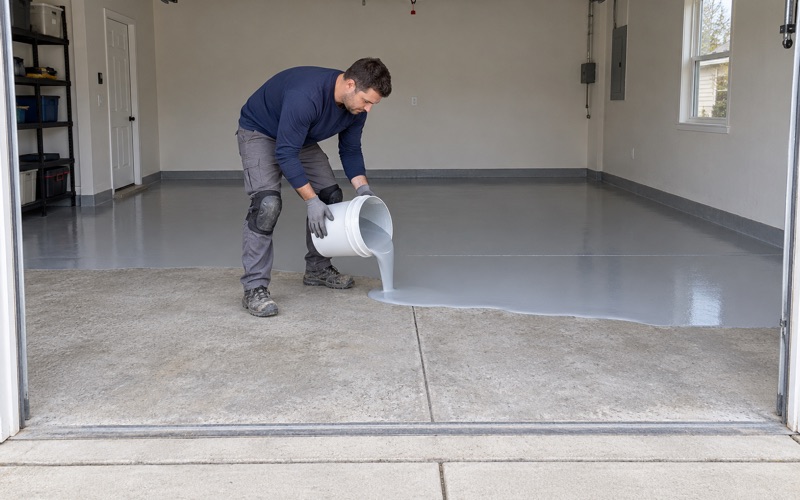
That shifts the specification toward a full-build floor: a 100% solids epoxy body coat, a vinyl flake or quartz aggregate broadcast for texture, and a polyaspartic or polyurea topcoat over it. An owner never has to ask whether those layers come off. The only question is how the floor will wear under the traffic it carries, from a work van to a daily driver.
Owned Industrial Buildings
When the company owns the building, a heavy-duty urethane cement or a high-build epoxy makes sense because no surrender clause will ever ask for it to come off. We still record the slab’s condition before work begins. An owner who later leases the space out becomes the landlord in this story, and a clear record of what the floor carried helps set fair return conditions for the next tenant.
Home Garages and Winter Salt
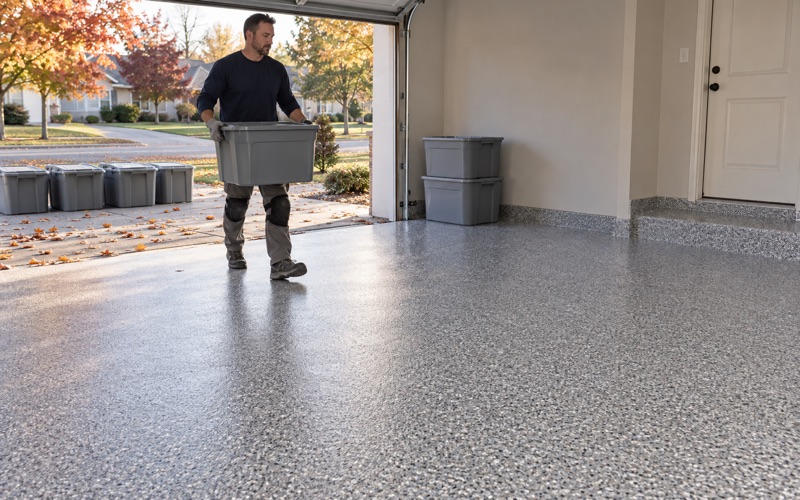
Most owner-occupied homes here are single-family detached houses, 2,627 by the census count, and many have a garage slab that takes road brine off the tires every winter. Calcium chloride and rock salt eat into bare concrete over time. We build those garage floors with a broadcast texture and a chemical-resistant topcoat, so the brine sits on the surface until it is rinsed away rather than soaking into the slab.
- 20+ Years of Floor Coating Work
- Moisture Testing in Every Scope
- Free Written Estimates