Plainfield Epoxy Flooring brings more than 20 years of epoxy-flooring work to Palos Heights, and this page takes up one narrow question that matters to anyone who cleans a floor for a living: what the disinfectant label on the bottle actually covers. The answer depends less on the product than on the floor under the mop. A sealed, seamless surface is the one the label was written for.
Most people assume a registered disinfectant works wherever it is poured. The federal registration says otherwise. Kill claims are tested and printed for a particular kind of surface, and a floor that drifts out of that category drifts out of the promise, even when the person mopping follows every step printed on the container. That gap is a flooring problem, not a cleaning one.
Care communities, clinics and homes where a relative is recovering all share it. Below we walk through the label language, the floors that fall outside it, and how a coated floor is built and kept so it stays inside the category. A coating never disinfects anything. Its job is to hand the product the kind of surface it was tested on, and to keep handing it that surface for years.
Independent Living, Assisted Living and Memory Care on College Drive
One Campus, Three Levels of Care
Palos Heights Senior Living sits at 7100 W. College Drive, inside the city limits and on the Worth Township side of the line, while city hall farther west at 7607 W. College Drive falls in Palos Township. The community’s own page describes independent living, assisted living and memory care in one place. Trade press reported a 178-unit, roughly $30 million Spectrum project, and later summaries give 99 independent, 55 assisted and 24 memory care apartments, opening in 2020.
We have not worked in that building, and we have not seen its floors, its cleaning products or its housekeeping records. It is not a customer of ours. We use it because one address running three levels of care is the clearest local picture of a building where floors are disinfected as a matter of routine, and the label question on this page applies to any community built the same way.
Floors That Get Disinfected, Not Just Mopped
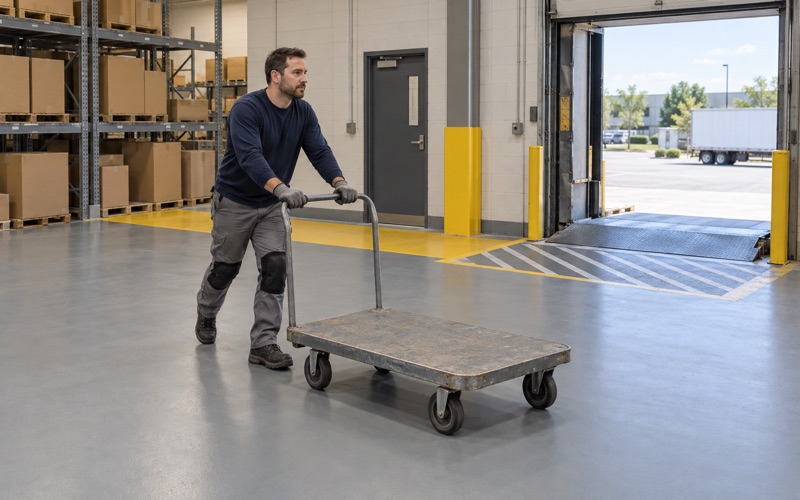
In assisted living and memory care, housekeeping typically works through dining rooms, corridors and common rooms with a registered disinfectant, and steps that work up when an illness moves through a building. That routine assumes the product does what its label says on every square foot it touches. The floor is the largest surface in the building, and it is the one least often asked whether it qualifies.
A facilities director usually judges a floor on appearance, wear and cost. The label adds a test that rarely makes the bid sheet: is this surface hard and non-porous today, rather than on the day it was installed? A floor that passes lets the product’s tested claim apply. A floor that fails leaves the disinfectant doing a job nobody tested it for, while the log records the work as done.
Why the Floor Belongs on the Housekeeping Checklist
None of this asks a housekeeper to change products or a nurse to change procedures. It asks the person who owns the building to treat the floor finish as part of the cleaning system rather than as decoration. When a floor is specified, repaired or recoated with the label in mind, the people mopping it can trust that the minutes they wait are the minutes that were tested.
Looking for epoxy-flooring closer to La Grange Park? See Epoxy-Flooring Services in La Grange Park.
What a Disinfectant Label Actually Promises
Hard, Non-Porous Surfaces at a Stated Contact Time
EPA’s registration letters spell out what a claim covers. On April 7, 2010, the agency accepted claims for Germ Away Foaming Germicidal Cleaner, EPA Reg. No. 44446-23, against influenza A (H1N1) virus on hard, non-porous surfaces in the presence of 5% fetal bovine serum, at a 10-minute contact time. Every part of that sentence is a condition: the surface, the soil load and the minutes the surface stays wet.
A 2007 letter on another product, EPA Reg. No. 1839-83, accepted MRSA claims on the same class of surface at a three-minute contact time. The pattern repeats from label to label. The minutes belong to a smooth, sealed test surface, and a floor that lets the solution soak in or drain into a seam cannot be expected to hold the product wet and in contact the way the test did.
The Word ‘Glazed’ on a Tile Label
The 2010 letter carries a sentence every floor buyer should know. EPA told the maker to add ‘glazed’ as a descriptor to porcelain and tile, and said that in the absence of that word, those use surfaces are porous. Unglazed tile, in other words, sits outside the hard, non-porous class, even though it feels hard underfoot and looks easy to clean.
This is where housekeeping habits and the label part ways. A tile floor wears well and mops up bright, so it is easy to treat as the ideal surface for a disinfectant. Under the agency’s own reading, unless that tile is glazed, the label makes no promise about it at all, and the same product and the same wait accomplish less than the cleaning schedule takes for granted.
What No Floor Can Promise About C. difficile Spores
The 2007 letter also shows the limit of any floor. EPA struck every claim against the vegetative form of Clostridium difficile, because the spore is the public-health concern and a vegetative claim gives buyers a misleading impression. Whether a product works on C. difficile spores is a question about that product’s own sporicidal claim, never about the surface underneath it.
We say this plainly because floor coatings are sometimes sold as if they did the disinfecting. Ours do not. An epoxy or polyaspartic film is not antimicrobial, kills nothing, and is not a product EPA registers to disinfect anything. What it can do is keep a floor inside the surface class a label was written for, which is a narrower promise and an honest one.
Bare Concrete, Open Grout and a Worn-Through Traffic Lane
Bare and Densified Concrete
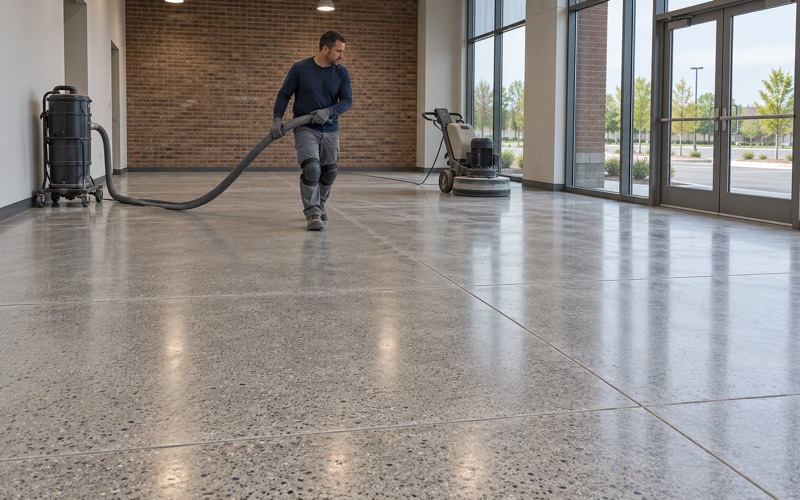
Bare concrete is porous by nature, which is why it darkens when wet and why spills wick into it. A lithium silicate densifier hardens the top of a slab and cuts down on dusting, but it leaves a cementitious surface behind rather than a continuous film. For label purposes, a densified service hallway or back-of-house corridor is still bare concrete, however polished it looks.
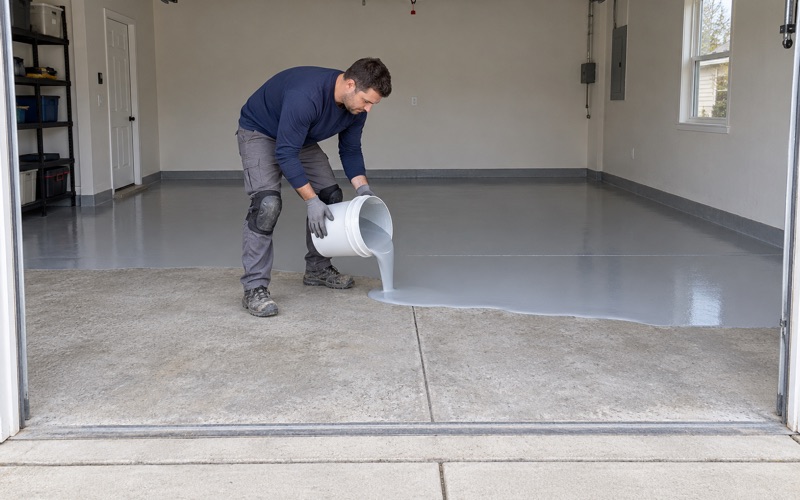
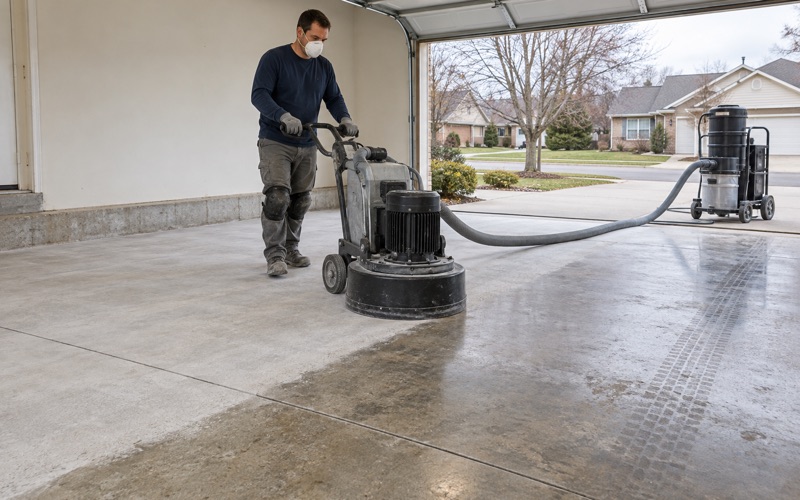
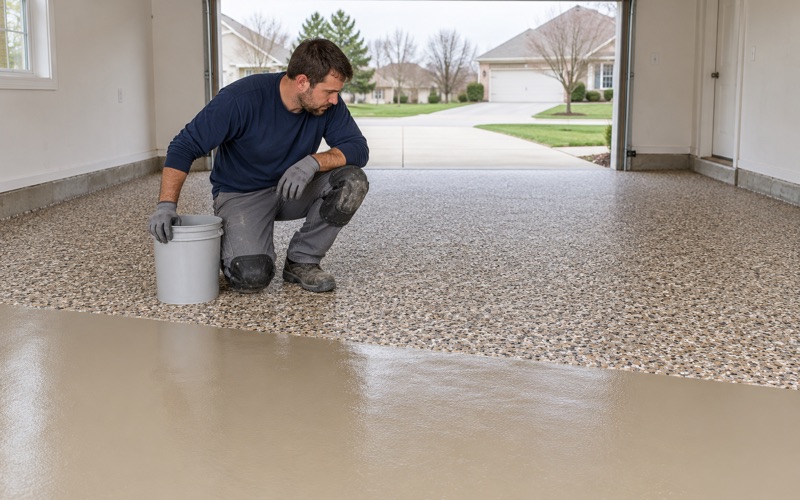
Turning that slab into a hard, non-porous surface means building a film on it. In a care building that usually means a 100% solids epoxy body coat, a polyaspartic or polyurea topcoat, and a semi-rigid polyurea joint filler so the saw cuts do not stay open. Where hot water and harsh cleaning are daily facts, urethane cement is the tougher base. Each room gets the build its traffic calls for.
Grout Lines and Unglazed Tile
Even glazed tile has a weak point. The grout between tiles is a cementitious joint, and open grout is porous. A long corridor of small glazed tile carries a great many linear feet of grout, each line a narrow channel where solution collects and soil settles. The glaze qualifies the tile face, and the joints are a separate surface with a separate answer.
Where a facility wants to keep its tile, the joints are the work: cleaned out, repaired and sealed, with the honest note that sealed grout needs upkeep of its own. Where the tile is unglazed or failing, removing it and coating the prepared slab replaces a field of joints with one seamless surface. Which route makes sense depends on the condition of the tile, not on a standard package.
When a Sealed Lane Wears Through
A coated floor qualifies only while the film is whole. Dining room entries, the path from an elevator to a front desk and the turn at the end of a corridor wear first, and once the topcoat has worn down to the body coat or the slab, that lane is porous again. The rest of the room still looks sealed, so the gap goes unnoticed for months.
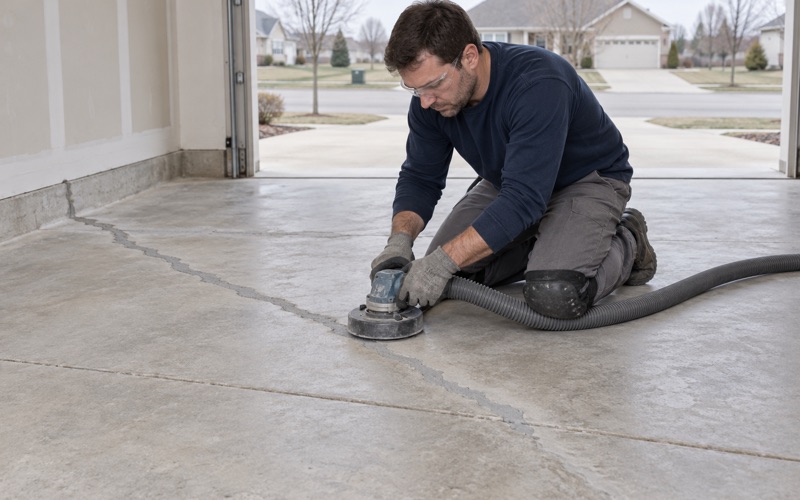
Cracks and failed joints do the same thing on a smaller scale. A hairline crack across a corridor is a strip of open concrete, and a filler that has pulled away from one edge is an open seam. We walk a floor and mark every one of those before we put a number on the job, and we tell an owner when a recoat will not hold until the slab itself is fixed.
Sealed Floors at Home for a Family Member in Care
A Ground-Floor Room or Basement Suite
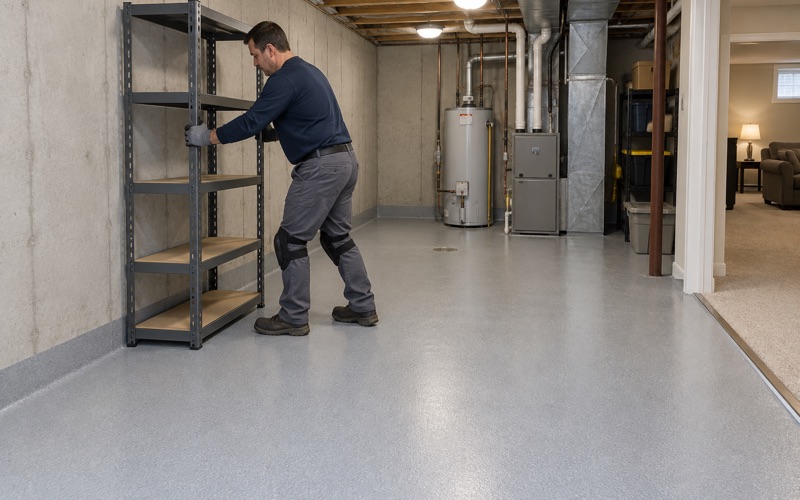
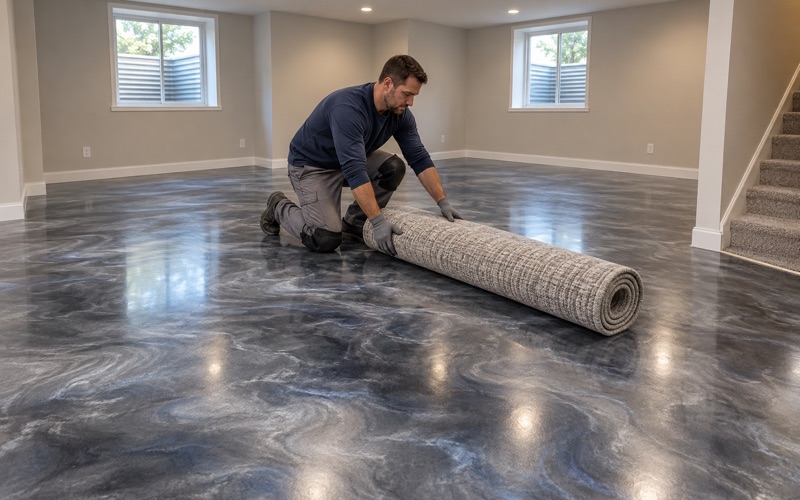
When a parent comes home after a hospital stay or leaves assisted living to move in with family, the room set up for them is often a basement suite or a converted ground-floor space. The same label logic follows the disinfectant home. A bare or worn-through basement slab is outside the hard, non-porous class, and a home caregiver is relying on that label just as a housekeeper does.
A film that blisters is no more intact than one that wore away, and moisture coming up through a slab is the usual cause. So moisture testing appears in our scope as its own priced, reported line before anything is mixed, starting with an ASTM D4263 plastic sheet test and going further where the result calls for it. High readings mean a moisture-mitigation primer goes down first.
Townhouse Garages and Association Rules
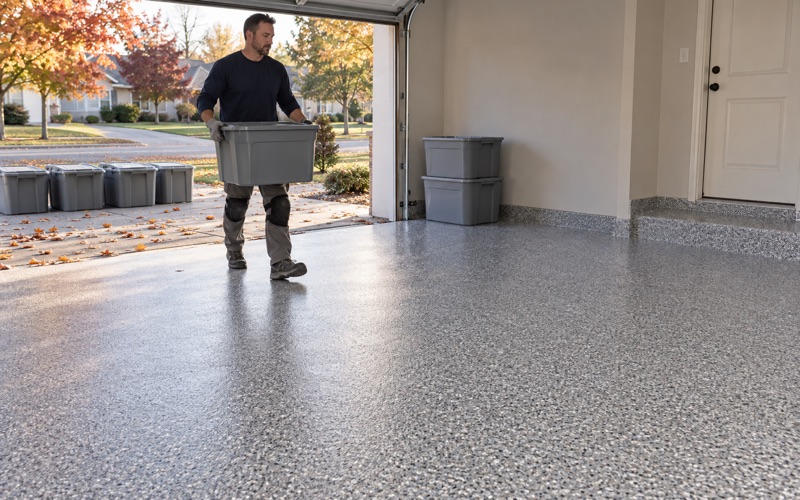
Owner occupancy in Palos Heights is 93.4 percent, and 1,020 owner-occupied homes are single-family attached units, so a good share of garage floors sit inside an association’s rules as well as the owner’s preferences. For a household caring for someone, the garage is often the door that brings in groceries, medical supplies and the person returning home, and its floor carries whatever comes in on the tires.
We ask for the association’s rules on garage work, noise hours and contractor access before scheduling, because a coated garage that breaks a bylaw is a dispute rather than a finished job. The city also reports teardown-and-replacement permits and new construction on vacant lots, so some of the slabs we see are recent pours that need their cure confirmed before any coating goes on.
Registering With the City Before the First Visit
Illinois issues no license for flooring or coatings work, so the local rules are the ones that count, and Palos Heights handles them in its own way. The Building Department at 7607 W. College Drive takes contractor registration in person between 7:30 a.m. and 2:30 p.m. on weekdays or by mail, refuses emailed registrations, and hands out permits in person. We complete that step for each job before a crew is scheduled, so a family never finds out at the door that the paperwork was skipped.
- 20+ Years of Floor Coating Work
- Moisture Testing in Every Scope
- Free Written Estimates