Plainfield Epoxy Flooring has spent more than 20 years on epoxy-flooring in Palos Hills garages, basements and working floors, and one question we settle before most contractors think to ask it is what becomes of the material that never reaches the slab. Every coating job ends with something left over: the last inch of a mixed batch, a partly used kit, solvent-dampened rags and empty pails.
Two-part floor coatings are chemistry, not paint. Once resin and hardener are mixed they start a reaction that gives off heat, and that heat behaves very differently in a deep pail than in a thin film spread across concrete. Unmixed components are a separate problem again, because they stay liquid and stay reactive for as long as they sit on a garage shelf.
This page walks through how we plan quantities, what we do with a batch that is mixed and not used, and where unmixed resin, hardener and thinner belong. It also covers the line between a homeowner’s leftovers and a contractor’s, which matters here because the one local collection on our record drew that line in writing, in plain words.
A Moraine Valley Collection and the Line It Drew
What the 2014 collection took
In April 2014 the Metropolitan Water Reclamation District announced a household hazardous waste collection with the Illinois EPA, Moraine Valley Community College and the Center for Sustainability. It ran from 8 a.m. to 3 p.m. on Saturday, May 3, 2014, at 9000 W. College Parkway, with entry on 88th Avenue. The accepted list named aerosol and oil-based paints, paint thinners, chemical cleaners, antifreeze and weed killers.
Palos Hills, a Cook County city established in 1958, is home to that campus, which sits beside the Palos Forest Preserves. The collection gave residents one supervised Saturday to drop off solvents and paints, and its published rules read like a plain-language guide to which floor-job leftovers count as household hazardous waste. That was a single dated event, and we have not confirmed whether the campus has hosted another since.
Contractor waste was turned away
The release was blunt about who could not use it: contractor, agricultural, business, governmental, commercial, industrial, school or public works wastes cannot be accepted. MWRD President Kathleen Therese Meany said these products are harmful to the water environment. A collection built for residents is not a disposal route for a hired crew, and we never treat it as one.
That distinction is the spine of how we talk about leftovers with a customer in this city. What a resident buys and opens in a do-it-yourself kit is household material. What our crew brings onto a job is ours from delivery to haul-out, and it leaves with us rather than sitting in a homeowner’s garage waiting for a collection day that may never come.
Why a dated event still matters
We cite the 2014 event because it is a documented local statement of a rule, not because it predicts a calendar. Collection programs change their sites, dates and accepted lists, and Cook County residents should confirm a current option before loading a car. The principle holds regardless: household chemicals go to a household collection, and business waste goes back with the business that made it.
Looking for epoxy-flooring closer to Hickory Hills? See Epoxy-Flooring in Hickory Hills.
Why Leftover Mixed Epoxy Never Sits in the Pail
Heat builds in a contained mass
WEST SYSTEM, a marine and craft epoxy maker, describes the cure of mixed epoxy as exothermic, or heat-generating. In a contained mass, the company warns, it can generate enough heat to melt plastic, burn skin or ignite surrounding combustible materials. Floor epoxies share that chemistry, though pot life and safe mass limits are specific to each product, so we read the data sheet for the system on the job.
In a runaway, the same maker says, mixed resin and hardener become hot and frothy as they thermally decompose, generating toxic vapors. A deep pail with a few inches of mixed coating in the bottom, set in a corner while the crew finishes a broadcast coat, is exactly the contained mass that warning describes. That pail is the most dangerous object on a finished floor job.
Mix to the floor, not to the kit
The cheapest leftover to handle is the one never mixed. We work quantities out from measured square footage and the coat count before ordering, then mix batches sized to what a crew can spread inside the working time. A garage measured carefully needs fewer spare units on the truck, and fewer spare units means less material that has to be managed at the end.
Batch sizing shifts with conditions as well. A warm garage shortens working time and a cool one lengthens it, so the last batch of the day is often the smallest one we mix. Holding a partial batch back unmixed costs nothing; mixing a full one and racing it across the last section of slab is how material ends up hardening in the bottom of a pail.
Hardener away from sawdust and rags
The same maker adds a warning that matters at cleanup: spontaneous combustion is a danger when hardeners are mixed with sawdust, wood chips or other cellulosic materials. Many garages and basements double as workshops, and a sweep pile of shavings by a bench is a poor place for a dripped hardener can or a wiping rag. We keep hardener and anything wet with it off wood debris entirely.
The concern does not end when the crew leaves. A kit’s hardener stored on a basement shelf above a bin of rags or a stack of cardboard sits next to exactly the materials that warning names. Do-it-yourself customers should keep it capped, on metal or concrete, and apart from anything made of wood or paper until it can go to a collection.
Spread Thin, Cure Solid, Then Dispose
A roller pan or shallow tray
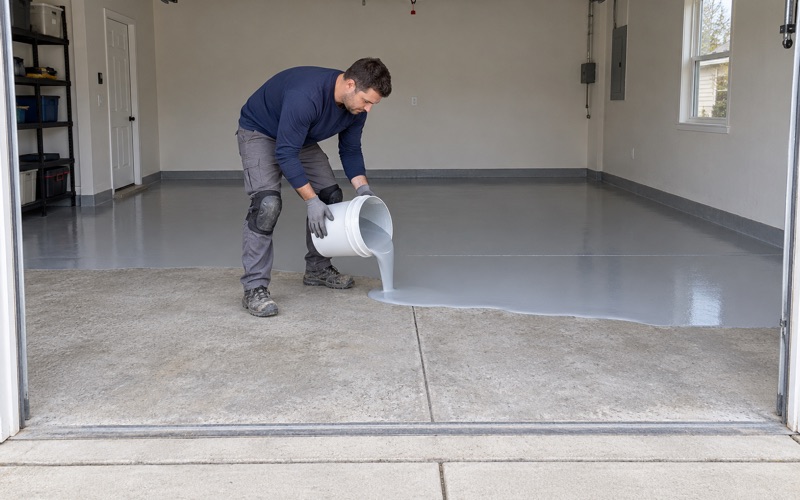
The remedy WEST SYSTEM gives is simple: transfer epoxy from the mixing pot to a roller pan or other wide, shallow container, because spreading it into thinner layers dissipates heat. On our jobs that means a lined tray set on bare concrete or another noncombustible surface, away from the work area, where a surplus batch can cure as a thin sheet instead of a hot plug.
We do this the moment a batch is clearly surplus, not at the end of the day. Waiting lets the reaction run in the pail, and once a mass starts heating, pouring it out becomes its own hazard. A shallow tray set out before mixing begins is cheap insurance on a garage floor where cars, bikes and stored belongings sit only a few feet away.
What cured material is, and what it is not
That maker notes that fully cured epoxy mixed at the correct ratio may be disposed of as a non-hazardous solid, subject to state and local rules. The qualifier carries weight. Disposal rules are local and product-specific, and an off-ratio batch that never fully hardened is not the same material, so we confirm the rule for the product before anything goes out as trash.
Tacky or soft remnants get more time or a proper hazardous route rather than a guess. A hard, fully cured sheet in a tray is a solid we can handle and bag; a gummy one still holds unreacted resin or hardener. The difference is easy to see and to test with a gloved fingertip, which is why we check every tray before the crew packs up.
Rags, pails and solvent cleanup
Solvent-dampened rags, used roller covers and mixing sticks are the other leftovers on every job. Rags wet with solvent or hardener are laid flat or kept in a closed metal container rather than balled up in a trash bag, and nothing goes into a bin that holds sanding dust or shavings. Empty pails stay open so any remaining film cures before they leave.
Cleanup solvent is used sparingly, poured from a small working container rather than an open pail, and what remains goes back into a sealed, labeled can that leaves with us. Tools that cannot be cleaned before the coating sets are left to cure solid and handled as cured waste where the rule allows, rather than soaked for hours in a bucket of thinner.
Unmixed Resin, Hardener and Thinner: Whose Leftovers Are They
A homeowner’s kit is household material
A do-it-yourself kit bought at a store and only partly used leaves unmixed resin, hardener and often a solvent in the garage. Those are the homeowner’s to dispose of, and the 2014 accepted list, with oil-based paints and paint thinners on it, shows the kind of collection they belong at. They should never go down a drain or out with weekly trash while still liquid.
Latex is the exception people expect to apply here, and it does not. The 2014 release said latex paint is not considered hazardous and can be dried and put out with regular trash, but a two-part epoxy kit is not latex paint, and its unmixed parts do not simply dry out in an open can. Keep them sealed and labeled until a current household collection can take them.
A hired crew hauls its own
On a job we are hired for, every can, pail and rag is contractor waste, and the collection on our record said plainly that contractor wastes could not be accepted. We do not leave partial kits behind as a favor or ask a customer to drop them at a residents’ event. Our quote states that leftovers leave with the crew, so nobody inherits a shelf of reactive chemistry.
Illinois licenses no flooring or coatings contractor, so we confirm the city’s own requirements before booking. Here a general contractor registers with the Building Department for $50, good for two years, with a $25,000 surety bond and a certificate of liability insurance. Commercial properties must use a registered contractor, while a homeowner doing his or her own work signs a hold-harmless agreement and owns that work’s risks.
Shared buildings and association floors
Palos Hills banned apartments until 1963, then allowed unit subdivisions, and most of its building took place from the late 1970s through the early 1990s. Today 1,757 owner households live in buildings of three or more units, more than the renters in such buildings, so a garage or storage floor is often an association’s decision rather than one owner’s.
In a shared building, leftovers left behind become a problem for every unit. A partial kit tucked into a common storage room, or a hardener can on a wooden shelf in a shared garage, puts the risk on neighbors who never agreed to it. On association work we clear every container from the site the same day, so the board never has to track where material went.
- 20+ Years of Floor Coating Work
- Moisture Testing in Every Scope
- Free Written Estimates