Plainfield Epoxy Flooring has spent more than 20 years installing epoxy flooring in Plano and across the region, and the work here starts with one question: what is actually landing on the floor? In a molding plant it is plastic feedstock. In a home garage it may be a hobby. Either way, the answer decides the texture, the color and the coating we propose.
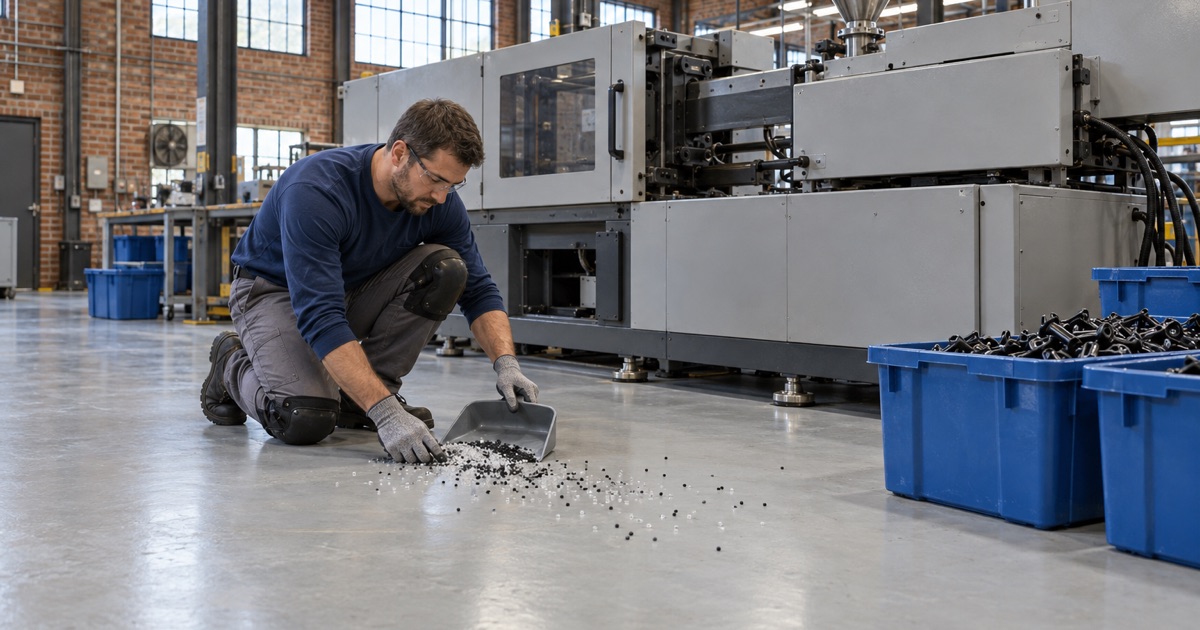
On a plastics floor, the thing most likely to put someone on the ground is a scatter of loose resin pellets. They are small, hard and easy to miss, and a cracked or dusting slab gives them places to hide. The floor we recommend for that problem is seamless, sealed and textured with restraint, and the reasoning applies in a hobby garage as much as in a production plant.
We write this for two readers. One manages a shop or warehouse where plastic resin is handled, molded or stored and wants fewer slips and a cleaner sweep. The other has a garage where resin crafts, beads or a small press have turned the floor into a hazard of its own, and wants the same answer at a home scale.
From the Harvester to Plano Molding: A Factory Town on South Street
Birthplace of the Harvester
Plano calls itself the Birthplace of the Harvester, and the title is earned. The Marsh Harvester was developed here from 1861, and the Plano Manufacturing Company took over the former Deering factory in 1881. By 1884 it employed 700 men turning out binders and other implements, before moving to West Pullman in 1893. Manufacturing has been part of how this town understands itself ever since.
Plano also has a turn in film history. In the summer of 2011, downtown was used for exterior filming of Man of Steel, and the city declared itself Smallville for the occasion. Behind the storefronts, though, the town’s working floors belong to people who make things, and those are the floors this page is about.
A Plastics Molder on East South Street
The best-known modern manufacturer in town is a plastics molder. The City of Plano business directory lists Plano Molding at 431 E. South Street, and the company keeps its headquarters in Plano, where both of its original factories still operate. Most of its bulk production has since moved to Sandwich and Mendota, and Pure Fishing, which bought the parent company in 2021, kept the Plano brand.
We want to be plain about our relationship to that plant: there is none. We have no contract with Plano Molding, Pure Fishing or any other Plano manufacturer, and we have not inspected their floors. What we bring is general knowledge of what an injection-molding floor asks of a coating, applied to whichever shop, warehouse or garage hires us.
Where Plano Sits on the Map
Plano is a Kendall County city of 9.02 square miles in Little Rock Township, about 55 miles from Chicago. Fire protection comes from the Little Rock-Fox Fire Protection District, with stations on East North Street and Mitchell Drive. Mailing addresses can mislead here: a Plano address on a rural road may sit in unincorporated township land, so we confirm which authority actually governs a site.
Our proposals also say Plano, IL in full. A search for epoxy work in Plano returns contractors in a same-named city in another state, which is no help to a floor in Kendall County. Plano’s industrial base is wider than one molder, too: a Menards distribution center opened here in 1998, and the Midwest Manufacturing site on Eldamain Road runs truss and concrete plants.
Looking for epoxy-flooring closer to Winfield? See Epoxy-Flooring Services in Winfield.
Resin Pellets Underfoot, and Where They Hide
Why OSHA Singles Out Pellets
OSHA’s guidance for the plastics industry calls slips and falls one of the major causes of accidents in the trade. It is specific about why: walking surfaces with spilled resin pellets or beads provide minimal traction. A pellet is small, hard and round, and underfoot it rolls like a ball bearing. A spill at a hopper or a dryer scatters them well beyond where they fell.
OSHA’s answer is not a product. The same guidance says the hazard can be minimized through proper safety and good housekeeping practices, and it does not require any floor coating. That is the honest frame for our work: a floor does not replace housekeeping, but it can decide whether housekeeping succeeds. A broom can only collect what it can reach and what a worker can see.
Cracks and Dusting Concrete
On a cracked slab, pellets and ground regrind drop into the fractures and stay there, out of reach of a push broom. Dusting concrete adds a second problem: a soft surface that keeps shedding fine dust, so the floor never actually gets clean. Spalled patches and broken edges become pockets where loose material collects shift after shift. Pellets that escape a sweep are back underfoot the next time a cart disturbs them.
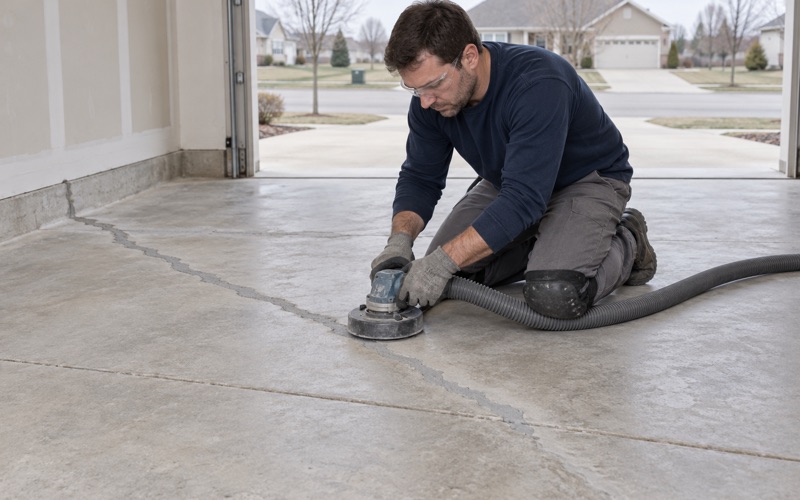
Before any price, we walk the slab and map its cracks, spalls and any old coating. A hairline crack can be routed and filled ahead of the coating; a slab that is breaking up will crack straight through a new floor, and coating it would only give pellets new edges to hide behind. In that case the honest recommendation is repair or replacement first.
Open Edges at Walls, Columns and Pits
Pellets migrate to the places a floor stops: the base of a wall, the foot of a column, the lip of a trench or pit. Where a coating ends in a ragged or lifted edge, material packs in underneath and the edge keeps peeling. We terminate the system in a keyed edge cut into the concrete so there is no lip for debris to work under.
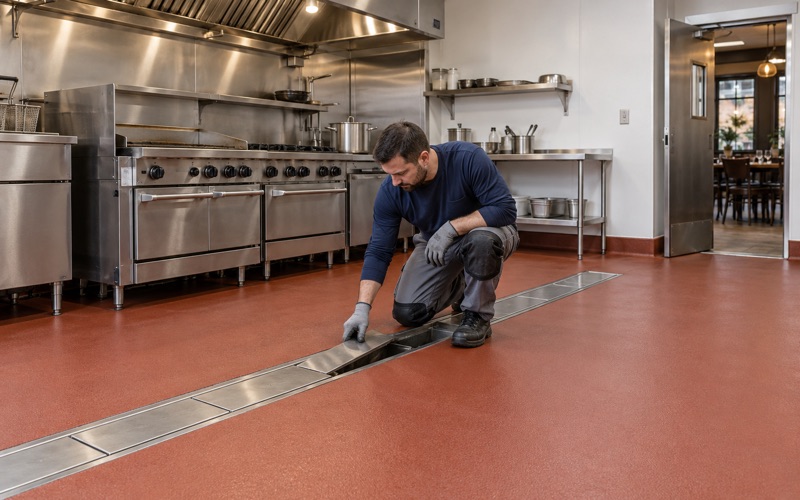
Trench drains, floor drains and sump lids get the same attention. The coating is carried to a clean, cut edge at each drain body rather than feathered thin, because a feathered edge is the first place a cart wheel catches. Once it lifts, pellets and fine regrind wedge under it, and the peel spreads outward from there.
A Seamless, Sealed Floor With a Texture Chosen for Loose Pellets
Why Seamless Matters
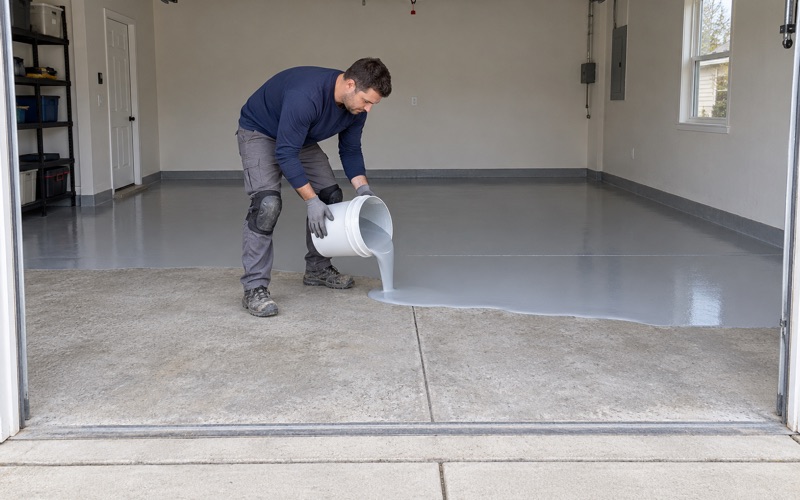
A seamless floor is the core of the answer. A troweled or roller-applied 100% solids epoxy cures into one continuous surface with no grout lines, tile seams or pores for a pellet to settle into. On a light, solid color, a stray pellet or a line of regrind stands out, which is what lets a crew find it and sweep it before someone steps on it.
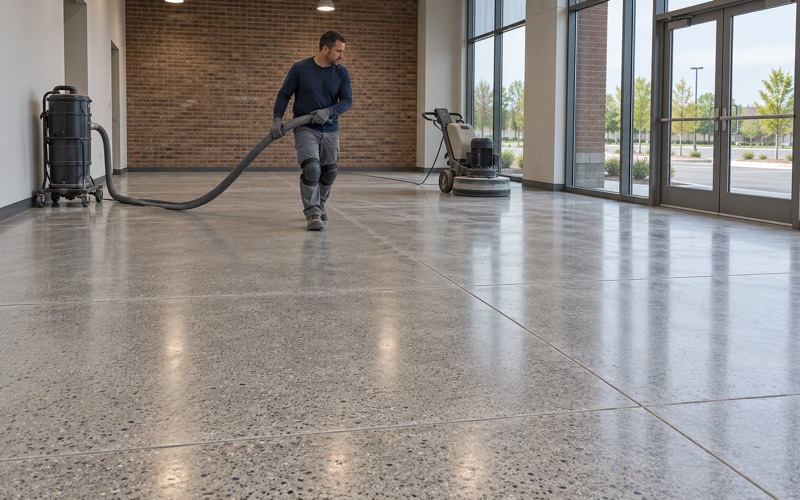
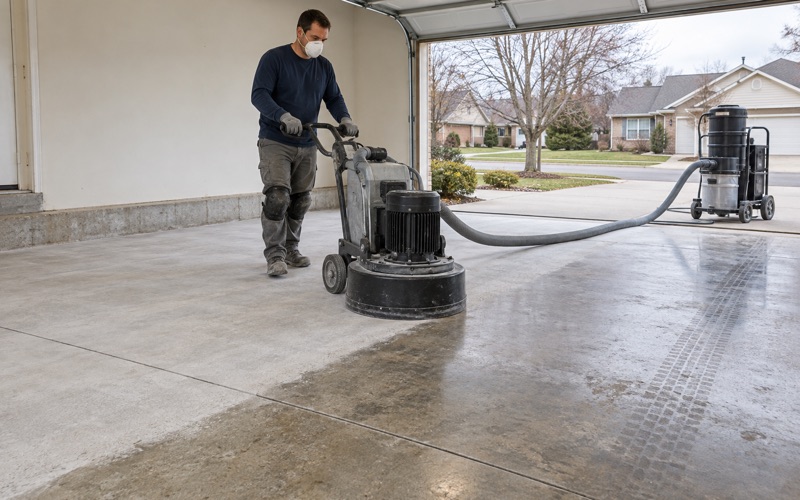
Sealing the slab also ends the dusting. Once the weak surface is ground away and the concrete is locked under a resin film, it stops contributing its own fines to the debris on the floor. On areas that stay bare, such as a storage zone, a lithium silicate densifier hardens the surface, though it is not a substitute for a coating where pellets fall.
Texture for Dry, Loose Material
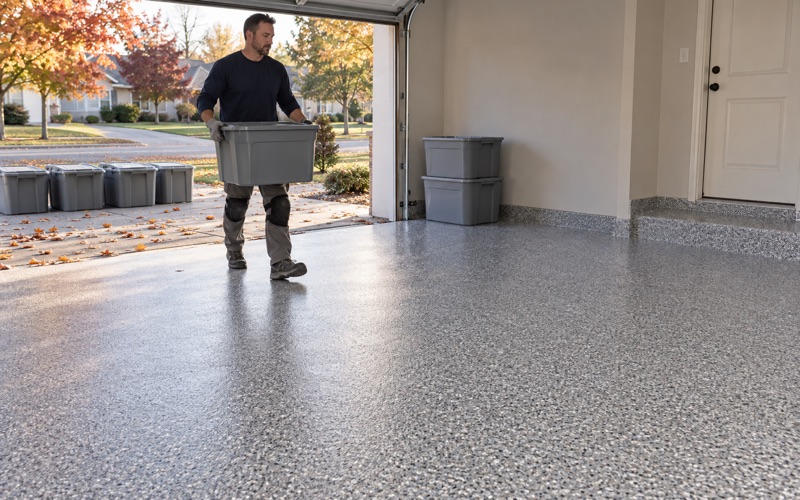
Texture is a judgment call, and pellets change it. A very aggressive broadcast gives boots grip but also gives pellets and regrind somewhere to lodge, which works against the sweep. We usually specify a fine quartz aggregate broadcast locked in by the topcoat, enough tooth to stop a foot from skating while still letting a broom or a dust mop pass cleanly.
The topcoat matters as much as the aggregate. Polyaspartic and polyurea topcoats resist scuffing from carts and pallet jacks and hold their color, which keeps the contrast that makes a pellet visible. Where an electronics or assembly area needs it, we can discuss static-dissipative and ESD systems, specified to a measured resistance range rather than a promise.
Scheduling Around a Running Floor
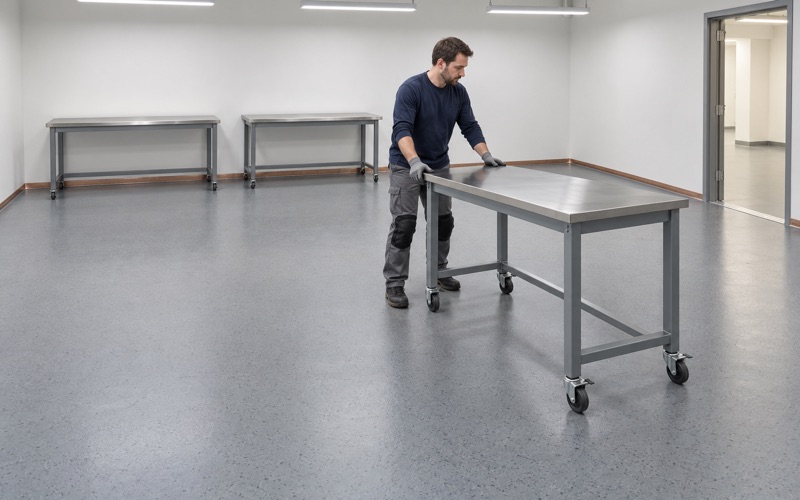
A plant floor rarely gets to stop for a week. We work production and warehouse floors in phases that follow the building’s own hours, nights and weekends included, so one aisle cures while the next stays in service. Pellet storage, hopper areas and the aisles beside the presses usually come first, because that is where spills concentrate.
Color can also be zoned while the work is phased. A contrasting band around a hopper or a dryer marks where spills are expected and tells a crew where to look first during a sweep, and a different field color in walkways keeps the traffic lanes readable as the plant layout changes.
The Same Problem at Home: Resin Hobbies, Beads and a Garage Shop
Craft Resin and Bead Spills in a Garage
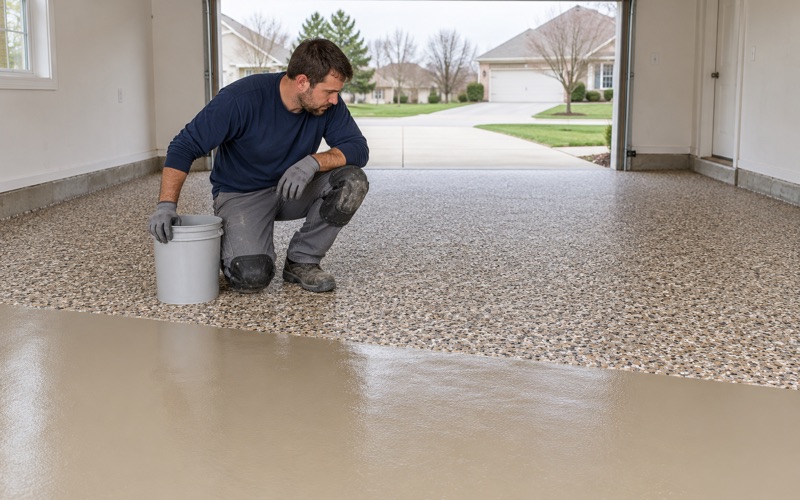
The pellet problem is not limited to factories. A garage used for resin casting, jewelry work or a hobby injection press collects the same small, hard beads, and on a bare garage slab they roll into cracks and sit in the low spots. A dense vinyl flake broadcast can camouflage a dropped bead, so for a workshop corner we often suggest a lighter solid color or a sparse flake blend.
Garage use also brings hot tire pickup into the decision. Thin store-bought kits often lift where warm tires sit, and that is a failure of film thickness and preparation rather than bad luck. The difference shows up in the first summer, so it belongs in the decision before the color chart does.
A 2000s-Era Slab Under Most Plano Homes
Plano’s housing stock is young. The Census count puts 49.1 percent of it in the 2000 to 2009 decade and another 11.2 percent since 2010, and 82.4 percent of owner-occupied homes are detached houses. That usually means a sound garage or basement slab, but young concrete is not automatically ready, and any old sealer or kit coating still has to be ground off.
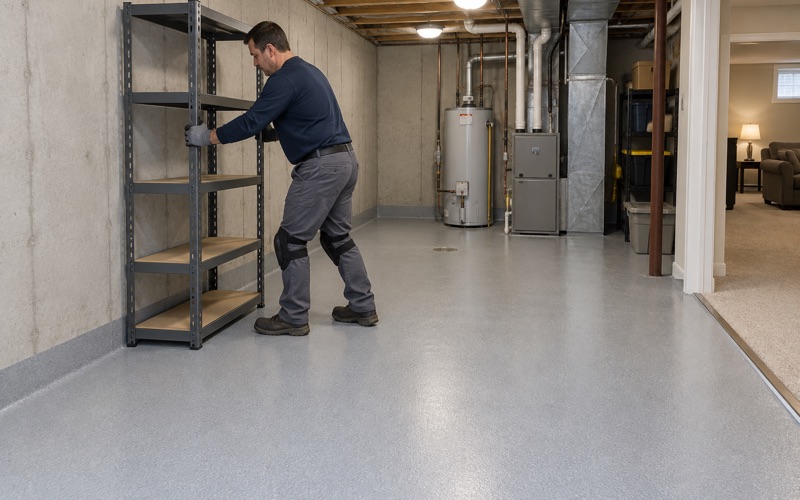
Moisture is tested, not assumed. The city’s typical wall-section exhibit draws a basement slab of 4 inches of concrete on 4 inches of gravel with footing drain tile, and no vapor retarder is legible in the scan. That leaves the question open, so we test before quoting a basement floor, with in-slab relative humidity probes where the reading has to be firm, and a moisture-mitigation primer goes in only when the numbers call for it.
Permits and Paperwork in Plano
Plano’s Building, Planning and Zoning office at 17 E. Main Street enforces the 2018 International Residential Code and 2018 IBC with the city’s own amendments. The small-projects permit list covers decks, fences, sheds, pools, roofs and windows, and does not address floor coatings, so we ask the office at 630-552-8275 rather than guess either way. That list also carries the HOA sign-off requirement for Lakewood Springs and Club and Churchill Farms, and it names no floor work either.
Some sites bring county paperwork into the picture. Septic permits go to the Kendall County Health Department, and floodplain information becomes part of a permit submission where it applies. Neither is something a floor coating changes, and we would rather point a homeowner to the right office than let a coating be mistaken for protection it does not give.
- 20+ Years of Floor Coating Work
- Moisture Testing in Every Scope
- Free Written Estimates