Plainfield Epoxy Flooring grinds and finishes polished concrete floors in Plainfield, IL, and brings 20+ years of slab work to stores, warehouses and homes across surrounding cities including Shorewood, Minooka, North Aurora, Warrenville and Lemont. Polished concrete is not a coating poured over the floor; it is the existing slab, cut down with diamond tooling, hardened with a densifier and honed until the surface itself carries the sheen.
Because nothing sits on top of the concrete, the slab you have is the floor you get. Before quoting a finish we grind a test patch, so you can see what the concrete holds, from the cream surface left by the trowel to the stone underneath, and we point out patching, staining and cracks that polishing will reveal rather than hide.
The written proposal then names the grit sequence, the densifier, any dye or guard and the target sheen, so the finished floor can be compared against what was agreed. That matters on a commercial job where a tenant or architect has written a specification, and just as much in a basement where the owner simply wants to know what they are paying for.
Our Step-by-Step Polished Concrete Floors Process
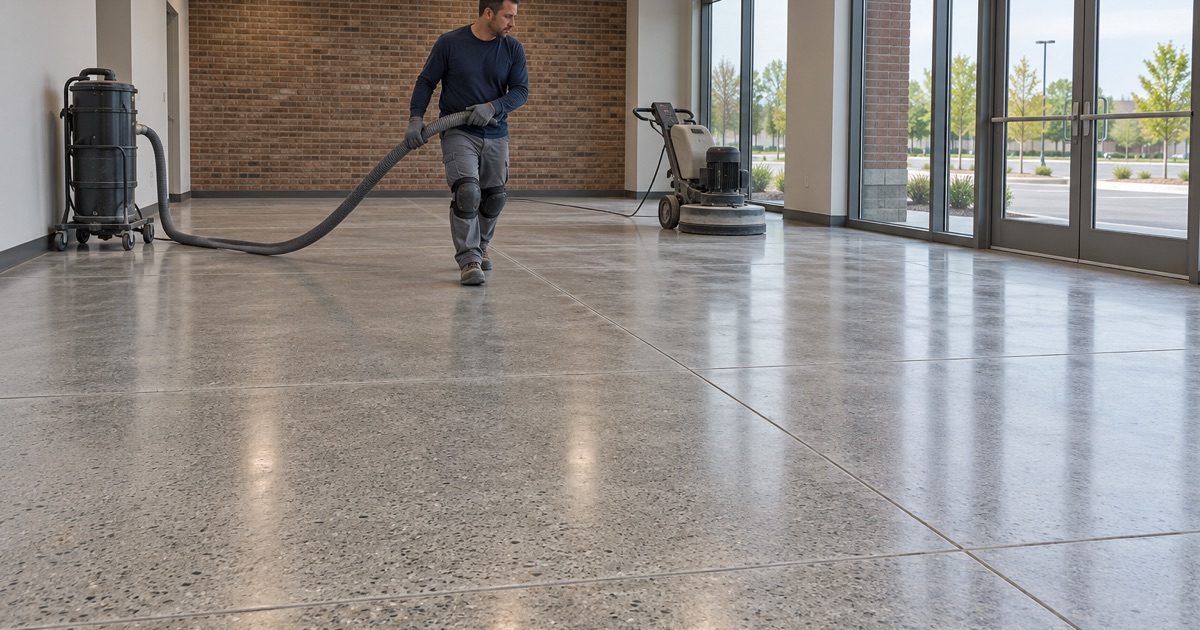
Step 1: Test Grind and Slab Assessment
We start by grinding a small area to show how much aggregate the slab will expose and how the surface responds. At the same visit we map cracks, old adhesive, patched sections and joints, and we check for moisture where the slab is going to sit under rugs, furniture or racking, because trapped vapor can still mark a polished floor.
Step 2: Coarse Grinding and Removal
The first passes use coarse metal-bond diamonds to remove adhesive, sealers, paint and the weak top layer, and to cut the floor flat enough for the finer passes to follow evenly. Our grinders run with dust shrouds and industrial vacuums, so the dust is captured at the head rather than drifting through a store or washed toward a drain.
Step 3: Repair and Lithium Silicate Densifier
With the surface open, cracks and pop-outs are filled and control joints are cleaned for filler. A lithium silicate densifier is then applied, reacting with the concrete to harden the surface so it takes a finer polish and resists dusting, which is what lets a polished slab stand up to foot traffic and pallet jacks without wearing soft.
Step 4: Honing and Polishing Passes
Resin-bond diamonds take the floor through progressively finer grits, each pass erasing the scratches from the one before. Where the passes stop decides the sheen, from a low satin hone to a high reflective polish, and stopping at the agreed grit is what makes the result match the proposal.
Step 5: Guard, Joint Filler and Burnishing
A penetrating guard can be added to help resist staining, and the control joints are filled with a semi-rigid polyurea filler where wheels cross them. A final burnish brings up the shine, and we leave the owner with plain maintenance guidance rather than a list of proprietary products.
Commercial Polished Concrete Floors
Retail and Big-Box Floors
Plainfield’s retail along Route 59 and 143rd Street includes big-box stores where polished concrete is a common floor choice, because it handles carts, foot traffic and floor scrubbers without a coating to wear through. For retail work we schedule passes in sections and around trading hours, so a store can keep aisles open while the floor is finished.
Warehouse and Distribution Slabs
Large warehouse and distribution floors often start as new, hard slabs that need densifying and a light polish rather than deep grinding. On these floors we focus on hardness, dust control and joint condition under forklift traffic, and we follow the owner’s or tenant’s specification on sheen, joint filler and any marking that will be laid out afterward.
Showrooms, Offices and Tenant Spaces
Showrooms, dealerships and office suites use polished concrete for a clean, modern look that is easy to keep up. When a tenant space turns over between leases, we can remove old carpet adhesive and tile thinset, patch anchor holes from past fixtures and polish the slab so the new occupant starts with a finished floor.
Residential Polished Concrete Floors
Basement Slabs Turned Into Living Space
A finished basement with polished concrete avoids carpet over a slab that can stay cool and damp, and gives a surface that tolerates a minor water event far better than flooring glued on top. Before polishing a basement, we test the slab for moisture and look at the sump and drains, since a polish does nothing to stop water coming up through the floor.
New-Construction Main Floors
Some newer homes are built with a slab intended to be the finished floor, and those slabs reward planning before the pour more than fixing afterward. When we are involved early we can talk with the builder about finishing and protecting the slab so it arrives at polishing with fewer stains, patches and saw marks.
Garages and Workshops
A polished garage or workshop floor is easier to sweep and resists dusting, but it is still bare concrete underneath, and road salt and oil will mark it. For a working garage we usually recommend a coated system instead, and we say so plainly rather than selling a polish that will look tired after one winter of brine.
Cost, Upkeep and Scheduling
How Polished Concrete Is Priced
We price polished concrete per square foot for the exact sequence the slab needs, not from a national average. The main drivers are how much has to come off first, such as carpet adhesive, tile thinset or an old coating, how deep the aggregate exposure goes, how much crack and joint work the floor needs, and whether a dye or guard is part of the finish.
A large, open, sound warehouse slab costs less per square foot than a small basement full of patches and corners, because the big machines cover open floor quickly while edges and repairs are slow hand work. We show those line items in the proposal so the number is explained rather than simply stated.
Day-to-Day Care
A polished floor is cleaned with a dust mop or auto-scrubber and a neutral cleaner, and it does not need stripping or waxing. Acidic cleaners and spills such as vinegar, citrus and some degreasers can etch the surface if left sitting, so we recommend wiping them up promptly and keeping walk-off mats at exterior doors during the salt season.
Working Around an Open Building
Commercial polishing is loud and the passes take time, so we plan the sequence around the hours a store, office or warehouse has to keep running. Overnight and weekend work is common, and we stage sections so the business can shift racking, fixtures and staff from one zone to the next rather than closing for the whole job.
Finish Choices and Honest Limits
Cream, Salt and Pepper, or Full Aggregate
How deep the grind goes decides the look. A cream finish keeps the troweled surface and shows almost no stone, a salt-and-pepper finish exposes fine aggregate, and a full exposure cuts deep enough to show larger stone across the floor. Deeper exposure takes more passes and shows more of whatever variation the original pour contains.
Sheen Levels and Dyes
A low hone reads matte and hides scratches and dust, while a high polish reflects light and looks dramatic in a showroom. Dyes can tint the slab gray, charcoal, tan or a custom color, and we discuss exposure to sunlight, since some dyes fade near large windows and overhead doors.
Saw-cut lines can divide the floor into a grid or border before the dye goes down, letting two tones sit side by side in a showroom or lobby. Those lines are planned off the slab’s own control joints, which keeps any pattern in step with where the concrete is designed to crack.
What Polishing Will Not Fix
Polishing does not hide past repairs, old adhesive shadows, deep cracks or color differences between pours, and it does not make a moving slab stable. When a floor has too much of that for a polish to read well, we tell you before the job is sold and walk through a coating system as the alternative.
- 20+ Years of Floor Coating Work
- Moisture Testing in Every Scope
- Free Written Estimates