Plainfield Epoxy Flooring applies polyaspartic floor coating systems across Plainfield, IL, drawing on 20+ years of floor coating work, and we install the same systems in surrounding cities including Shorewood, Minooka, North Aurora, Warrenville and Lemont. Polyaspartic is a fast-curing aliphatic coating related to polyurea, and its strengths are speed, ultraviolet stability and resistance to the abrasion and chemicals a garage or shop floor sees.
Those strengths also make it unforgiving. A polyaspartic cures quickly enough that there is no time to fix poor prep once it is down, so the slab underneath gets the same grinding, crack repair and moisture testing as any floor we coat. The speed is a benefit only when the steps before it were done properly.
Every proposal names the products, the coats in the system and the finished thickness, whether the job is a single clear topcoat over an epoxy flake broadcast or a full polyaspartic build from primer up. That way the floor installed can be checked against the floor quoted, and the warranty exclusions are walked through before the job is sold.
How Polyaspartic Floor Coating Systems Work
Fast Cure and Short Working Time
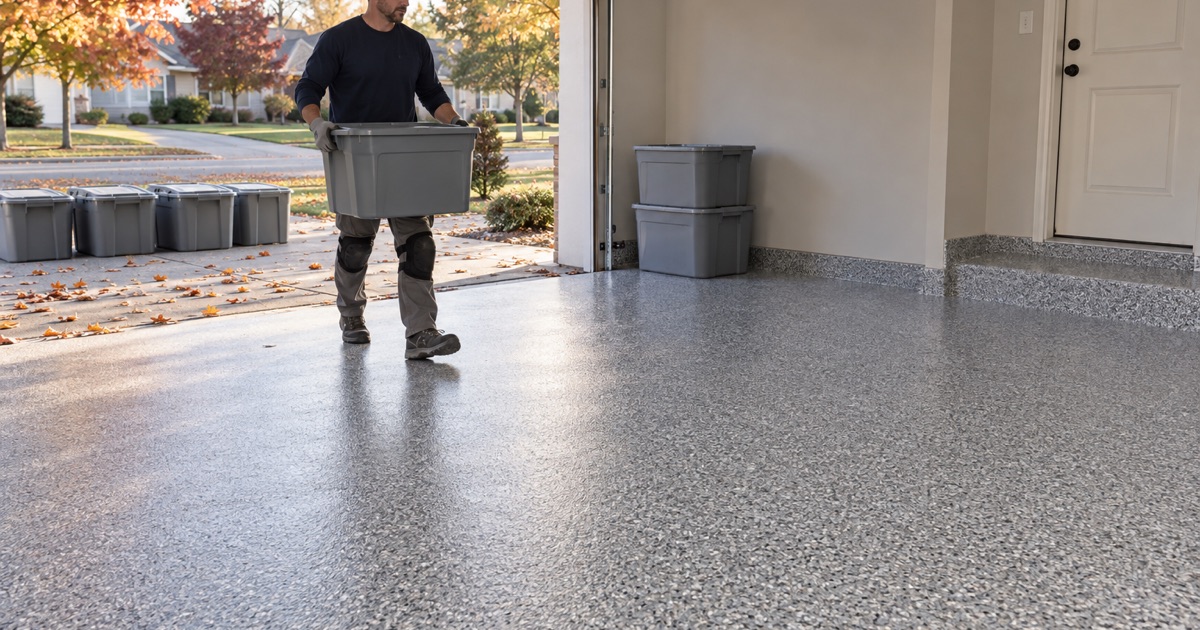
Polyaspartic resins cure much faster than standard epoxies, which is why a garage or shop can often be back in use the next day. The tradeoff is a short working window once components are mixed, so our crews mix in batches sized to the area being coated and work in sections, which keeps lap lines and roller marks out of the finished floor.
Ultraviolet Stability and Color Hold
Standard epoxy ambers when sunlight reaches it, and the yellowing shows first near the garage door and under windows. Aliphatic polyaspartic coatings hold their color and clarity in sunlight, which is why we use them as the clear topcoat on flake and metallic systems and as the wear layer on floors with strong daylight.
Abrasion, Chemical and Hot Tire Resistance
The topcoat takes the wear from tires, dragged equipment and dropped tools, along with spilled fuel, oil and brake fluid. A polyaspartic or polyurea topcoat stands up to that abrasion and chemical exposure and resists hot tire pickup, where a warm tire grips and pulls a softer coating off the slab.
Chemical resistance is not unlimited, and each product publishes what it tolerates and for how long. Where a floor will see something unusual, such as battery acid in a fleet shop or a strong solvent in a hobby workshop, we check the product data against that exposure before choosing the topcoat.
Polyaspartic Floors for Homes
Garage Floors Through a Will County Winter
Winter road crews in Will County use calcium chloride brine and rock salt, and every car brings it into the garage. A sealed polyaspartic topcoat keeps that salt water on the surface where it can be pushed out the door, rather than soaking into bare concrete and scaling it, and a textured finish keeps the floor safer underfoot when slush is melting.
One-Day Garage Systems, Honestly Scoped
A one-day polyaspartic garage floor is realistic on a sound, dry slab, and we do install them. When the slab needs crack repair, an old coating removed or a moisture-mitigation primer because of high readings, we add the time it takes rather than squeezing the job into one day and leaving the problem under the coating.
Basements, Workshops and Home Gyms
In a basement or workshop, the fast cure means less time with the room out of use and less odor lingering in the house. We still start a basement with a moisture test and a look at the sump and drains, because polyaspartic is a floor finish, not waterproofing, and water under pressure will lift it as readily as any coating.
Polyaspartic Floors for Commercial Spaces
Short Shutdowns for Shops and Stores
Retail spaces, auto repair bays and service shops lose money every hour a floor is closed. Polyaspartic systems let us coat a section overnight or over a weekend and return it to use quickly, and we schedule the work around the hours the business has to stay open, section by section where the layout allows.
In an auto repair bay, the system is detailed around lift posts, trench drains and anchor bolts so no strip of bare concrete is left to soak up fluids. A broadcast of fine aggregate in the topcoat gives technicians grip on a floor that is often wet with coolant or washdown water.
Showrooms and Customer Areas
A showroom or customer area wants a floor that keeps its gloss and color under lights and daylight. A polyaspartic topcoat over a decorative flake or metallic base holds that appearance under foot traffic and regular cleaning, and its clarity lets the decorative layer underneath stay visible.
Coating Rules That Bind the Installer
Illinois limits the volatile organic compound content of floor coatings and industrial maintenance coatings under 35 Ill. Adm. Code Part 223 Subpart C, and the rule applies to whoever applies the coating as well as to the manufacturer. We choose compliant products for each job, which carries extra weight inside the Chicago area’s 2015 ozone nonattainment area.
Choosing a Polyaspartic System
Full Polyaspartic Builds
A full polyaspartic build uses polyaspartic for the base, the broadcast coat and the topcoat, which gives the fastest return to service and the most consistent ultraviolet performance from the slab up. It suits garages that cannot be out of use for long and commercial floors coated during a single overnight shutdown.
The cost per square foot is usually higher than a hybrid system, and the fast cure leaves less room on a large or complicated floor. We recommend a full build where the schedule or the sunlight justifies it, not as a default upgrade on every job.
Epoxy Base With a Polyaspartic Topcoat
The hybrid most of our garage customers choose pairs a 100% solids epoxy base, which soaks into the ground concrete and builds thickness, with a polyaspartic topcoat that carries the wear and holds the color. The epoxy takes longer to cure than polyaspartic, so these systems usually run over two days rather than one.
In exchange, the slower base gives more time to work the broadcast evenly and wets out the concrete thoroughly, which helps on older, porous slabs. On a fifteen- to thirty-year-old subdivision garage with worn spots and repaired cracks, that extra working time is often worth the extra day.
Flake, Quartz and Clear Options
Polyaspartic topcoats go over vinyl flake broadcast floors, quartz aggregate broadcast floors and clear coats over polished or stained concrete. Flake is the most common in garages, quartz suits wet commercial areas that need grip, and a clear polyaspartic can protect a decorative floor that would otherwise be left bare.
What the Warranty Leaves Out
Polyaspartic floors carry warranties like any coating, and like any coating those warranties exclude moisture first, followed by slab movement, new cracking and damage from chemicals or impacts outside the product’s rating. We go through the exclusions with you before signing, so the coverage is understood rather than assumed.
Prep, Moisture and Cure Conditions
Grinding to the Right Profile
Polyaspartic needs a mechanically opened surface to bond, so we diamond grind or shot blast every slab to a profile on the ICRI CSP scale suited to the system, and we never acid etch. The grinders are vacuum-shrouded, and the dust is collected at the machine rather than swept or rinsed toward a floor drain.
Moisture Testing First
A fast topcoat is still pushed off by vapor coming through the slab. We measure moisture with ASTM F1869 calcium chloride kits or ASTM F2170 relative humidity probes, and when the readings exceed what the system tolerates, a moisture-mitigation primer goes down first as a separate layer in the build.
Temperature, Humidity and Dew Point
Fast-curing coatings are sensitive to humidity and to the spread between the slab surface and the dew point, and a cold slab under warm, humid air can collect condensation that ruins the bond. We read slab temperature and humidity on the day and reschedule when conditions are wrong, rather than coating against the calendar.
In practice that means a heated garage can often be coated in winter, while an unheated one during a deep cold stretch waits until spring. Humid late-summer mornings can be just as tricky, because a slab cooled overnight sits close to the dew point until the air dries out, so we sometimes start later in the day for a better bond.
- 20+ Years of Floor Coating Work
- Moisture Testing in Every Scope
- Free Written Estimates