Plainfield Epoxy Flooring has spent more than 20 years installing epoxy flooring in Shorewood and across this part of Will County, and the floors we get asked about most here are the ones where a finish has a job beyond looking clean. We open every slab with a diamond grinder or shot blaster before any resin touches it, and we never acid etch, because a coating holds only as well as the profile beneath it.
Moisture testing is written into our scope as its own line item, whether the slab sits under a two-car garage, a finished basement or a commercial bay. The proposal names the product, the system build and the finished thickness, so what was quoted can be checked against what went down. Prices are quoted per square foot for the system we actually propose, never pulled from a national per-garage figure.
This page looks at one particular kind of floor: a surface that has to stay smooth, hard and sealed because of what lands on it and what settles on it. The clearest example comes from indoor firing ranges, and the same reasoning carries over to home reloading benches and gun-cleaning corners. We close with what the village asks of contractors and how we time a cure around the slab rather than the calendar.
An Indoor Range on the Shorewood Frontage Road
Range USA and Its Twenty Lanes
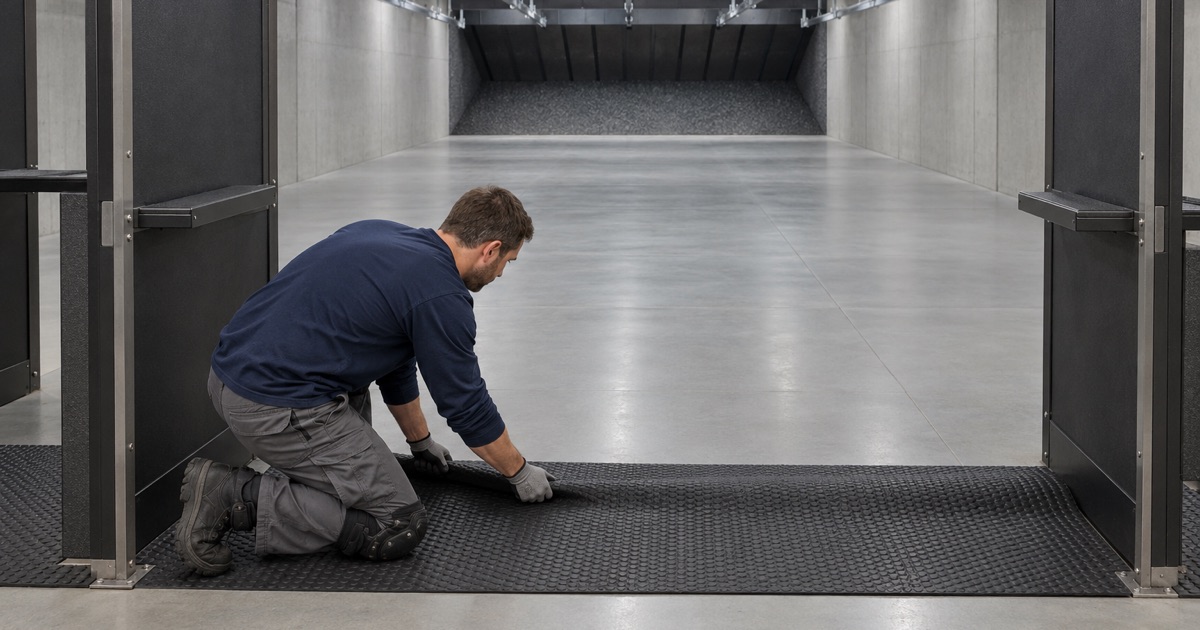
Range USA runs an indoor shooting range at 19641 NE Frontage Rd, on the northeast frontage road facing Interstate 55. Directory listings describe twenty 25-yard lanes for handguns and long guns, from .22 LR practice to full-power rifle cartridges, along with more than 70 rental firearms, a retail store and classes in basic handgun, defensive shooting and concealed carry. The business was formerly Shoot Point Blank.
We bring the range up for one reason: it is a working example, inside the village, of a room where the floor is part of the design rather than a finish picked last. We have no relationship with Range USA, have never worked on its floors, and have not seen how its floors, baffles or cleaning routine are built. Everything below is about the principle, not that building.
On the I-55 Frontage Road
Patch reported on February 19, 2026, that the Range USA building, a retail building of more than 15,000 square feet, was listed for sale at just over $4.15 million. A Census geocoder lookup of the address falls inside Shorewood village, Troy Township. The same frontage road corridor holds the more familiar kind of industrial floor, such as Heartland Corporate Center at 21530 SW Frontage Road, with 36-foot clear heights and 108 truck docks.
What a Coating Can and Cannot Do
One thing needs saying plainly before going further. A floor coating is not ballistic protection, not a bullet trap and not a lead-removal service, and no resin turns concrete into armor. What a well-built floor can do is avoid making a range designer’s job harder by adding texture, pits or raised edges where the design calls for none. That distinction runs through the rest of this page.
Looking for epoxy-flooring closer to Minooka? See Epoxy-Flooring Services in Minooka.
Why a Range Floor Is Part of the Ricochet Math
What the Design Guidance Says
The clearest written guidance we know of comes from overseas: the British defense ministry’s JSP 403, Volume 2, Chapter 21, covering test ranges. It says the range floor should be smooth and sealed to minimize unwanted ricochet where handheld weapons are used, and to aid cleaning. It is military design guidance from the United Kingdom, not an Illinois rule, an OSHA rule or part of any US building code.
We cite it because it explains the physics in plain terms, not because anyone in Shorewood is bound by it. It also warns against any material that might harbor dust and prevent effective cleaning, a point that turns out to matter on floors that never see a firearm. Both ideas, a smooth surface and nowhere for dust to hide, shape how we build a range-style floor.
Hard, Flat and Undamaged
The same chapter notes that a bullet striking a range floor can ricochet at up to 45 degrees, and that hard flat surfaces without damage or distortion are known to hold the ricochet to roughly half the incoming angle of strike. Read simply, a flatter departure keeps a fragment traveling low and onward rather than climbing toward the ceiling or back toward the firing line.
That is a surprising thing to learn about a floor. A pocked patch, a raised lip at an old repair or a fixture standing proud of the surface changes how a stray round behaves when it hits. The floor does not stop anything, but its condition helps decide where the energy goes, which is why the guidance asks for a floor prepared to avoid excessive ricochet and backsplash.
Backsplash and Surface Texture
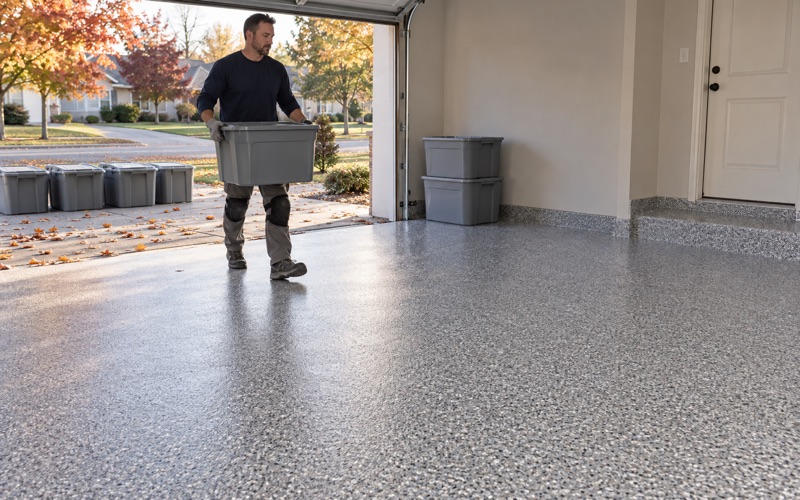
Backsplash is the spray of fragments thrown back from an impact, and a coarse surface feeds it. A deep vinyl flake broadcast or a heavy quartz aggregate broadcast, both excellent choices on a garage floor, give a bullet more to catch on. Downrange, the right resin floor is the opposite of an anti-slip garage finish: smooth, hard and continuous from wall to wall.
That is our reasoning from the guidance, not a claim about any particular range. Range operators work with their own designers and ballistic suppliers, and the floor is one part of a system that includes baffles, deflectors and the trap. When we describe a smooth range-style surface, we mean a coating chosen to stay flat and sealed, not a product doing a baffle’s work.
Smooth, Sealed and Flush: The Downrange Finish
Building the Smooth Surface
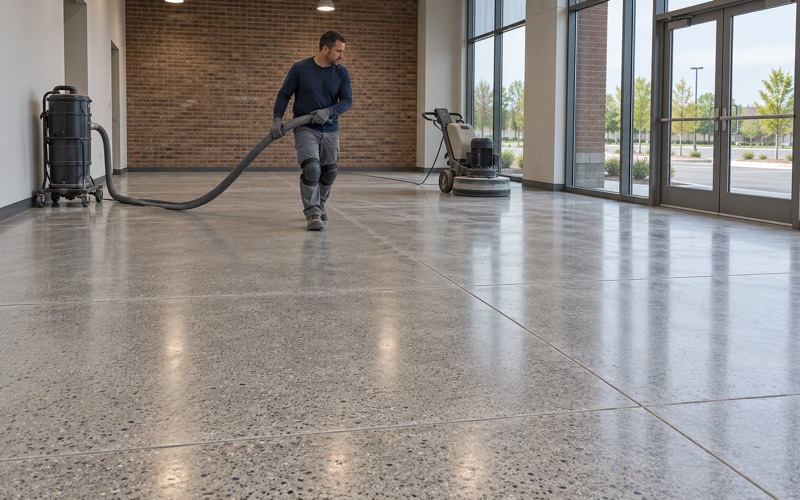
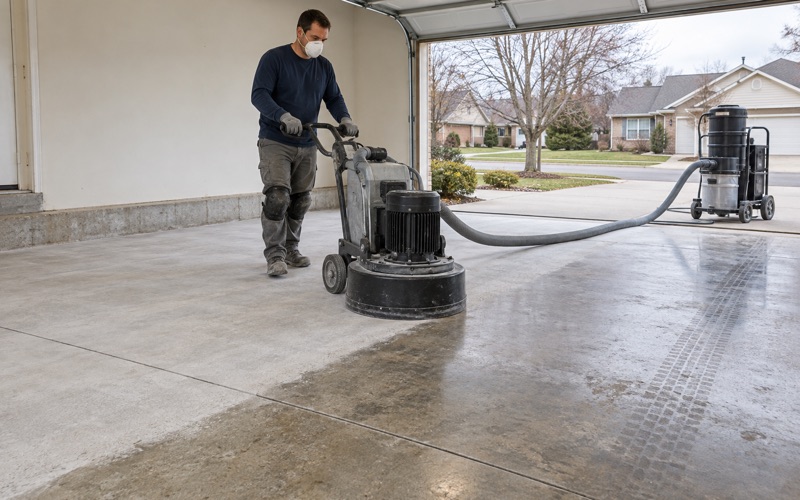
A smooth floor starts with a correct profile and a dry slab. We diamond grind or shot blast to the ICRI CSP range the primer calls for, then test moisture before anything goes down, using ASTM F2170 in-situ relative humidity probes or an ASTM F1869 calcium chloride test, with a moisture-mitigation primer where the readings call for one. Moisture is also the first exclusion we read out from the warranty.
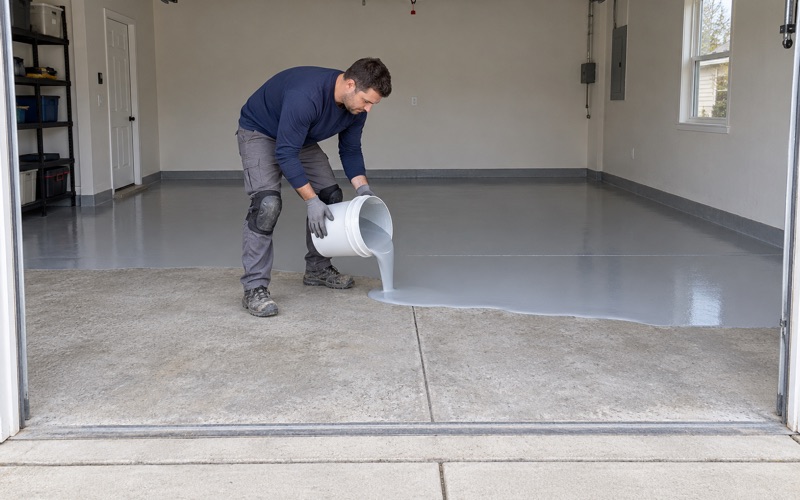
The body coat is 100% solids epoxy, which carries no solvent to evaporate and pull the film down into the profile, laid to level rather than rolled thin. The topcoat is a hard polyaspartic or polyurea finish with no broadcast, so the floor has no grain to hold grit and nothing for a squeegee to drag across. Every product sits within the Illinois VOC limits, which bind the installer as well as the maker.
Repairs That Finish Flush
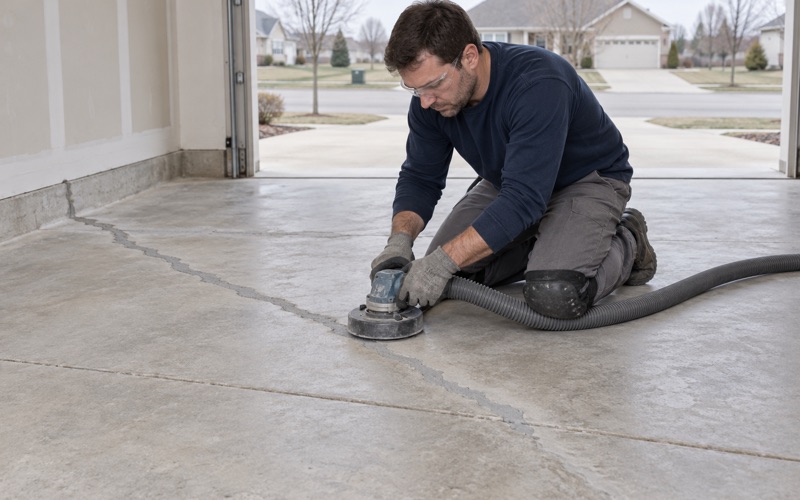
Damage downrange should be repaired flush, level with the surrounding floor rather than mounded or left as a crater. We cut out the damaged area, clean it, fill it with an epoxy mortar or urethane cement patch and grind it level before recoating. A repair that sits higher than the floor around it brings back the exact edge the smooth surface was built to remove.
We read the cracks, joints and any old coating before quoting, and if a slab is too far gone for patching to last, we say plainly that it needs repair or replacement before it can be coated. Fresh resin over spalled or delaminating concrete looks fine for a season, then lets go along the same lines the old damage had already drawn.
Sealed Joints and No Recesses
JSP 403 makes a second point that applies to any floor: range dust contains lead and unburned propellant, which can become an explosive hazard. The guidance wants joints sealed and fixtures installed so dust cannot accumulate, and it notes that eliminating recesses and sharp corners aids cleaning. Those are design goals from a foreign guide, not a requirement anyone in Shorewood is held to.
In resin terms, that means control joints filled rather than left open. We fill them with a semi-rigid polyurea joint filler, shaved flush, and carry the coating tight around drains, anchors and columns. A floor with no open saw cuts and no gaps at its edges gives fine dust nowhere to settle, which makes ordinary cleaning far more effective.
Firing-Line Footing, the Reloading Bench and Shorewood Jobs
Texture Where People Stand
Behind the firing line the logic flips. That is where people stand, shift their weight and set down gear, so footing matters more than flatness. The same guidance lists loose-laid sheet rubber as a suitable finish, and in a general resin plan this is where a textured broadcast or rubber matting belongs. A range-style floor is really two floors, divided at the line where shooters stand.
For a garage that doubles as a workshop, the same split works on a smaller scale. A smooth, flake-free zone sits under the workbench where things get dropped and wiped up, and a broadcast texture covers the walking path and the area by the door. One continuous system can carry both finishes without a seam or lip where they meet.
The Home Reloading Bench and Gun-Cleaning Corner
Shorewood is a village of resident owners: 6,632 of 6,852 occupied homes are owner-occupied, and only 38 detached houses are rented. A garage or basement corner set aside for reloading or gun cleaning is therefore the homeowner’s own call. The smooth, sealed, easy-to-clean logic suits that corner well, because spilled powder and cleaning solvent are easier to find and wipe up on a continuous floor.
Under a reloading bench we build an epoxy and polyaspartic system with no flake, so a dropped primer or a scatter of powder shows at once. The rest of the garage still has to handle the calcium chloride brine and rock salt that a Will County winter tracks in on the tires. We are not selling a safety system or a lead cleanup, only a floor that is easier to keep clean.
Registration, Permits and Cure Timing
Every contractor working in the village registers with Shorewood: $120 per calendar year, a $10,000 License & Permit Bond for a general contractor or $5,000 for a subcontractor, and $500,000 in general liability insurance. Illinois issues no state license for flooring or coatings work, so we confirm those village rules before a job is scheduled. On whether an interior coating needs a permit, we call the Building Department at (815) 553-2310 rather than guess.
Every home job gets a written contract and the Home Repair: Know Your Consumer Rights pamphlet before work starts, as the Illinois Home Repair and Remodeling Act requires. Cure is scheduled against slab temperature and the dew point spread at the surface, not by date, and an unheated garage sometimes has to wait for spring. Grinding dust is collected at the grinder and never washed toward a drain.
- 20+ Years of Floor Coating Work
- Moisture Testing in Every Scope
- Free Written Estimates