Plainfield Epoxy Flooring handles epoxy flooring in Summit with more than 20 years in the trade behind it, and the question we get most often on a newer commercial slab is simple: is it ready to coat? The honest answer is often harder than the floor looks. Concrete that came out of construction smooth, hard and faintly glossy may have been treated, and that treatment decides how the surface has to be opened.
That matters most to a business moving into a building someone else built. A landlord or developer finishes the floor for a generic use, and a tenant who later wants a coated pick area, a bright aisle or a washable room inherits whatever went on the slab. We start those jobs by asking what was applied, not by assuming a hard floor is a clean floor.
The same logic reaches home garages, where a previous owner may have rolled on a penetrating sealer or hardener years ago and left no record. This page walks through what those products do to the top of a slab, why one maker treats a densified surface as something to blast before coating, and what a tenant or homeowner should ask before any resin is priced.
A New, Empty Warehouse on West 59th Street
What the brochure says, and what it leaves out
Bridge Point Summit sits at 7955 West 59th Street, inside the Village of Summit and Lyons Township. The November 2025 leasing brochure from NAI Hiffman for Bridge Industrial lists 341,887 square feet, all of it available, with 36-foot clear height, 32 docks expandable to 54 and delivery in the second quarter of 2026. No tenant is named, and the floor will be finished before one is.
What the brochure does not state is just as useful. It gives no slab thickness, no reinforcement, no vapor retarder, no densifier and no floor finish. We are not suggesting anything was or was not applied there. The point is that a first tenant reading that sheet cannot tell from it how the concrete was treated, and has to ask.
A floor finished before its use is known
A speculative warehouse is built so that many kinds of business could lease it. That is sensible for the developer and leaves the floor decision half made for whoever signs. A slab finished for forklifts and pallet racking may serve a distributor well as it stands, while a tenant who needs a coated packing zone or a light-colored floor is starting from someone else’s choice.
The site’s own history is a reminder that floors here carry heavy work. State tank records name Pielet Brothers Scrap Iron Metal at the address, and EPA’s records list Midwest Metallics, a scrap business, at the same number. A rail spur and 102 trailer spaces point the same way: this is a building planned for freight, not showroom traffic.
Where the village fits in
The address geocodes inside Summit village, so building questions go to the Village of Summit Building and Public Works department at the Strzelczyk Municipal Center, 7321 West 59th Street, a short drive east on the same road. Health matters run through the Cook County Department of Public Health, because Summit’s addresses fall in Lyons Township rather than Stickney Township’s own health district.
That check matters on 59th Street and on Archer Road alike, because a mailing address reading Summit does not always mean the village. The Argo plant’s published Archer Road address geocodes to Bedford Park, and the line runs along Archer itself. Before we plan any commercial job here, we confirm which village’s desk will actually see the paperwork.
Looking for epoxy-flooring closer to Lyons? See Epoxy-Flooring in Lyons.
Densified Concrete Is Not Ready-to-Coat Concrete
How lithium silicate works its way in
A lithium-silicate densifier is a water-based liquid sold to harden and tighten the top of a power-troweled slab. Sika’s data sheet for Sikafloor CureHard LI lists warehouses, industrial buildings, storage areas and aircraft hangars among its uses. The product penetrates the concrete and fills surface pores by crystallization, and the maker says it can go on fresh concrete right after power troweling.
In the maker’s own test the penetration depth is 6 millimeters, and the full sealing and hardening effect takes about seven days at 20 degrees Celsius. That band at the top of the slab now behaves differently from the concrete beneath it, harder and far less open. That is exactly the layer any coating would have to grip.
Why a hard, glossy floor still needs opening
Resin coatings bond best to concrete with open pores and a clean, roughened face. A densifier is designed to close exactly those pores, which is why it makes a slab dust less and wear well under forklifts. The same property works against adhesion: a coating laid on a sealed-up surface has less to key into and may peel where traffic is heaviest.
Sika says so directly for its own product. The data sheet’s limitations section states that a floor treated with CureHard LI must be treated mechanically, from light to heavy shot blasting depending on the depth of the penetration, before a coating system goes on. That is one maker’s instruction for one densifier, not a rule for every product, but on that product it is the one we follow.
Preparation depth on hardened concrete
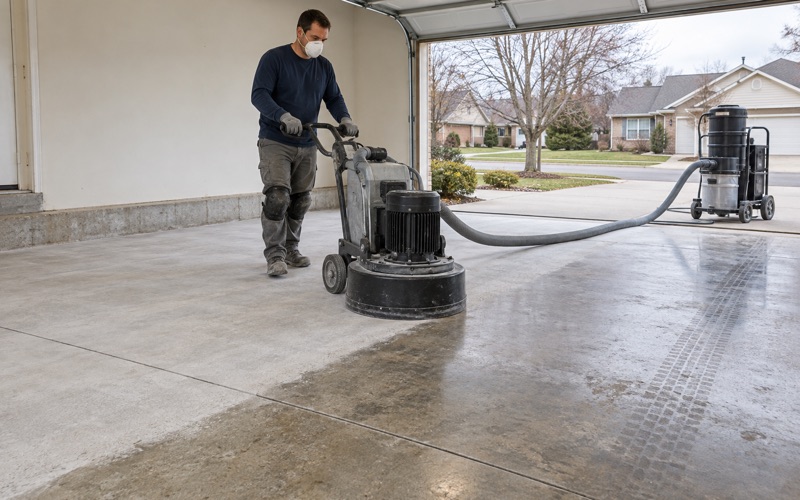
The phrase that matters is depending on the depth of the penetration. A light pass may be enough where the treatment stayed shallow, while a deeper treatment calls for a heavier blast to get below it. We do not guess at that depth from the shine; we test a small area, check how the surface takes a coating, and size the preparation from there.
Our rule is that every floor is opened mechanically before primer goes down, with no chemical shortcut in its place, and a densified slab shows why that rule exists. A heavier pass takes more time and costs more than a light one, so a tenant should see that line priced before the fit-out budget is set. Surprises in preparation are the most expensive kind.
Questions for the Landlord Before a Tenant Coats
Ask what went on the slab, and when
The first tenant in a new building is in the best position to get a straight answer, because the people who poured and finished the floor are still easy to reach. We suggest asking the landlord in writing whether any densifier, hardener or sealer was applied, which product it was, and at what point in construction. A product name turns guesswork into a data sheet.
If the answer is a lithium-silicate product, its data sheet is the first place to look for the preparation the maker expects before a coating, as Sika’s spells out. If nobody knows, that is an answer too: the floor gets tested rather than trusted. Either way the tenant learns it before a fit-out schedule is fixed, not after a coating lets go.
Which zones actually need a coating
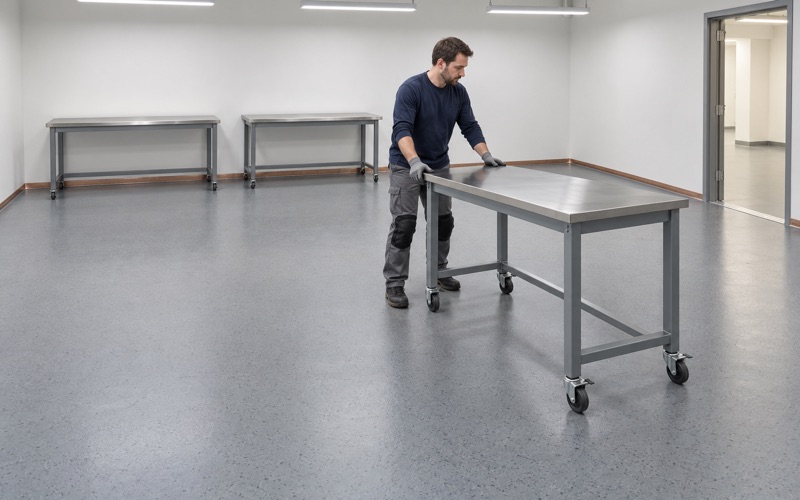
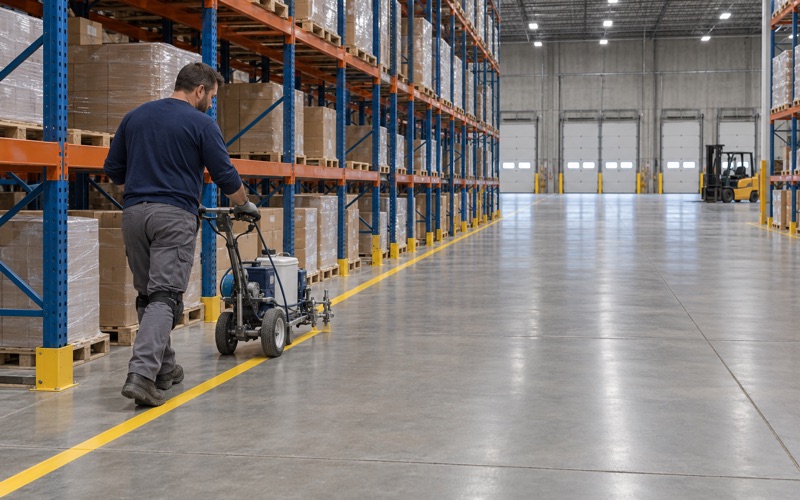
A warehouse tenant rarely needs resin on every square foot. In a building the size of Bridge Point Summit, the coated areas are more likely to be a packing line, a light-colored pick area, a break room or a food-handling room, while the racking aisles stay as finished concrete. Mapping those zones first keeps preparation costs tied to the floor that actually needs them.
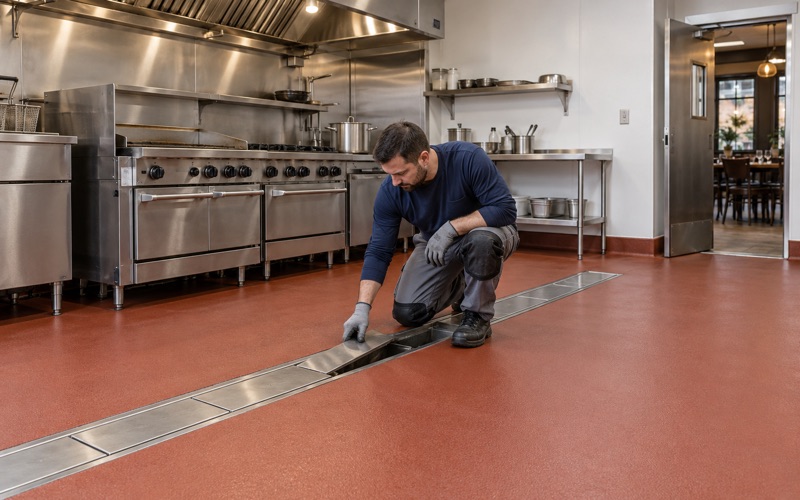
Each of those zones may also carry a different system. A food-handling room brings its own cleaning and sanitation demands, and a pick area under constant forklift turns wants a harder-wearing topcoat than a break room. We would rather quote three right-sized areas than one blanket number across a floor that does three different jobs.
Timing the work around a building that has to run
Once a tenant moves in, the floor is rarely empty again. Docks run, trucks come and go and inventory has to move, so coating a zone after occupancy means working inside a building that cannot stop. Where a tenant can schedule the coated areas before racking and stock arrive, the preparation is faster and the floor is easier to close off.
When the work has to happen after move-in, we plan it around the hours the operation keeps, including overnight and weekend windows, and close one zone at a time so the rest of the floor keeps working. Mechanical preparation is loud and needs clear space, so the sequence is agreed with the tenant’s operations staff rather than imposed on them.
Hardened and Sealed Garage Slabs at Home
The sealer nobody remembers
Densifiers and penetrating sealers are not only warehouse products. Some homeowners and builders apply a clear penetrating sealer or hardener to a garage slab to cut dusting and staining, and the result can look like plain concrete years later. Summit’s housing is mostly established, with just 44 units built in 2020 or later, so a garage floor here often has decades of unknown history behind it.
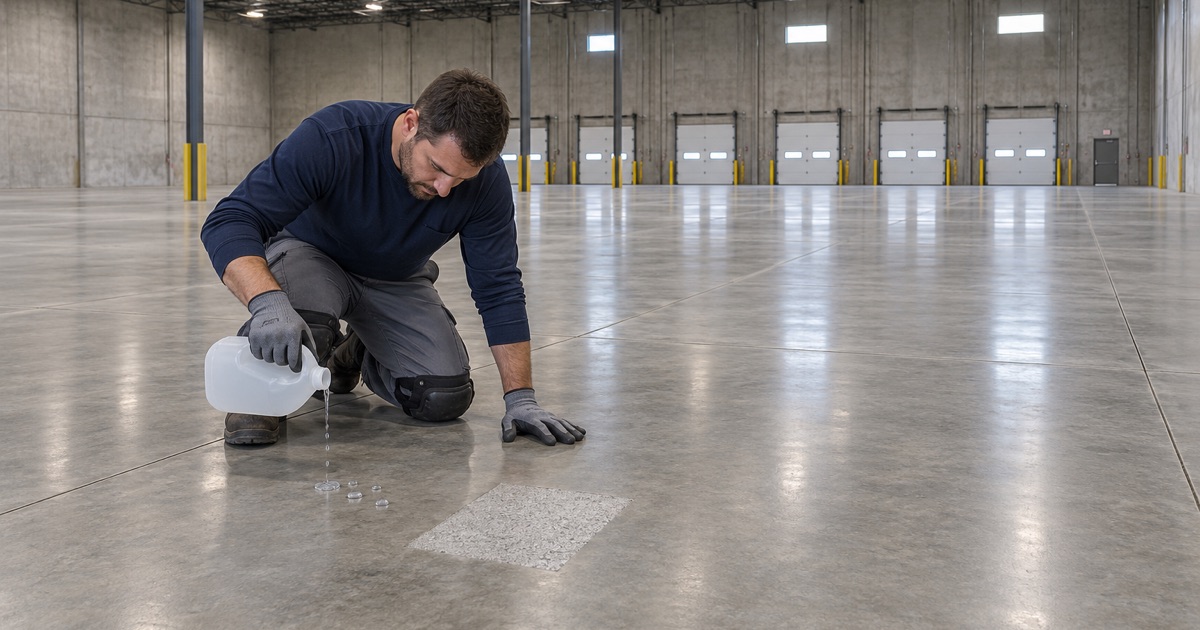
A quick water drop on a clean area is a useful first look: water that beads or sits suggests something has closed the surface, while water that darkens and soaks in suggests open concrete. It is a clue rather than a verdict, and it does not tell us which product was used or how deep it went.
Why a garage gets the same caution
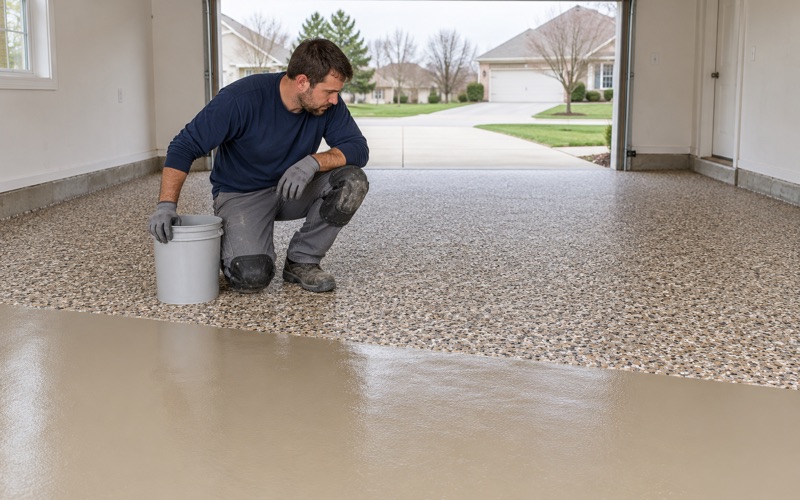
A garage coating takes hot tires, dropped tools and winter slush, and it fails first where adhesion is weakest. On a slab with an old penetrating treatment, a coating can look fine for a season and then lift in the tire paths. An extra hour spent opening a hardened surface properly is cheaper than a floor peeling in strips.
The answer scales down from the warehouse. Preparation reaches the whole floor, with extra attention along the tire paths and at the apron by the door, and the first coat goes down only once the surface takes water evenly. A homeowner who knows a sealer was applied should tell us, and one who is not sure should say that too.
A high name on low ground
The village takes its name, in use since 1836, from the highest point on the Chicago Portage between the Chicago and Des Plaines rivers, just north of town. The name is misleading on the ground: the village’s own 2024 hazard mitigation annex says most of Summit lies in the Des Plaines River floodplain, so slab moisture is a real question in garages and basements alike.
That is why a moisture test sits in our scope as its own line, on a garage slab or a warehouse slab, before any system is chosen. A coating can trap what a slab is still giving off, and on low ground that is not a risk to guess at. The test result shapes the primer choice as much as the preparation does.
- 20+ Years of Floor Coating Work
- Moisture Testing in Every Scope
- Free Written Estimates