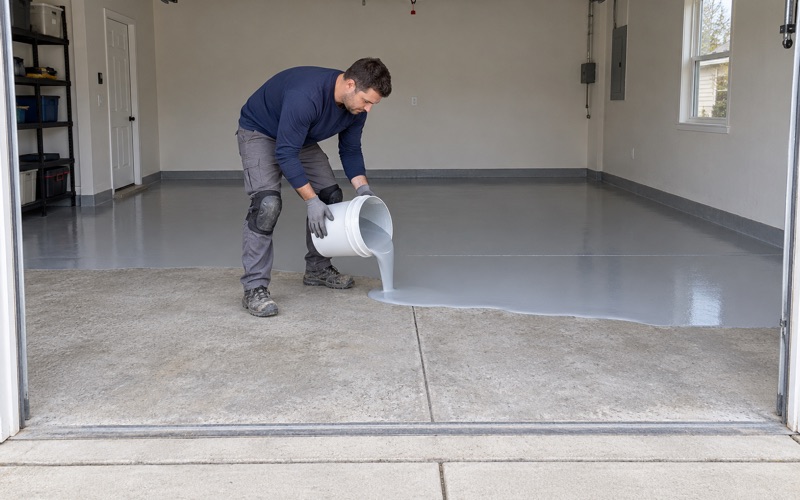
Plainfield Epoxy Flooring has done epoxy flooring in Warrenville for homeowners who have owned their houses a long time and for families who just moved in, and in more than 20 years one question has earned its place at the start of every garage and basement visit here. Has the house had termite work, or is some coming? Treatment for subterranean termites in an existing home goes through the floor, and a coating laid down in the wrong order ends up wearing a row of patches.
That sequencing is what this page is about. We open every slab mechanically with a diamond grinder or a shot blaster, and we never acid etch, so a treater’s old plugs, every crack and every joint are exposed and read before we price anything. The proposal then names the product, the system build and the finished thickness, so you can hold the floor that went down against the paper you signed.
What we are not is a pest control company. We do not inspect for termites, treat them or warrant against them, and nothing we install changes that. Our part is narrower and still matters: coat after the treater is finished, fill cracks and joints once the soil work is done, and repair a floor cleanly when treatment has to happen through a coat that is already there.
What Warrenville’s own code says about termites
The table entry behind this page
Warrenville is a city in DuPage County on the DuPage River, just north of I-88, and it writes its own amendments into the building code. Title 8, Chapter 9 of the city code, adopted by Ordinance 2023-01, puts the 2021 International Residential Code in force for detached one- and two-family dwellings and for townhouses no more than three stories tall.
The amendment that matters for floors is to Table R301.2(1), the climatic and geographic design criteria. Warrenville filled in its termite line as moderate to heavy. That is the city’s own rating, printed in its own code, and it is why we bring up termite work on garage and basement floors here instead of leaving it to luck.
What “moderate to heavy” does and does not tell you
The rating is a regional design value. It is not a survey of local houses, and it says nothing about whether a particular garage or basement has termite activity. Nobody should read it as a count of infested homes, and we do not either; a single line in a design table cannot tell you what is under your slab.
What it does tell a homeowner is that termite inspection and treatment are an ordinary part of owning a house here. So before we schedule a coating, we ask whether the house has a treatment contract, a recent inspection or a renewal coming due, because each of those can put a drill through the floor we are about to finish.
The rest of that table, and why we read it
The same table lists a frost line depth of 42 inches, weathering rated severe, a ground snow load of 25 psf and a mean annual temperature of 52 degrees F. Those are the conditions the city expects a house to be built for, and the weathering line reaches a garage coating directly, because winter rides in on the tires.
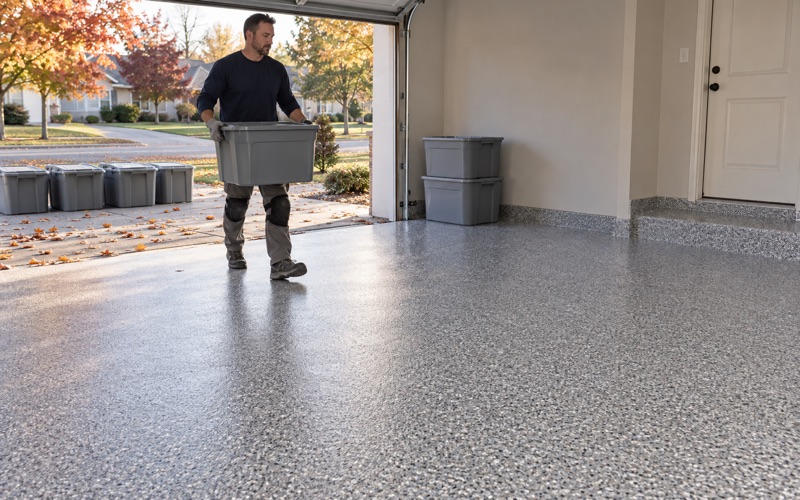
Our garage systems are built for the calcium chloride brine and rock salt that come off a car all winter, with a chemical-resistant topcoat over the broadcast. We also schedule curing against slab temperature and the dew point spread at the surface rather than a calendar date, and we say plainly when an unheated garage has to wait for spring.
Looking for epoxy-flooring closer to Lemont? See Epoxy-Flooring Services in Lemont.
How termite treatment reaches the soil under a slab
Drilling down from the top of the slab
Termites under an existing house live in the soil, and the slab is in the way. The usual practice is to treat from inside by drilling through the floor from the top and injecting termiticide into the soil below. One state rule we have read, Georgia’s structural pest control rule 620-6-.04, sets those holes no more than twelve inches apart and no more than twelve inches from the outside edge of the slab.
That rule belongs to Georgia, and we cite it only as a picture of how the work is commonly done. We have not read Illinois’ own treatment rule, and the termiticide label is what governs a treater’s spacing and method. The point for a coated floor is simpler: expect holes roughly a foot apart wherever the treater decides the soil needs product.
Cracks, expansion joints and plumbing penetrations
Drilling is not confined to the slab edge. The Georgia rule also calls for treatment at all other points of potential termite entry through the slab, and older termiticide labels describe holes about a foot apart beside cracks and expansion joints. Plumbing penetrations, where a drain or supply line rises through the concrete, get the same attention, with the treater working around pipes and electrical conduit.
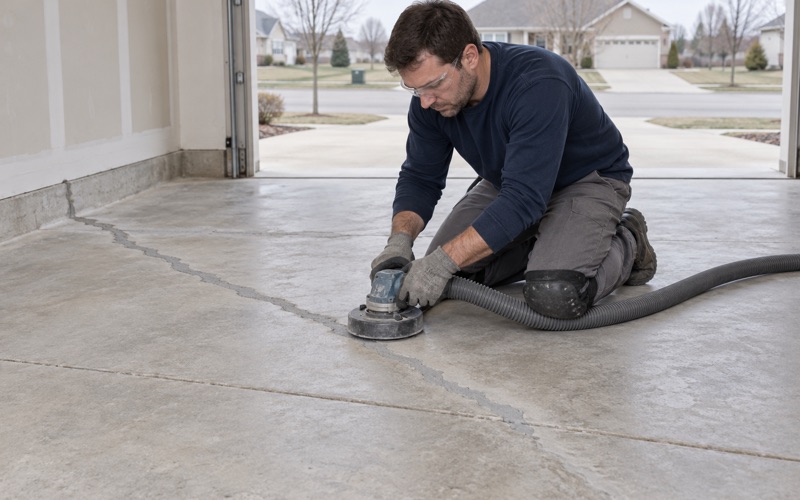
Those are exactly the spots a coating contractor works hardest. We read every crack, joint and old coating before quoting, and we say so when a slab needs repair or replacement before it can be coated at all. Cracks are routed and filled, and control joints are filled with a semi-rigid polyurea joint filler, which means our filler is what a treater would have to drill through later.
Every hole sealed afterward
The Georgia rule closes with a plain instruction: after application, all holes are securely sealed to prevent any upward movement of the termiticide. On bare concrete that seal is a plug or a smear of patching compound, and nobody gives it a second look.
On a decorative floor it is a different matter. A line of drilled holes sealed with gray patch across a vinyl flake or quartz aggregate broadcast reads as damage, even when the treatment was done exactly right. That is why the order of the two jobs matters more than how well either one is done.
Treat first, fill cracks and joints second, coat last
Ask about termite work before the date is set
Our first visit includes a question most coating salespeople skip: is a termite inspection or treatment scheduled, overdue or under contract? If the answer is yes, we would rather wait a few weeks than coat a floor that is about to be drilled. If nobody knows, we suggest calling a pest control company before committing to a date, because the concrete cannot answer that for us.
None of this changes how we price. We quote per square foot for the system actually proposed, not from a national per-garage figure, and the quote stays the same whether we start next week or next month. What moves is the start date, and moving a date costs far less than patching a brand-new floor.
Let the treater finish, then grind and fill
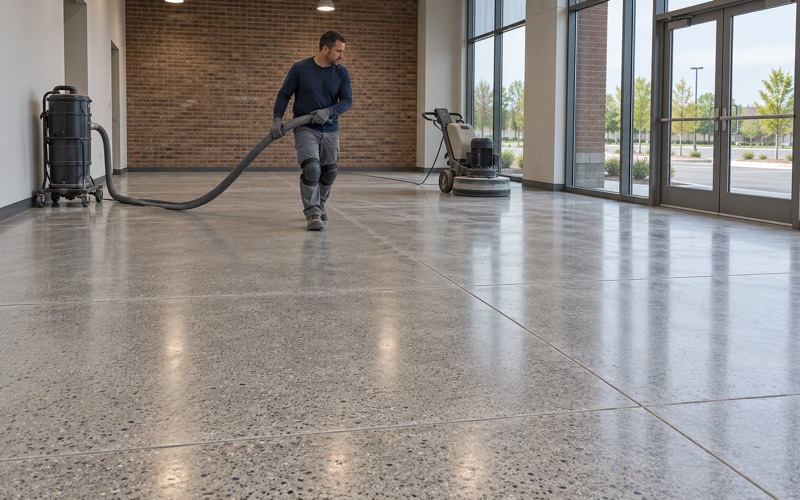
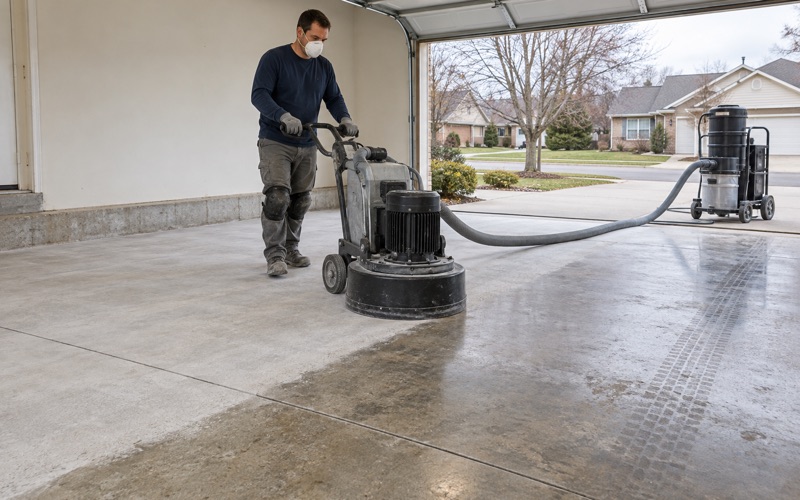
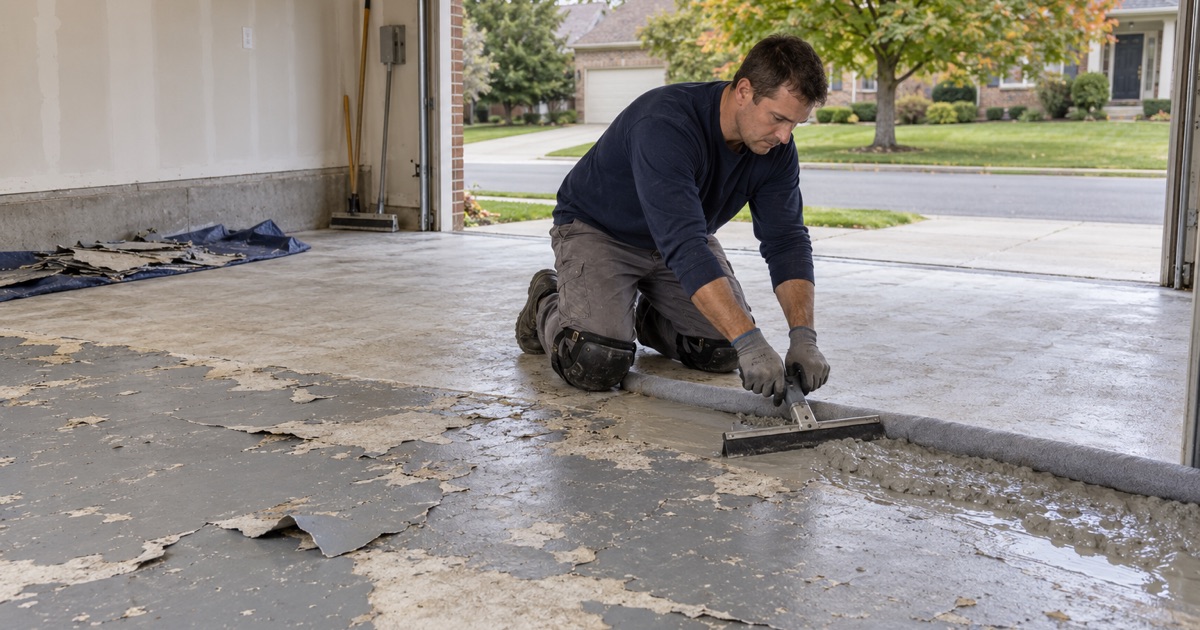
Once the treater has drilled, injected and sealed, the slab is ours. We grind the whole floor to the ICRI CSP profile the system calls for, which opens the treater’s plugs along with old sealer and weak surface paste. Plugs that stand proud are ground flush, and plugs that are soft or sunken are cut out and refilled with a repair material that suits the primer.
Only then do cracks and joints get filled. Filling them before treatment means the treater either drills through fresh filler or skips an entry point, and neither outcome helps anyone. Grinding dust is collected at the grinder by a vacuum, never swept loose or washed toward a floor drain or a storm inlet.
Moisture testing before the first coat
Treated or not, every slab gets tested before resin goes on it. Moisture testing is a line item in our scope, not an upsell after a floor blisters, and depending on the room it may be an ASTM F1869 calcium chloride test, ASTM F2170 in-situ relative humidity probes, or an ASTM D4263 plastic sheet check as a first read.
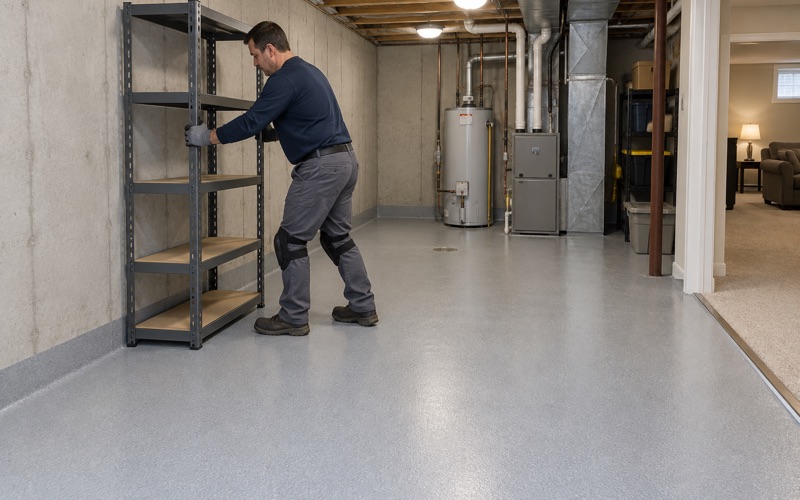
If the readings run high, a moisture-mitigation primer goes into the build, or we tell you the floor is not ready. In a basement we start with where the water is coming from, and we say plainly that a coating is not waterproofing. Moisture is also the first exclusion we read aloud from the warranty, before the job is sold rather than after.
Patching and color-matching a coated floor after treatment
What a treater’s holes do to an existing coat
Sometimes the coating came first and the house needs treatment now. The treater drills through resin and concrete alike, and the bit tends to chip the coat around each hole. After sealing, you are left with a row of plugs along the walls, around the water heater and beside each joint.
The edge of the coating around a hole can also lift if liquid got under it during injection. Before quoting a repair we tap and look at the ring around every plug, which tells us whether each hole needs a small patch or whether a wider section has to come up and be rebuilt.
Plugging and color-matching the holes
Our repair cuts each damaged edge back to well-bonded coating, fills the hole flush with the slab, and rebuilds the coat in layers to the original thickness. On a solid-color floor we match the base color and the topcoat sheen, and on a flake floor we broadcast matching flake into the patch so the repair reads as floor rather than as a dot.
An exact match is not always possible on an older coat that has faded or worn under traffic, and we tell you that before we start. When holes run the full length of a garage, a scuff-sand and a fresh polyaspartic topcoat over the whole floor often looks better than thirty separate patches, and we will price both so you can choose.
A coating does not keep termites out
No epoxy, polyurea or urethane cement system we install stops termites, and we never sell one as though it did. A resin floor is a wearing surface on top of the slab, it is no barrier to termites of any kind, and it does not replace treatment of the soil. Protection from termites is the treating company’s work, done under the product label.
Warrenville’s permit page lists flooring among the work that needs no building permit, so a home garage coating is usually settled between you, us and your treating company. Every home job still gets a written contract and the Home Repair: Know Your Consumer Rights pamphlet before work starts, as the Illinois Home Repair and Remodeling Act requires, and our coatings stay within the Illinois VOC limit for architectural coatings.
- 20+ Years of Floor Coating Work
- Moisture Testing in Every Scope
- Free Written Estimates