Plainfield Epoxy Flooring handles epoxy-flooring in Westchester with more than 20 years behind us, and one floor here is never ours to schedule alone. Most of what we coat is a garage, a basement or a commercial room that we can walk into on the morning a job starts. The concrete at the bottom of an elevator hoistway is the exception, and the reason is written into Illinois law.
That floor is the elevator pit, the concrete well beneath the lowest landing where the car’s buffers stand and where oil and water tend to collect. Building owners ask about cleaning and coating it for good reasons: a stained, damp pit floor is hard to inspect and unpleasant to work on. What changes is who opens the door, who stays in the pit and who decides when the car can run again.
In Westchester’s office, hotel and condominium buildings, that answer is the building’s elevator contractor, not us. Below we set out what the Office of the State Fire Marshal says about pits, how a pit-floor job is booked, why any oil or water source is dealt with before coating, and how the finish is laid around the equipment that has to stay clear. The rest of our Westchester work runs the usual way.
What Illinois Says About the Elevator Pit
The Fire Marshal’s notice on pit access
The Elevator Safety Division of the Office of the State Fire Marshal put the rule in plain words in a notice whose file is dated February 3, 2016: “only elevator personnel licensed by the State of Illinois (or those accompanied by licensed and trained elevator personnel) may access elevator pits and hoistways.” The notice describes pits, hoistways and car tops as inherently dangerous, with hazards that include falling, shearing, crushing and electrical shock.
What prompted it is telling. Smoke and heat detector companies had been entering pits without elevator personnel present, and the Fire Marshal said that practice runs counter to Illinois statutes and regulations. A floor coater is in exactly the same position as those detector crews: a trade with a legitimate job at the bottom of the hoistway and no authority to be there alone.
ASME A17.1-2013 and Requirement 2.2.4.4
The notice rests on 225 ILCS 312/35 and on the elevator code the state adopted. Illinois’s Elevator Safety Review Board adopted ASME A17.1-2013 in Title 41 of the Illinois Administrative Code, section 1000.60(a)(1)(A), so the national safety code for elevators and escalators carries the force of state regulation here. Requirement 1.3 defines who counts as elevator personnel, and Requirement 2.2.4.4 makes the pit accessible only to them.
The same code also controls the keys. Requirement 8.1.2 places pit and hoistway access-door keys in Security Group 1, so the key to that door is not something a floor contractor collects from the front desk. For a floor job, that settles the question before anyone talks about products: the first call goes to whoever maintains the elevator, not to a coating crew.
Where we stand under the rule
We hold no elevator license, and we do not go into a pit or hoistway unless elevator personnel are there with us for the whole visit. That is not a courtesy we extend; it is the law the notice describes. On a pit-floor job our crew works as an accompanied visitor, and the elevator mechanic present has the final word on where we stand, what we touch and when we leave.
Looking for epoxy-flooring closer to Worth? See Epoxy-Flooring in Worth.
Booking Pit-Floor Work Through the Elevator Contractor
The building calls its elevator contractor first
A pit-floor coating starts with the owner or manager of the building, who books a visit with the company that already maintains the elevator. That contractor takes the car out of service, opens the pit and stays present while our work is done. We then fit our visit into the window the elevator company offers, rather than the other way around.
We are glad to talk the job through with the manager beforehand, so the elevator contractor hears the scope once and accurately: pit size, the floor’s present condition, how long preparation and each coat take, and how long the finish needs before anyone walks on it. A clear scope lets them plan how many hours the car stays down, which is usually the cost the building cares about most.
Timing the job around a building that keeps running
Taking a car out of service matters most where it is the only one. In a hotel or a condominium building with a single elevator, residents and guests lose the elevator while the pit is open, so we plan the work in the tightest sequence the materials allow and will run overnight or across a weekend when that is the window the building can spare.
In an office building, an evening or Sunday slot usually costs tenants far less. Either way, the cure time of the chosen system sets the minimum the car has to stay down, and we say so before booking rather than discovering it in the pit. Where a quick return to service is needed, a polyaspartic topcoat over a primed slab shortens that wait compared with a full-cure epoxy build.
Why this comes up in Westchester
Westchester, a Cook County village of 16,892 at the 2020 census, describes itself as mostly residential and built-out, with 1,278 multifamily dwelling units among its housing. The elevator buildings among them, plus the village’s hotels and office buildings, are where pit floors exist at all. The elevator trade has a presence here too, with an elevator company listing an address on Enterprise Drive; we have no relationship with it.
Oil and Water in a Pit: The Source Comes First
Hydraulic oil belongs to the elevator contractor
On a hydraulic elevator, oil on the pit floor is a sign that the elevator equipment needs attention, and diagnosing it is the elevator contractor’s work, never ours. We do not price a coating as a cure for it. A finish laid over a floor that is still being fed oil will lose its bond, so the first step is the elevator contractor finding and correcting the source.
Water in the pit, and what a coating cannot do
Water is the other thing that shows up on pit floors. Like oil, it has a source, and that source is dealt with first by the people responsible for the elevator and the building. A resin floor is not waterproofing, it will not hold back a leak, and it does nothing to bring a pit into line with the elevator code. We say so before anyone signs.
What a coating can do is give a dry, sound pit floor a sealed surface that wipes down easily. If the pit has a sump, the finish stops short of it and leaves the opening and its cover exactly as the elevator contractor needs them. Our job ends at the edge of the floor we were asked to coat.
Testing a pit floor before it is called coatable
Because a pit sits at the lowest point of the building, we price a moisture test into the proposal before choosing any system, just as we would on a basement slab. The plastic sheet test under ASTM D4263 gives a quick first read. Where that result or the floor’s history raises doubt, we move to a quantitative measurement before recommending anything for the pit.
Testing runs on the elevator contractor’s clock, so we agree with them in advance how the test is set and read without adding a needless shutdown. Some pits read too damp for an ordinary coat. Then the choice is a moisture-mitigation primer under the finish, or no coating at all until the water question is settled, and we put that choice to the building in writing.
Coating Around the Buffers, the Ladder and the Stop Switch
Preparing a floor in a confined pit
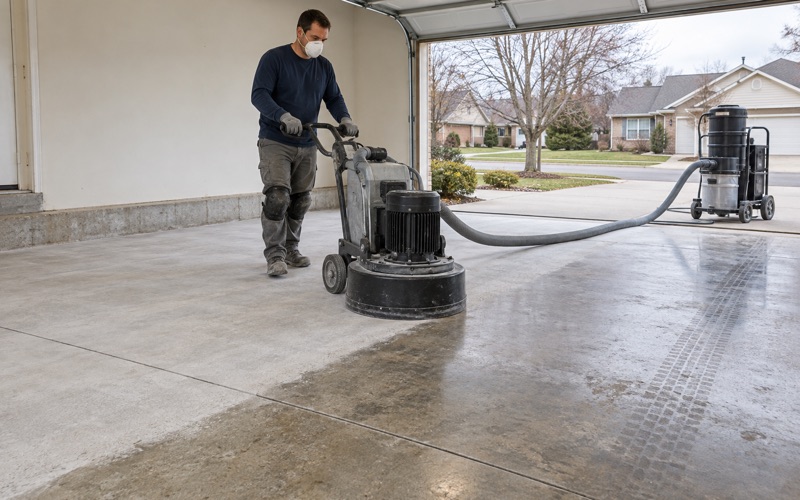
Every floor we coat is abraded mechanically to an ICRI surface profile before resin touches it, and a pit gets the same treatment; acid has no part in it. Down there the tools are compact, hand-guided grinders sized to the space, worked slowly around anything the elevator mechanic has pointed out as off limits. A light profile in the CSP 2 to 3 range suits a thin coating.
Ventilation is the other constraint. A pit is a closed, sometimes cool space, which is why we favor 100% solids epoxy with little solvent to vent, and why we watch for amine blush, the greasy film some epoxies form in cool, damp air. A blushed coat has to be washed off before the next one bonds, and in a pit that can cost a second shutdown.
What the finish stays clear of
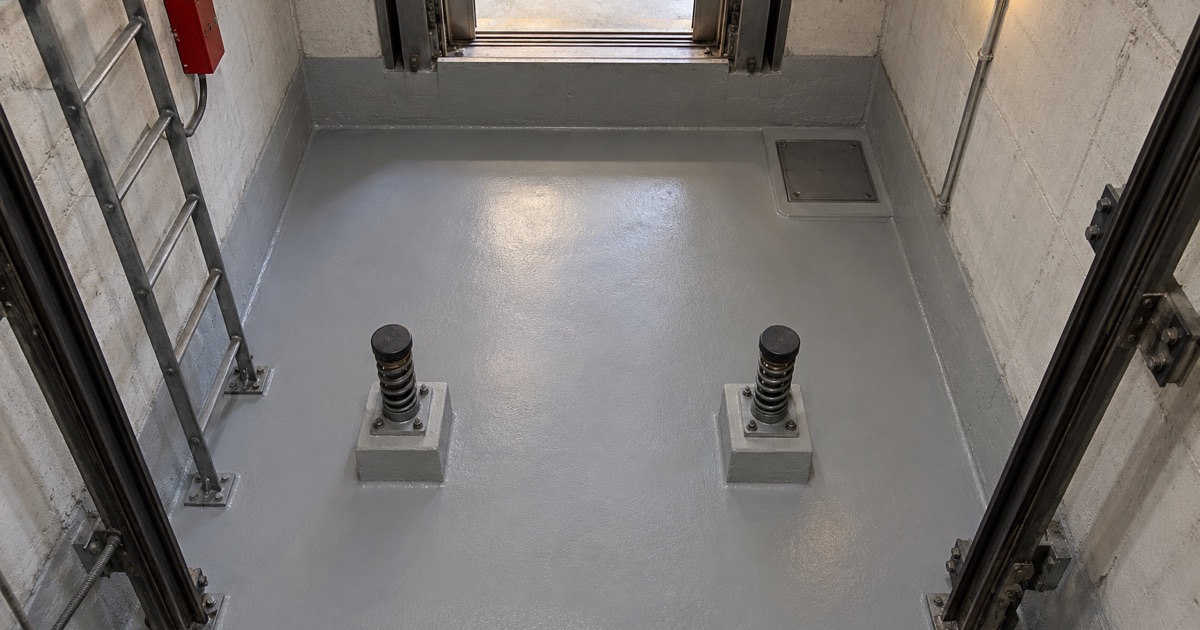
The pit holds equipment the elevator depends on: the buffers beneath the car, the pit ladder, the pit stop switch, and any equipment bases the elevator contractor names. Before preparation starts, the mechanic marks each of those, and our coating stops short of every one. We do not grind against buffer mounts, coat ladder rungs or cover a switch, and nothing is relocated to make the floor easier.
Clearance is also about the next visit. Elevator personnel stand, kneel and climb in that pit for routine work, so the edges of the coating are finished clean and flat rather than left as a lip to catch a boot. The route from the ladder to the equipment stays as walkable as it was before we arrived, only easier to keep clean.
Choosing grip and color for a working floor
A pit floor is a work surface for elevator mechanics, so traction matters, but so does how easily the floor gives up a fresh spill. A heavy aggregate traps grime and makes wiping harder, while a light quartz aggregate broadcast into the base coat adds grip without turning the floor into something that holds dirt. We match that texture to the pit rather than to a showroom sample.
Color does practical work too. A light gray finish shows a new drip of oil or a film of water at a glance, which helps the elevator contractor notice when a source has come back. Decorative vinyl flake has no place here; the aim is a plain, sealed floor that the people responsible for the pit can read, clean and work on until the next recoat.
- 20+ Years of Floor Coating Work
- Moisture Testing in Every Scope
- Free Written Estimates