Plainfield Epoxy Flooring has put more than 20 years into epoxy flooring in Winfield and the surrounding area, and the floors we think hardest about are the ones where something small must have nowhere to hide. A slab that looks smooth from standing height can still hold a hairline crack, an open saw-cut joint or a gap at the wall base, and on some floors those openings matter more than the color.
On a floor like that, most of the real work happens before any resin is mixed. We go looking for every opening a crumb, a hair or an egg could slip into, from the corner behind a utility sink to the anchor holes under a bolted-down table, because the finished coat can only be as continuous as the concrete it seals.
This page is about one specific reason to care about cracks: animals carrying fleas, washed and brushed on a concrete floor. It covers what entomologists say happens to the eggs that drop, what pest-management guidance asks of a floor, and how we turn that into a scope for a grooming room, a mudroom or a garage bay. It is also clear about what a floor cannot do.
A Grooming Shop and Where Flea Eggs Land
A grooming shop on Beecher Avenue
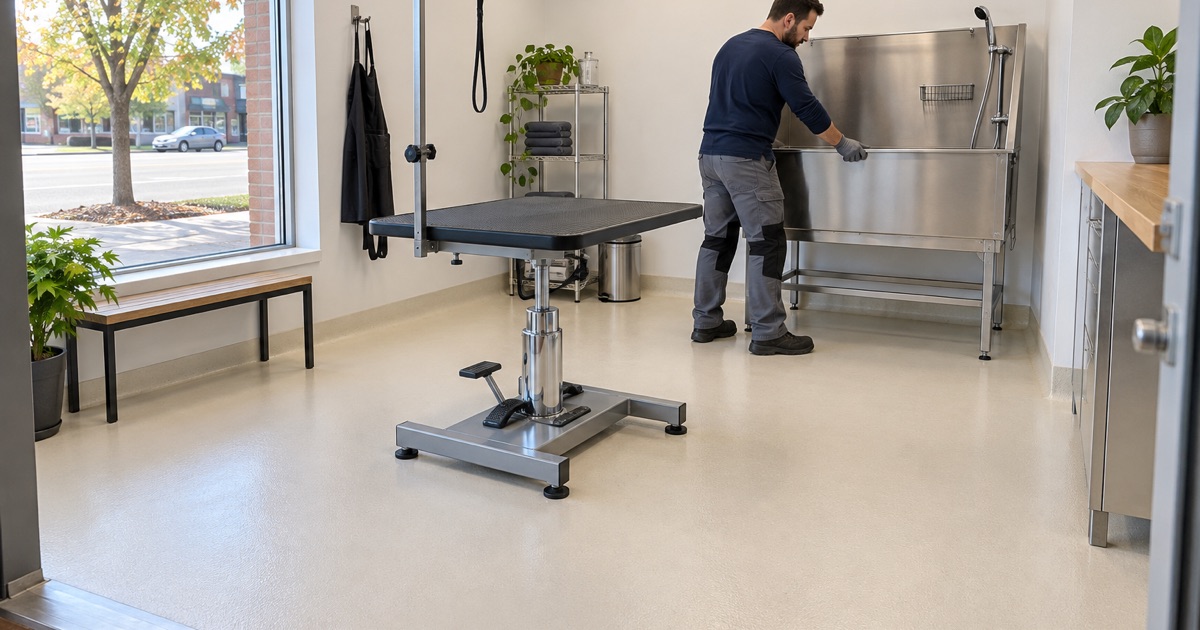
Downtown Winfield has a working example of the kind of room we mean. Cut & Cuddle Pet Grooming, listed at 27W460 Beecher Avenue inside the village, washes and combs out dogs and cats, the everyday business of any groomer. We have not been inside, and nothing here describes its floors or its services; it is simply the clearest local picture of a room where animals are bathed and brushed all day.
What matters for flooring is the activity rather than the address. Any room where animals are lathered, rinsed, dried and combed puts water, loose hair and whatever the animal carried in onto the same stretch of concrete, day after day, and the floor either sheds that load into a mop bucket or keeps some of it in its seams.
What comes off a dog during a wash and comb-out
The cat flea, Ctenocephalides felis, is the most common species and feeds on cats, dogs and people. University of Florida school IPM guidance, hosted by Texas A&M AgriLife Extension, says flea eggs easily fall from the host into cracks, crevices, carpet, bedding or lawn covering. A single female can lay up to 25 eggs a day for three weeks.
Alongside the eggs comes flea dirt, the dried blood adult fleas leave behind in an animal’s coat. It looks like fine grit, and it is the food the larvae live on once they hatch. A good wash and a thorough comb-out loosen both, which is the whole point of grooming, and both settle wherever the rinse water and hair settle.
Why a broom and mop miss the worst of it
Open floor gets swept and mopped. The eggs that matter are the ones that roll into a slab crack, an open control joint, the gap where the slab meets the wall, or the underside of a rubber mat that never gets lifted. A mop head rides over those openings, and the guidance notes that vacuuming picks up adults and eggs but does poorly on larvae coiled around carpet fibers.
That is why the guidance points at crevices rather than at open floor. A room can be cleaned conscientiously every evening and still shelter a population in places no cleaning tool reaches, which makes it a floor question as much as a housekeeping one.
Looking for epoxy-flooring closer to Burr Ridge? See Burr Ridge Epoxy-Flooring.
Eggs to Larvae to Cocoons That Wait for the Next Dog
Eight to 24 days in a crack
According to the same guidance, larvae hatch within 48 hours and feed on the flea dirt that drops from fur. They need relative humidity of at least 70 percent and temperatures of 70 to 90 degrees, and they last eight to 24 days before spinning a cocoon. A warm, damp grooming room with debris packed into a joint comes close to what they want.
Concrete itself is not the problem; the openings in it are. A crack that holds a film of rinse water and a pinch of flea dirt becomes a sheltered pocket with food and moisture, out of reach of the mop that cleaned the floor around it an hour earlier.
Pupae that can wait up to 12 months
The cocoon stage is the long one. Pupae can remain in their cocoons up to 12 months when no host is around, and vibration or rising temperature stimulates the adults to emerge. On a grooming floor that vibration is the next dog walking in, so a crack can keep releasing fleas long after the animal that dropped the eggs has gone home.
This is what separates a crack from a stain. A stain is cosmetic, and the cleaning routine handles everything around it; an open seam is shelter that outlasts any single cleaning, any single treatment of the animals and sometimes the season it started in.
What a floor can and cannot do
We are blunt about the limits. A floor does not kill fleas, and no coating replaces treating the animals or a proper pest-control program; we are a flooring contractor and do no pest-control work. What a sealed floor can do is remove the crevices, so the cleaning a groomer or homeowner already does reaches every part of the surface.
The guidance itself divides the labor that way. It lists vacuuming, citrus-based shampoos registered with the EPA as flea products, and attention to cracks and crevices as separate steps, and only the last of those belongs to whoever builds the floor.
Seal the Cracks: What IPM Asks of a Floor
Routing and filling cracks and control joints
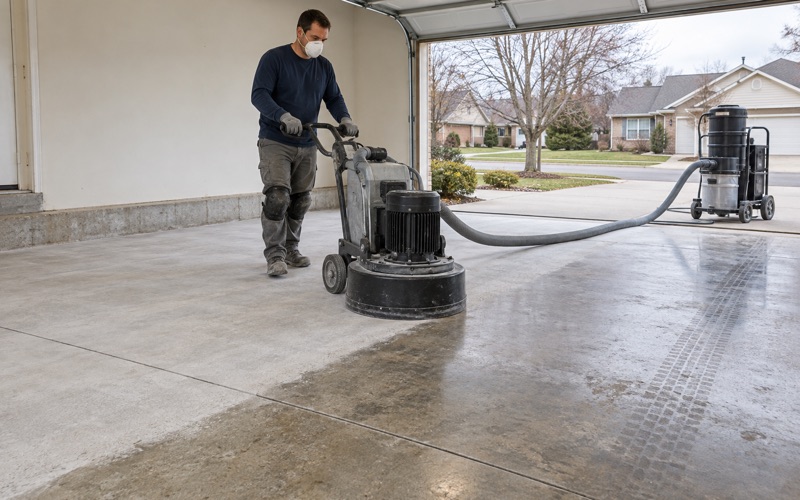
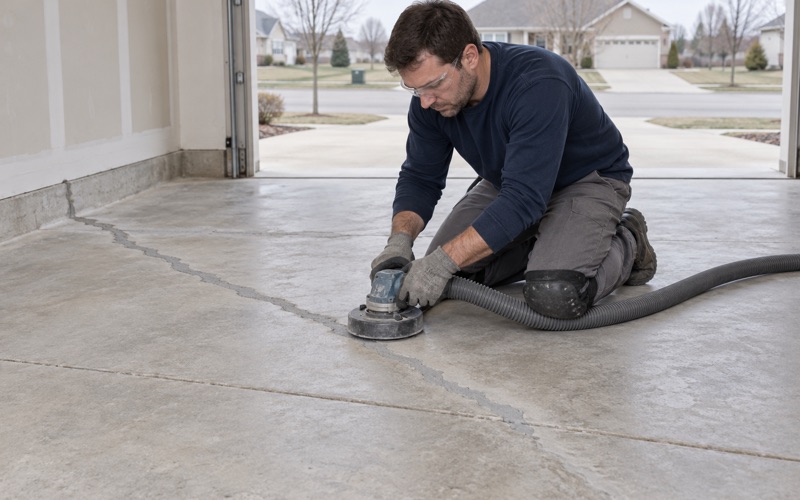
The guidance is direct: use vacuum attachments to clean cracks and crevices, then caulk or seal these openings permanently. On concrete we take that literally. Each crack is vacuumed out and routed open, the surface is mechanically profiled to the ICRI CSP range the filler and resin need, and the opening is filled against clean, sound concrete instead of bridging a plug of packed hair and grit.
Control joints are filled flush with a semi-rigid polyurea joint filler, cracks with a compatible repair material, and the whole surface is then coated as one continuous build. A crack that is still widening is a different matter: sealing it shut only invites a new split beside the old one, so we point it out at the walkthrough and price the repair as its own item.
A coved base instead of an open wall gap
The seam where floor meets wall is the crevice most rooms forget. In a grooming or bathing room we carry the resin up the wall as a coved base, so floor and wall become one curved surface with no gap for eggs, hair or rinse water to collect behind. A wash-down then reaches into the corner instead of pushing debris into it.
Fixtures create crevices of their own. The feet of a tub stand, the base of a grooming table and the anchors of a dryer cart each leave a ring where floor meets metal, so we plan with the owner which pieces come up during the work, which can be relocated, and where the coating must be sealed tightly around a fixture that has to stay.
A seamless coat, and mats that lift out
Over the filled cracks and the cove we lay a seamless system, typically a 100% solids epoxy body under a polyaspartic or polyurea topcoat chosen against the shampoos and cleaners the room actually uses. We keep the texture fine, since a deep broadcast adds valleys for debris to lodge in, and a smooth, closed surface is what lets a groomer see grit at a glance.
Rubber mats belong on that floor only if they lift out and get washed. A mat glued down or left in place for months recreates the very crevice the coating removed, one layer higher, so we recommend loose mats that are lifted, washed and dried on a routine the room can actually keep.
Mudrooms and Garages Where the Family Dog Gets Bathed
A dog bathed in the garage
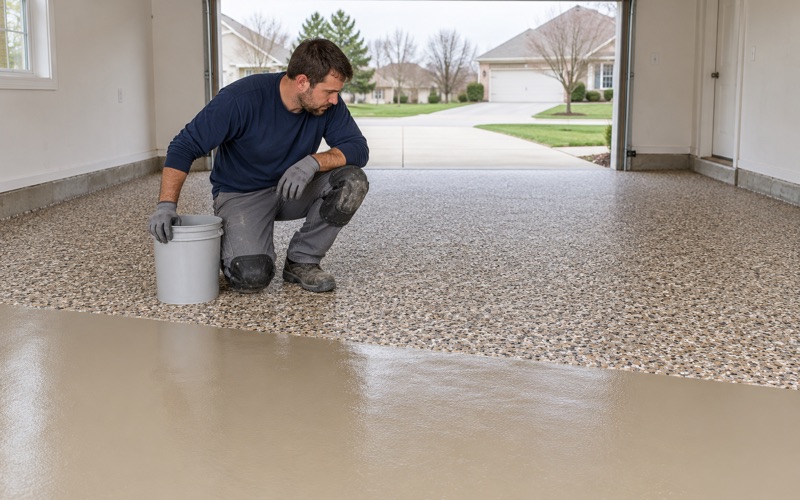
Winfield is overwhelmingly a village of owners, with 91.9 percent of occupied homes owner-occupied by Census count, and plenty of those households wash the dog wherever the hose reaches: a mudroom tub, a laundry corner or a dog bathed in the garage. A cracked garage slab or an open joint under that bathing spot can hold eggs and flea dirt just as a shop floor can.
For a home bathing area, we route and fill the cracks in that zone, carry a short cove up the walls where the tub or wash spot sits, and coat the floor as one surface. It will not treat the pet, but it means a rinse and a sweep reach everything that fell off it.
Slabs from the 1980s and a bathing corner that stays damp
Winfield’s housing is 67.6 percent built in 1980 or later, with the 1980s the largest single decade, so the typical slab here is a 35-to-45-year-old builder-grade floor rather than a prewar basement. Those slabs often carry old sealers, oil and fine cracks, and a coating laid over grease or oil is a guaranteed failure, so they are degreased and profiled first.
A bathing corner is wet several times a month, which is exactly the humidity larvae favor, so it is also where we check the slab for rising vapor before anything is sealed over it. A garage floor that stays damp from below would push the coat off in that same corner, and we would rather find that with a test than with a blister.
Who answers which question in the village
Winfield is an incorporated village in DuPage County, spanning Milton and Winfield Townships, and building questions for a storefront grooming room or a home project go to the Village of Winfield Building Department at 27W465 Jewell Road. The village code is published online through American Legal, and we read the current requirements there before work is scheduled.
Fire code questions do not go to the village at all. The Winfield Fire Protection District is a separate special district covering about thirteen square miles and more than 30,000 residents, from two stations. For a commercial room where animals are bathed, it is worth knowing which office answers which question before a build-out starts, so nobody waits on the wrong desk.
- 20+ Years of Floor Coating Work
- Moisture Testing in Every Scope
- Free Written Estimates