Plainfield Epoxy Flooring has put more than 20 years into epoxy-flooring in Worth and across the south suburbs, and the question facility managers raise most is not about color or flake size. It is about what happens to the cleaning routine once a waxed tile room becomes a coated concrete one. That routine decides which machines cross the floor every night, and some of those machines burn fuel.
A floor finished with acrylic wax is kept glossy by high-speed burnishing. A resin floor is not burnished at all; its makers write a scrubbing program instead. So changing the floor in a corridor or a large shared room changes the equipment that maintains it, and the custodial closet becomes part of the scope conversation rather than an afterthought handed over once the coating has cured.
This page walks through that decision for big institutional rooms: why burnishing goes with wax, what the carbon monoxide record on propane burnishers actually says, how a coated floor is cleaned, and which precautions still apply where some floors in a building stay on wax. We do not claim a coating fixes indoor air. It changes the routine, and the routine is what matters here.
New Rooms at Worth Junior High and the Wax Question

Classrooms, a media center and a multi-purpose room
In March 2024 the Southwest Messenger Press reported the construction program at Worth Junior High, 11151 S. New England Avenue: work that ‘includes, but is not limited to, the addition of classrooms, media center and multi-purpose room,’ plus remodeling of the science classrooms, the music room and the art lab. Work was to begin April 1, with completion anticipated in fall 2025.
That is a familiar school floor plan: corridors linking new space to old, a large multi-purpose room that hosts lunch one hour and an assembly the next, and remodeled rooms that each wear in their own way. We have not seen what flooring went into those rooms or how the building is maintained, and we have no part in that project. It is simply the kind of plan this decision covers.
Burnishing belongs to waxed tile
Tile in a school corridor is usually finished with layers of acrylic floor finish, and that finish is buffed at high speed to bring the gloss back between strip-and-recoat cycles. The burnisher is the tool that makes wax look like wax. In large buildings it is often a propane machine, because a cord cannot reach the length of a corridor and a big room wants a wide, fast pad.
None of that carries over to a resin floor. The Sherwin-Williams care guide for its resinous floors describes scrubbers, rotary machines and pad colors, and it never mentions burnishers or wax. Its finish coats are epoxy, polyurethane and acrylic, and the program it lays out has no burnishing step, so a burnishing schedule has nothing left to do in a room once the tile is gone.
Why the custodial closet is part of the scope
When a school or hall moves one room from waxed tile to a coated floor, the propane burnisher stops being part of that room’s care. That is a real change for a night crew that plans its shift around one machine covering every hallway. We ask early which machines run on the floor today, which rooms will stay on wax, and who owns the new cleaning routine after handover.
Looking for epoxy-flooring closer to Campton Hills? See Epoxy-Flooring Services in Campton Hills.
Propane Burnishers and Carbon Monoxide
What the Ontario alert recorded
Ontario’s labor ministry published an alert in March 2022, updated in May 2025, on carbon monoxide poisoning linked to propane-powered floor burnishers. In one retail store a worker lost consciousness. In another, ten workers, one of them unconscious, were treated for carbon monoxide poisoning after a burnisher was used. Both cases were retail stores in Ontario, not schools, and not in Illinois.
A NIOSH investigation from Oregon describes a janitor killed by carbon monoxide from a propane buffer. We cite these records because they are the documented hazard, not because anything similar has been reported in Worth. The point is narrow: a fuel-burning engine running indoors puts its exhaust into the room it is cleaning, and a large, closed building at night gives that exhaust time to build.
The causes the alert names
The alert names two causes: inadequate equipment maintenance and inadequate ventilation. An engine that is not tuned and tested is an engine nobody has checked, and a hallway with its air handling turned down overnight gives the gas nowhere to go. The symptoms workers are told to recognize are headache, dizziness, confusion and nausea, all easy to mistake for the end of a long shift.
That is why its precautions read like a maintenance plan rather than a product pitch. Machines are run and maintained to the manufacturer’s instructions in well-ventilated areas, and a qualified person services them, including engine tuning and exhaust testing. Those duties belong to whoever runs the building, and they hold no matter what floor the machine happens to be crossing.
What a coating changes and what it does not
A resin floor is not a carbon monoxide control, and we will not describe one that way. What changes is narrower: a room that no longer carries wax no longer needs burnishing, so a propane machine has no reason to enter it. Every other waxed floor in the building still has its machine, and that machine’s exhaust is still the building’s concern.
We put it this way in writing because the point is easy to oversell. A coating changes the cleaning routine for the rooms it covers and nothing beyond them. It does not make any fuel-burning machine safe indoors, and a facility that keeps propane equipment on other floors still needs every precaution covered in the last section of this page.
How a Resin Floor Is Cleaned Instead
Automatic scrubbers on smooth areas
The Sherwin-Williams guide sends large, smooth areas to an automatic floor scrubber, which applies the cleaning solution, agitates it and picks it back up. Textured areas can take the same scrubber or a rotary floor machine. The guide gives the solution five to ten minutes of dwell before recovery, which suits a multi-purpose room where the lunch-hour mess waits until the evening crew arrives.
For a school, that usually means the night crew’s main machine on a coated room is a scrubber rather than a burnisher. Battery scrubbers are common and suit hallways and big rooms well. Scrubbing still needs wet-floor signs and a plan between passes, but it does not need an engine running indoors or a gloss schedule to keep the floor looking finished.
White, tan or red pads
Where a rotary machine is used, the guide calls for a white, tan or red 3M pad or a similar one. Those sit at the gentle end of the pad range. The aggressive stripping pads a crew reaches for on waxed tile can dull or scratch a resin finish, so the pad shelf in the custodial closet has to change along with the floor itself.
We hand the maker’s care guide over with the floor and walk the custodial lead through it before the room reopens. The pad color, the cleaning chemical and the dwell time are set by the coating manufacturer for that system, and a crew that keeps its old wax habits can wear a new floor down faster than foot traffic would.
Grit, gloss and what a topcoat is for
The same guide warns that epoxy finishes are harder and will scratch when subjected to abrasive dirt. In a school that grit arrives on shoes from the parking lot and the playground, so entry mats and frequent dust mopping do more for a coated floor’s appearance than any machine. A polyurethane or polyaspartic topcoat over the epoxy is how we build a surface meant for daily scuffing.
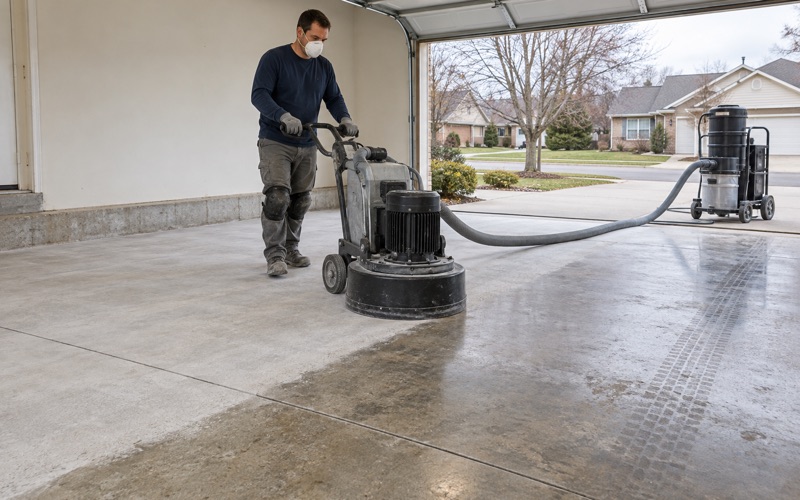
That topcoat only lasts if the layers beneath it are locked into the slab. Every slab we coat is opened by machine to a profile measured against the ICRI CSP chips, with no chemical shortcut standing in for that step. Long school hallways expose a weak bond quickly, because carts, chairs and floor machines find every soft spot within a term or two.
Where Burnishing Stays: Battery Machines, Air and CO Monitors
Battery and electric burnishers
Few buildings convert every floor at once. A school may coat a science room or a multi-purpose room and leave its hallways on waxed tile for years. For those remaining floors, the Ontario alert’s first precaution is to use electric or battery-powered burnishers instead of propane models where possible. A battery-powered burnisher puts no exhaust into the room, which is the whole reason for the swap.
Mixing floors in one building also means mixing routines. The hallway crew keeps its burnisher and its wax, while the coated rooms get a scrubber and the gentle pads. We mark that boundary on the plan we hand over, so the night shift knows exactly where the burnisher stops and the scrubber takes over, and nobody runs the wrong pad across a new floor.
CO monitors and training
The alert also calls for continuous carbon monoxide monitors with audible and visual alarms set below the exposure limit, and for training workers to recognize the symptoms. A CO monitor is the piece that tells a crew working alone in a closed building that something is wrong before anyone feels it. It is also the honest check on whether ventilation and servicing are working.
None of this is something a floor coating replaces. A coated room removes one machine from one space, and that is all. The monitors, the airflow and the training stay with every room where a fuel-burning burnisher still runs, and we write that into the scope whenever a building plans only a partial conversion.
Scheduling the work in Worth
A school or public hall cannot shut a wing for a week while a room is coated, so we plan grinding, coats and cure around the hours the building stands empty: overnight, weekends and the breaks between terms. A multi-purpose room used on a Friday can be ground that evening and returned to service once the system’s cure allows, with timing taken from the product sheet.
Worth registers the contractors who work inside the village, at $110 a year, with a certificate of insurance naming the village and a $10,000 surety bond. The building department’s permit list names a range of remodeling work but not flooring either way, so we ask the department before a job begins rather than guess. Its listed codes are the 2006 International editions.
- 20+ Years of Floor Coating Work
- Moisture Testing in Every Scope
- Free Written Estimates